Isaiah 11
Douay-Rheims 1899 · Tap a verse to see its cross-references.
The Root of Jesse
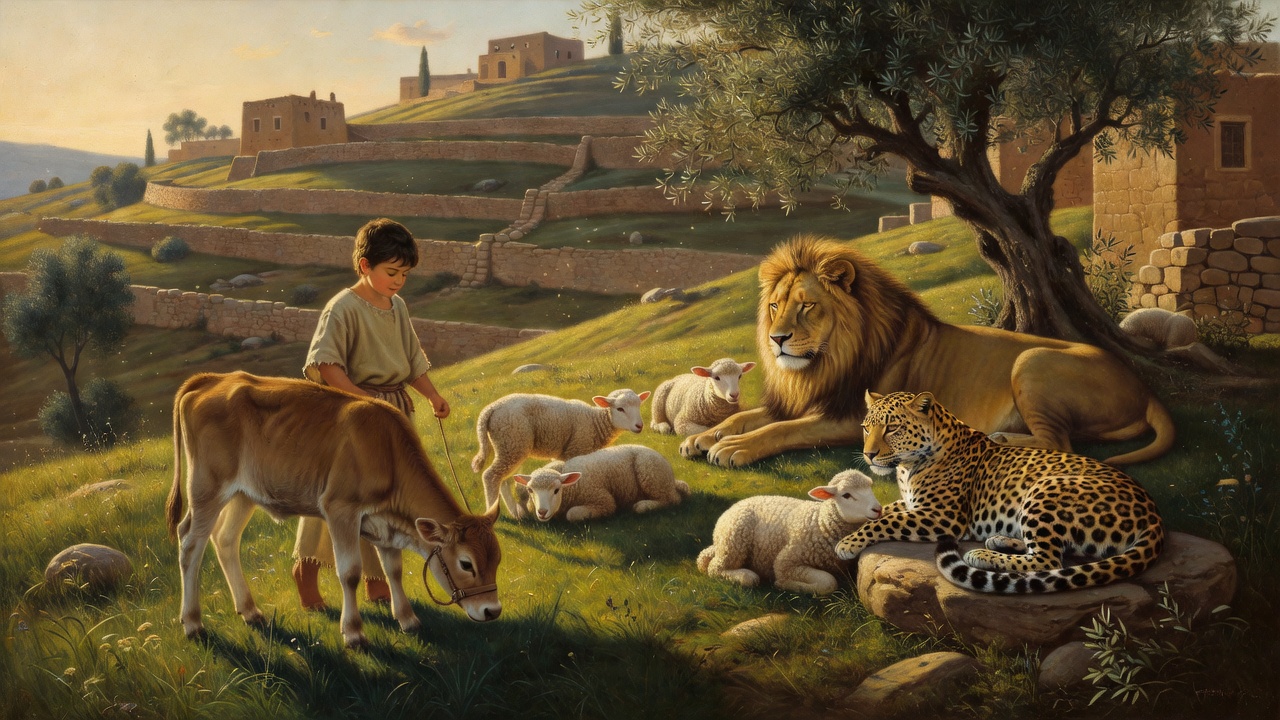
1And there shall come forth a rod out of the root of Jesse, and a flower shall rise up out of his root. 2And the spirit of the Lord shall rest upon him: the spirit of wisdom, and of understanding, the spirit of counsel, and of fortitude, the spirit of knowledge, and of godliness. 3And he shall be filled with the spirit of the fear of the Lord. He shall not judge according to the sight of the eyes, nor reprove according to the hearing of the ears. 4But he shall judge the poor with justice, and shall reprove with equity for the meek of the earth: land he shall strike the earth with the rod of his mouth, and with the breath of his lips he shall slay the wicked. 5And justice shall be the girdle of his loins: and faith the girdle of his reins. 6The wolf shall dwell with the lamb: and the leopard shall lie down with the kid: the calf and the lion, and the sheep shall abide together, and a little child shall lead them. 7The calf and the bear shall feed: their young ones shall rest together: and the lion shall eat straw like the ox. 8And the sucking child shall play on the hole of the asp: and the weaned child shall thrust his hand into the den of the basilisk. 9They shall not hurt, nor shall they kill in all my holy mountain, for the earth is filled with the knowledge of the Lord, as the covering waters of the sea. 10In that day the root of Jesse, who standeth for an ensign of the people, him the Gentiles shall beseech, and his sepulchre shall be glorious. 11And it shall come to pass in that day, that the Lord shall set his hand the second time to possess the remnant of his people, which shall be left from the Assyrians, and from Egypt, and from Phetros, and from Ethiopia, and from Elam, and from Sennaar, and from Emath, and from the islands of the sea. 12And he shall set up a standard unto the nations, and shall assemble the fugitives of Israel, and shall gather together the dispersed of Juda from the four quarters of the earth. 13And the envy of Ephraim shall be taken away, and the enemies of Juda shall perish: Ephraim shall not envy Juda, and Juda shall not fight against Ephraim. 14But they shall fly upon the shoulders of the Philistines by the sea, they together shall spoil the children of the east: Edom, and Moab shall be under the rule of their hand, and the children of Ammon shall be obedient. 15And the Lord shall lay waste the tongue of the sea of Egypt, and shall lift up his hand over the river in the strength of his spirit: and he shall strike it in the seven streams, so that men may pass through it in their shoes. 16And there shall be a highway for the remnant of my people, which shall be left from the Assyrians: as there was for Israel in the day that he came up out of the land of Egypt.
Did you know?
The Peaceful Kingdom and the Restored Remnant
- Jesse of Bethlehem was the father of King David. By describing the coming ruler as a shoot from the stump of Jesse and as the root of Jesse, the prophecy points to a renewal of the Davidic line even after the royal house appeared cut down.Sources: Jesse · the Bible text itself
- The places listed for the gathering of the remnant reflect the ancient Near Eastern world: Pathros designates Upper Egypt, Shinar is an ancient name for Babylonia in southern Mesopotamia, and Elam was a highland territory east of Babylon.Sources: Pathros · Shinar · Elam · the Bible text itself
- Ephraim, named for the second son of Joseph, was often used in prophetic literature to represent the northern kingdom of Israel. Isaiah foresees a time of lasting reconciliation that ends the long-standing jealousy and conflict between the northern tribes and Judah.Sources: Ephraim · the Bible text itself
Notes written with AI assistance from open sources (Theographic Bible Metadata, CC BY-SA 4.0; Easton’s Bible Dictionary, public domain) and reviewed before publishing.
Places in this chapter
- Assyria · 36.359, 43.153 · verses 11, 16
- Cush · Today: Cush 1 · 16.935, 33.751 · verse 11
- Egypt · 30.129, 31.308 · verses 11, 16
- Elam · 32.189, 48.258 · verse 11
- Great Sea · Today: Mediterranean Sea · 31.805, 34.170 · verse 11
- Hamath · Today: Hama · 35.136, 36.750 · verse 11
- Pathros · Today: Upper Egypt · 24.100, 32.700 · verse 11
- Shinar · Today: Babylonia · 32.543, 44.422 · verse 11
- Ammon · 31.955, 35.934 · verse 14
- East · Today: region around Amman · 31.955, 35.934 · verse 14
- Edom · 30.746, 35.604 · verse 14
- Moab · Today: Moab 1 · 31.181, 35.701 · verse 14
- Philistia · 31.664, 34.546 · verse 14
- Euphrates · Today: Euphrates River · 31.004, 47.442 · verse 15
Only places identified with high confidence are shown (90% or more according to the scholarly sources compiled by OpenBible). Period map: DARE (Digital Atlas of the Roman Empire), CC BY 4.0; modern map: © OpenStreetMap contributors; places: OpenBible.info (CC BY 4.0).
Credits and license for this translation
Douay-Rheims 1899
The Holy Bible in English, Douay-Rheims American Edition of 1899, translated from the Latin Vulgate
Public Domain
Language: English
Dialect: archaic American
Translation by: English College, Douai
This Public Domain Bible text is brought to you courtesy of eBible.org.
Help support free Bible access at https://eBible.org/give.php .
2022-11-03
Section headings adapted from the Berean Standard Bible (public domain); they are not part of this translation’s text.
Source: http://ebible.org/engDRA/ · eBible.org