Ezekiel 19
Douay-Rheims 1899 · Tap a verse to see its cross-references.
A Lament for the Princes of Israel
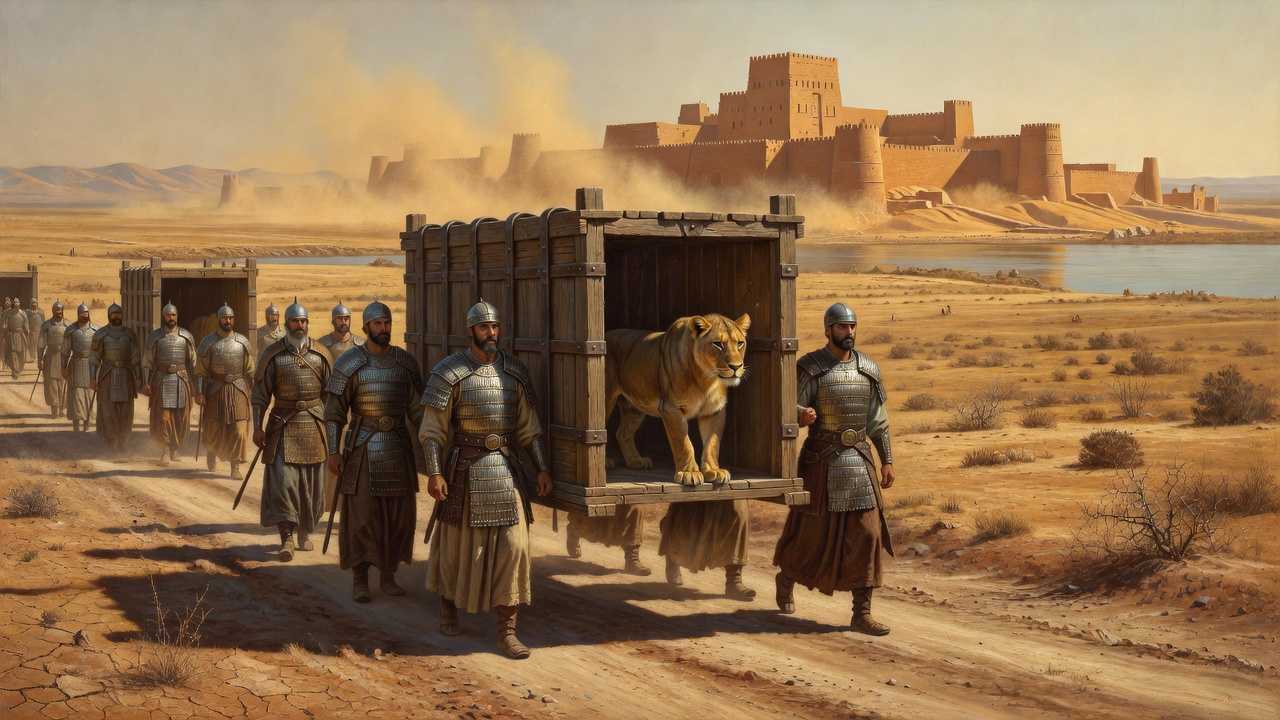
1Moreover take thou up a lamentation for the princes of Israel, 2And say: Why did thy mother the lioness lie down among the lions, and bring up her whelps in the midst of young lions? 3And she brought out one of her whelps, and he became a lion: and he learned to catch the prey, and to devour men. 4And the nations heard of him, and took him, but not without receiving wounds: and they brought him in chains into the land of Egypt. 5But she seeing herself weakened, and that her hope was lost, took one of her young lions, and set him up for a lion. 6And he went up and down among the lions, and became a lion: and he learned to catch the prey, and to devour men. 7He learned to make widows, and to lay waste their cities: and the land became desolate, and the fulness thereof by the noise of his roaring. 8And the nations Game together against him on every side out of the provinces, and they spread their net over him, in their wounds he was taken. 9And they put him into a cage, they brought him in chains to the king of Babylon: and they cast him into prison, that his voice should no more be heard upon the mountains of Israel. 10Thy mother is like a vine in thy blood planted by the water: her fruit and her branches have grown out of many waters. 11And she hath strong rods to make sceptres for them that bear rule, and her stature was exalted among the branches: and she saw her height in the multitude of her branches. 12But she was plucked up in wrath, and cast on the ground, and the burning wind dried up her fruit: her strong rods are withered, and dried up: the fire hath devoured her. 13And now she is transplanted into the desert, in a land not passable, and dry. 14And a fire is gone out from a rod of her branches, which hath devoured her fruit: so that she now hath no strong rod, to be a sceptre of rulers. This is a lamentation, and it shall be for a lamentation.
Did you know?
A Lament for the Princes of Israel
- Ezekiel frames this funeral song as an allegory of a mother lioness rearing her cubs. The first cub learns to tear prey but is captured with hooks and brought to Egypt, while the second cub is trapped in a net, placed in a cage, and led into captivity before the king of Babylon.Sources: the Bible text itself · Egypt · Babylon
- The second half of the lament compares the royal line to a flourishing vine planted beside abundant waters, bearing strong branches fit for rulers' scepters. It depicts the vine being uprooted in fury, scorched by the east wind, consumed by fire, and transplanted into a parched wilderness.Sources: the Bible text itself
Notes written with AI assistance from open sources (Theographic Bible Metadata, CC BY-SA 4.0; Easton’s Bible Dictionary, public domain) and reviewed before publishing.
Places in this chapter
Only places identified with high confidence are shown (90% or more according to the scholarly sources compiled by OpenBible). Period map: DARE (Digital Atlas of the Roman Empire), CC BY 4.0; modern map: © OpenStreetMap contributors; places: OpenBible.info (CC BY 4.0).
Credits and license for this translation
Douay-Rheims 1899
The Holy Bible in English, Douay-Rheims American Edition of 1899, translated from the Latin Vulgate
Public Domain
Language: English
Dialect: archaic American
Translation by: English College, Douai
This Public Domain Bible text is brought to you courtesy of eBible.org.
Help support free Bible access at https://eBible.org/give.php .
2022-11-03
Section headings adapted from the Berean Standard Bible (public domain); they are not part of this translation’s text.
Source: http://ebible.org/engDRA/ · eBible.org