2 Chronicles 8
Douay-Rheims 1899 · Tap a verse to see its cross-references.
Solomon’s Additional Achievements
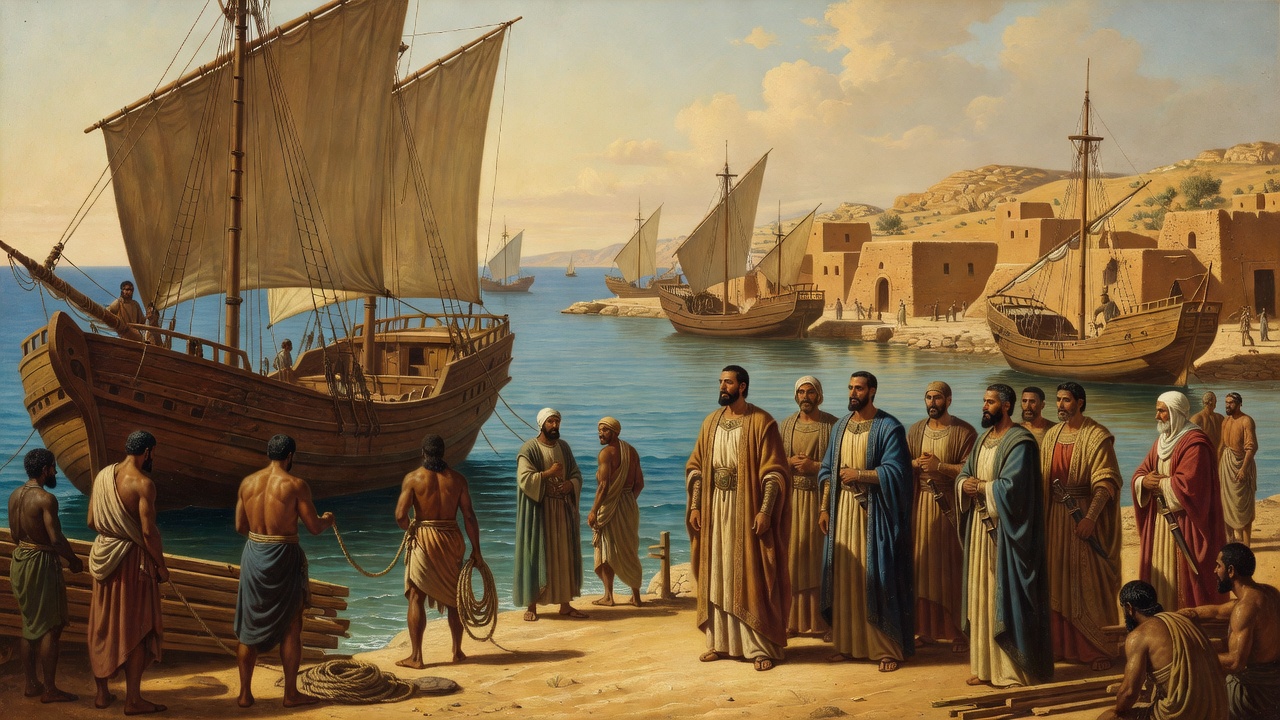
1And at the end of twenty years after Solomon had built the house of the Lord and his own house: 2He built the cities which Hiram had given to Solomon, and caused the children of Israel to dwell there. 3He went also into Emath Suba, and possessed it. 4And he built Palmira in the desert, and he built other strong cities in Emath. 5And he built Beth-horon the upper, and Beth-horon the nether, walled cities with Rates and bars and locks. 6Balaath also and all the strong cities that were Solomon’s, and all the cities of the chariots, and the cities of the horsemen. All that Solomon had a mind, and designed, he built in Jerusalem and in Libanus, and in all the land of his dominion. 7All the people that were left of the Hethites, and the Amorrhites, and the Pherezites, and the Hevites, and the Jebusites, that were not of the stock of Israel: 8Of their children, and of the posterity, whom the children of Israel had not slain, Solomon made to be the tributaries, unto this day. 9But of the children of Israel he set none to serve in the king’s works: for they were men of war, and chief captains, and rulers of his chariots and horsemen. 10And all the chief captains of king Solomon’s army were two hundred and fifty, who taught the people. 11And he removed the daughter of Pharao from the city of David, to the house which he had built for her. For the king said: My wife shall not dwell in the house of David king of Israel, for it is sanctified: because the ark of the Lord came into it. 12Then Solomon offered holocausts to the Lord upon the altar of the Lord which he had built before the porch, 13That every day an offering might be made on it according to the ordinance of Moses, in the sabbaths, and on the new moons, and on the festival days three times a year, that is to say, in the feast of unleavened bread, and in the feast of weeks, and in the feast of tabernacles. 14And he appointed according to the order of David his father the offices of the priests in their ministries: and the Levites in their order to give praise, and minister before the priests according to the duty of every day: and the porters in their divisions by gate and gate: for so David the man of God had commanded. 15And the priests and Levites departed not from the king’s commandments, as to any thing that he had commanded, and as to the keeping of the treasures. 16Solomon had all charges prepared, from the day that he founded the house of the Lord, until the day wherein he finished it. 17Then Solomon went to Asiongaber, and to Ailath, on the coast of the Red Sea, which is in the land of Edom. 18And Hiram sent him ships by the hands of his servants, and skillful mariners, and they went with Solomon’s servants to Ophir, and they took thence four hundred and fifty talents of gold, and brought it to king Solomon.
Did you know?
Solomon's Construction and Administration
- Solomon fortified strategic locations throughout his realm, including Upper and Lower Beth-horon to secure the pass from Jerusalem to the coastal plain, and Tadmor (later known as Palmyra) in the Syrian wilderness.Sources: the Bible text itself · Beth-horon · Tadmor
- Solomon relocated his wife, the daughter of Pharaoh, from the City of David into her own palace, declaring that any dwelling where the Ark of the Lord had entered was holy.Sources: the Bible text itself · Daughter of Pharaoh
- In an alliance with King Hiram of Tyre, experienced sailors sailed from Ezion-geber and Eloth on the Red Sea coast of Edom alongside Solomon's men to Ophir, returning with 450 talents of gold.Sources: the Bible text itself · Hiram
Notes written with AI assistance from open sources (Theographic Bible Metadata, CC BY-SA 4.0; Easton’s Bible Dictionary, public domain) and reviewed before publishing.
Places in this chapter
- Hamath · Today: Hama · 35.136, 36.750 · verse 4
- Tadmor · Today: Palmyra · 34.547, 38.274 · verse 4
- Lower Beth-horon · Today: Beit Ur al Tahta · 31.895, 35.084 · verse 5
- Upper Beth-horon · Today: Beit Ur al Fauqa · 31.886, 35.114 · verse 5
- Jerusalem · 31.777, 35.234 · verse 6
- Lebanon · 33.540, 35.584 · verse 6
- City of David · 31.774, 35.236 · verse 11
- Edom · 30.746, 35.604 · verse 17
- Red Sea · Today: Gulf of Aqaba · 28.750, 34.750 · verse 17
Only places identified with high confidence are shown (90% or more according to the scholarly sources compiled by OpenBible). Period map: DARE (Digital Atlas of the Roman Empire), CC BY 4.0; modern map: © OpenStreetMap contributors; places: OpenBible.info (CC BY 4.0).
Credits and license for this translation
Douay-Rheims 1899
The Holy Bible in English, Douay-Rheims American Edition of 1899, translated from the Latin Vulgate
Public Domain
Language: English
Dialect: archaic American
Translation by: English College, Douai
This Public Domain Bible text is brought to you courtesy of eBible.org.
Help support free Bible access at https://eBible.org/give.php .
2022-11-03
Section headings adapted from the Berean Standard Bible (public domain); they are not part of this translation’s text.
Source: http://ebible.org/engDRA/ · eBible.org