Job 14
Darby Translation · Tap a verse to see its cross-references.
Job Laments the Finality of Death
1Man, born of woman, is of few days, and full of trouble. 2He cometh forth like a flower, and is cut down; and he fleeth as a shadow, and continueth not. 3Yet dost thou open thine eyes upon such a one, and bringest me into judgment with thee? 4Who can bring a clean [man] out of the unclean? Not one! 5If his days are determined, if the number of his months is with thee, [and] thou hast appointed his bounds which he must not pass, 6Look away from him; and let him rest, till he accomplish, as a hireling, his day. 7For there is hope for a tree: if it be cut down, it will sprout again, and its tender branch will not cease; 8Though its root grow old in the earth, and its stock die in the ground, 9Yet through the scent of water it will bud, and put forth boughs like a young plant. 10But a man dieth, and is prostrate; yea, man expireth, and where is he? 11The waters recede from the lake, and the river wasteth and drieth up: 12So man lieth down, and riseth not again; till the heavens be no more, they do not awake, nor are raised out of their sleep. 13Oh that thou wouldest hide me in Sheol, that thou wouldest keep me secret until thine anger be past, that thou wouldest appoint me a set time, and remember me, — 14(If a man die, shall he live [again]?) all the days of my time of toil would I wait, till my change should come: 15Thou wouldest call, and I would answer thee; thou wouldest have a desire after the work of thy hands. 16For now thou numberest my steps: dost thou not watch over my sin? 17My transgression is sealed up in a bag, and thou heapest up mine iniquity. 18And indeed a mountain falling cometh to nought, and the rock is removed out of its place; 19The waters wear the stones, the floods thereof wash away the dust of the earth; and thou destroyest the hope of man. 20Thou prevailest for ever against him, and he passeth away; thou changest his countenance, and dismissest him. 21His sons come to honour, and he knoweth it not; and they are brought low, and he perceiveth it not. 22But his flesh hath pain for himself alone, and his soul mourneth for himself.
Did you know?
The Frailty of Life and the Hope of Renewal
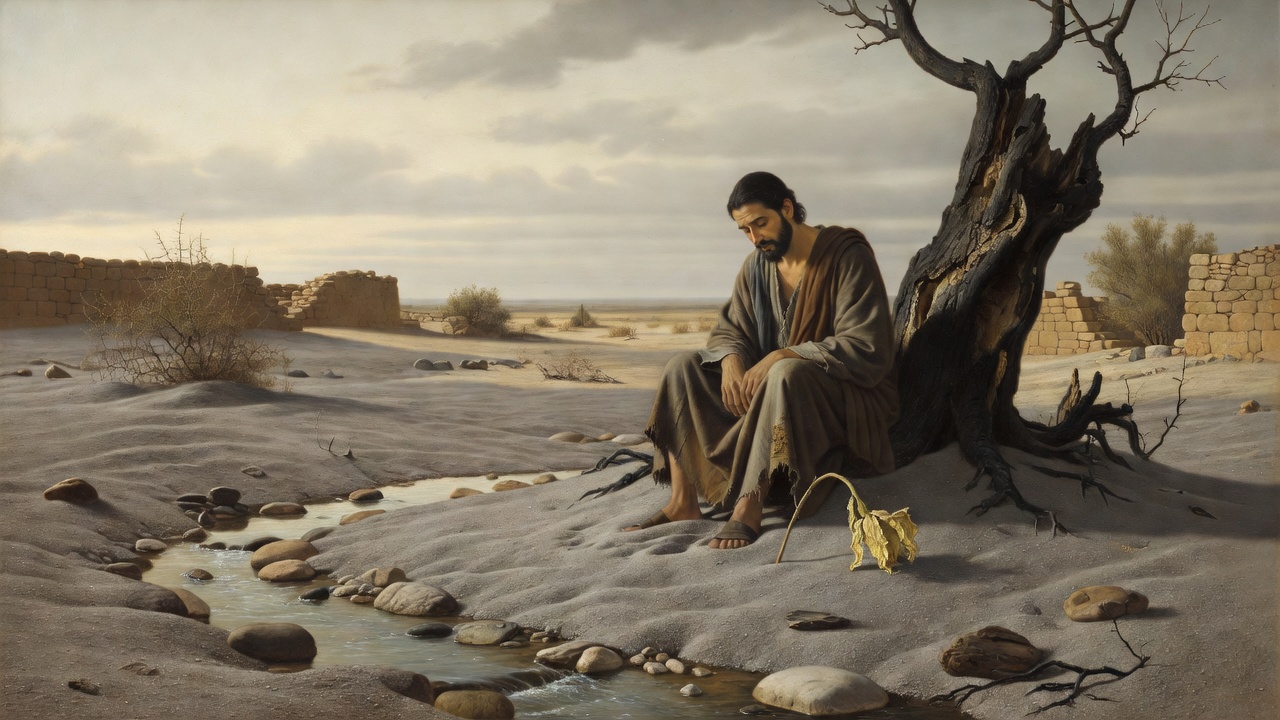
- In this speech, Job contrasts the fate of mortals with that of a tree. While a felled tree can sprout new shoots at the scent of water even after its stump seems dead, a human being dies, lies down, and does not rise again to life on earth.Sources: the Bible text itself
- Job contemplates Sheol as a potential hiding place where he might be sheltered until divine anger passes, imagining a longing in which God would seal his transgressions in a bag and call upon the work of His hands.Sources: the Bible text itself
- To capture the brevity and decay of human existence, the chapter draws upon natural metaphors of erosion and transience, comparing human life to a fleeting shadow, a withered flower, and rocks worn down by water.Sources: the Bible text itself
Notes written with AI assistance from open sources (Theographic Bible Metadata, CC BY-SA 4.0; Easton’s Bible Dictionary, public domain) and reviewed before publishing.
Credits and license for this translation
Darby Translation
The Holy Scriptures, a New Translation from the Original Languages by J. N. Darby
Public Domain
Language: English
Dialect: archaic British
Translation by: J. N. Darby
2019-11-15
Section headings adapted from the Berean Standard Bible (public domain); they are not part of this translation’s text.
Source: http://ebible.org/engDBY/ · eBible.org