Ezekiel 19
Darby Translation · Tap a verse to see its cross-references.
A Lament for the Princes of Israel
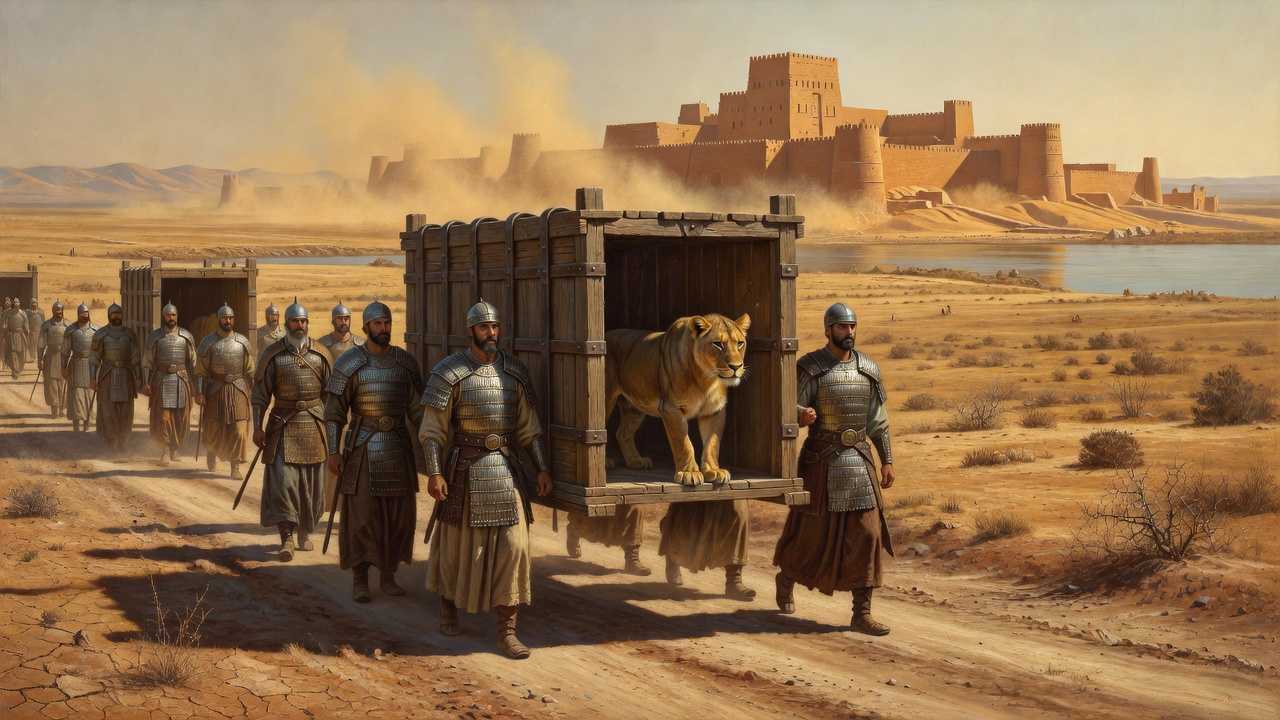
1And thou, take thou up a lamentation for the princes of Israel, 2and say, What was thy mother? A lioness: she lay down among lions, she nourished her whelps in the midst of the young lions. 3And she brought up one of her whelps; it became a young lion, and he learned to catch the prey; he devoured men. 4And the nations heard of him; he was taken in their pit, and they brought him with nose-rings into the land of Egypt. 5And when she saw that she had waited [and] her hope was lost, she took another of her whelps, [and] made him a young lion. 6And he went up and down among the lions; he became a young lion, and learned to catch the prey; he devoured men. 7And he knew their [desolate] palaces, and he laid waste their cities, so that the land was desolate, and all it contained, by the noise of his roaring. 8Then the nations set against him on every side from the provinces, and spread their net over him; he was taken in their pit. 9And they put him in a cage with nose-rings, and brought him to the king of Babylon; they brought him into strongholds, that his voice should no more be heard upon the mountains of Israel. 10Thy mother was as a vine, in thy rest, planted by the waters: it was fruitful and full of branches by reason of many waters. 11And it had strong rods for sceptres of them that bear rule, and its stature was exalted between the thick boughs; and it was conspicuous by its height with the multitude of its branches. 12But it was plucked up in fury, it was cast down to the ground, and the east wind dried up its fruit; its strong rods were broken and withered; the fire consumed them. 13And now it is planted in the wilderness, in a dry and thirsty ground: 14and a fire is gone out of a rod of its branches, [which] hath devoured its fruit; so that it hath no strong rod to be a sceptre for ruling. This is a lamentation, and shall be for a lamentation.
Did you know?
A Lament for the Princes of Israel
- Ezekiel frames this funeral song as an allegory of a mother lioness rearing her cubs. The first cub learns to tear prey but is captured with hooks and brought to Egypt, while the second cub is trapped in a net, placed in a cage, and led into captivity before the king of Babylon.Sources: the Bible text itself · Egypt · Babylon
- The second half of the lament compares the royal line to a flourishing vine planted beside abundant waters, bearing strong branches fit for rulers' scepters. It depicts the vine being uprooted in fury, scorched by the east wind, consumed by fire, and transplanted into a parched wilderness.Sources: the Bible text itself
Notes written with AI assistance from open sources (Theographic Bible Metadata, CC BY-SA 4.0; Easton’s Bible Dictionary, public domain) and reviewed before publishing.
Places in this chapter
Only places identified with high confidence are shown (90% or more according to the scholarly sources compiled by OpenBible). Period map: DARE (Digital Atlas of the Roman Empire), CC BY 4.0; modern map: © OpenStreetMap contributors; places: OpenBible.info (CC BY 4.0).
Credits and license for this translation
Darby Translation
The Holy Scriptures, a New Translation from the Original Languages by J. N. Darby
Public Domain
Language: English
Dialect: archaic British
Translation by: J. N. Darby
2019-11-15
Section headings adapted from the Berean Standard Bible (public domain); they are not part of this translation’s text.
Source: http://ebible.org/engDBY/ · eBible.org