Song of Songs 7
Bible in Basic English · Tap a verse to see its cross-references.
Admiration by the Bridegroom
1How beautiful are your feet in their shoes, O king's daughter! The curves of your legs are like jewels, the work of the hands of a good workman: 2Your stomach is a store of grain with lilies round it, and in the middle a round cup full of wine. 3Your two breasts are like two young roes of the same birth. 4Your neck is as a tower of ivory; your eyes like the waters in Heshbon, by the doorway of Bath-rabbim; your nose is as the tower on Lebanon looking over Damascus: 5Your head is like Carmel, and the hair of your head is like purple, in whose net the king is prisoner. 6How beautiful and how sweet you are, O love, for delight. 7You are tall like a palm-tree, and your breasts are like the fruit of the vine. 8I said, Let me go up the palm-tree, and let me take its branches in my hands: your breasts will be as the fruit of the vine, and the smell of your breath like apples; 9And the roof of your mouth like good wine flowing down smoothly for my loved one, moving gently over my lips and my teeth.
The Bride
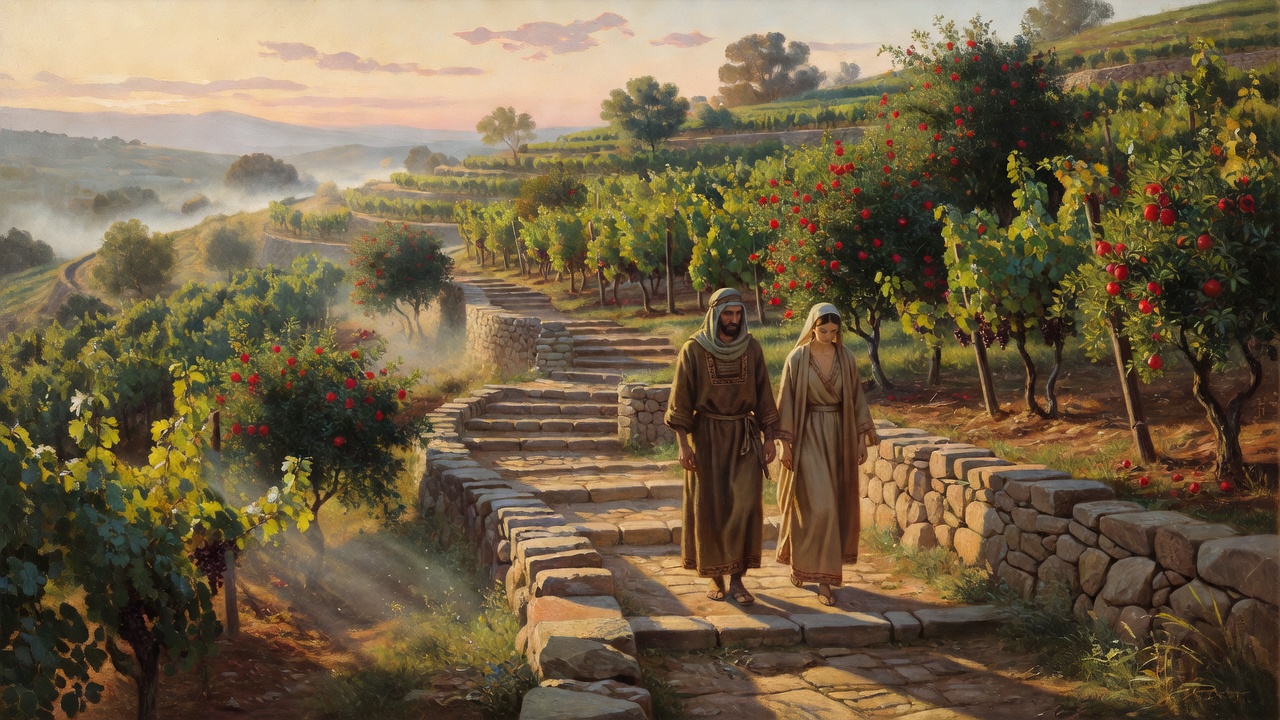
10I am for my loved one, and his desire is for me. 11Come, my loved one, let us go out into the field; let us take rest among the cypress-trees. 12Let us go out early to the vine-gardens; let us see if the vine is in bud, if it has put out its young fruit, and the pomegranate is in flower. There I will give you my love. 13The mandrakes give out a sweet smell, and at our doors are all sorts of good fruits, new and old, which I have kept for my loved one.
Did you know?
Poetry of Love and Landscape
- The poem describes the woman's beauty using prominent landmarks of the region. Her eyes are compared to the calm pools of Heshbon near the gate of Bath-rabbim east of the Jordan, while her profile is likened to a majestic tower in the mountain range of Lebanon overlooking Damascus.Sources: the Bible text itself · Heshbon · Bath-rabbim · Lebanon
- The chapter concludes with an invitation to the countryside during the renewal of spring. The lovers seek out budding grapevines, blooming pomegranates, and fragrant mandrakes, reflecting the close connection in ancient Hebrew poetry between romantic intimacy and the vitality of the natural world.Sources: the Bible text itself
Notes written with AI assistance from open sources (Theographic Bible Metadata, CC BY-SA 4.0; Easton’s Bible Dictionary, public domain) and reviewed before publishing.
Places in this chapter
- Bath-rabbim · Today: in Tell Hesban · 31.801, 35.809 · verse 4
- Damascus · 33.511, 36.306 · verse 4
- Lebanon · 33.540, 35.584 · verse 4
- Mount Carmel · 32.672, 35.023 · verse 5
Only places identified with high confidence are shown (90% or more according to the scholarly sources compiled by OpenBible). Period map: DARE (Digital Atlas of the Roman Empire), CC BY 4.0; modern map: © OpenStreetMap contributors; places: OpenBible.info (CC BY 4.0).
Credits and license for this translation
Bible in Basic English
The Bible in Basic English
Public Domain
Language: English
Dialect: simple British
Translation by: Samuel Henry Hooke
The Bible In Basic English was printed in 1965 by Cambridge Press in England. Published without any copyright notice and distributed in America, this work fell immediately and irretrievably into the Public Domain in the United States according to the UCC convention of that time. A call to Cambridge prior to placing this work in etext resulted in an admission of this fact.
2020-04-17
Section headings adapted from the Berean Standard Bible (public domain); they are not part of this translation’s text.
Source: http://ebible.org/engBBE/ · eBible.org