Proverbs 31
Bible in Basic English · Tap a verse to see its cross-references.
The Sayings for King Lemuel
1The words of Lemuel, king of Massa: the teaching which he had from his mother. 2What am I to say to you, O Lemuel, my oldest son? and what, O son of my body? and what, O son of my oaths? 3Do not give your strength to women, or your ways to that which is the destruction of kings. 4It is not for kings, O Lemuel, it is not for kings to take wine, or for rulers to say, Where is strong drink? 5For fear that through drinking they may come to have no respect for the law, wrongly judging the cause of those who are in trouble. 6Give strong drink to him who is near to destruction, and wine to him whose soul is bitter: 7Let him have drink, and his need will go from his mind, and the memory of his trouble will be gone. 8Let your mouth be open for those who have no voice, in the cause of those who are ready for death. 9Let your mouth be open, judging rightly, and give right decisions in the cause of the poor and those in need.
The Virtues of a Noble Woman
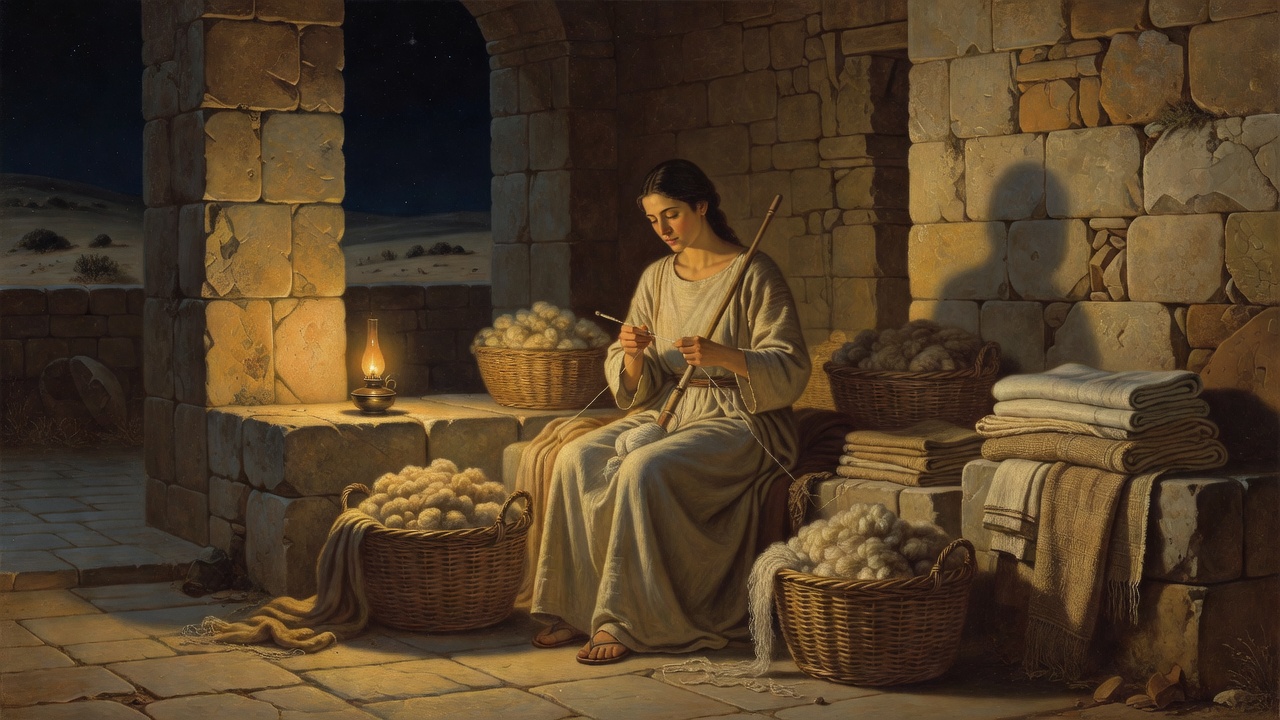
10Who may make discovery of a woman of virtue? For her price is much higher than jewels. 11The heart of her husband has faith in her, and he will have profit in full measure. 12She does him good and not evil all the days of her life. 13She gets wool and linen, working at the business of her hands. 14She is like the trading-ships, getting food from far away. 15She gets up while it is still night, and gives meat to her family, and their food to her servant-girls. 16After looking at a field with care, she gets it for a price, planting a vine-garden with the profit of her work. 17She puts a band of strength round her, and makes her arms strong. 18She sees that her marketing is of profit to her: her light does not go out by night. 19She puts her hands to the cloth-working rod, and her fingers take the wheel. 20Her hands are stretched out to the poor; yes, she is open-handed to those who are in need. 21She has no fear of the snow for her family, for all those in her house are clothed in red. 22She makes for herself cushions of needlework; her clothing is fair linen and purple. 23Her husband is a man of note in the public place, when he takes his seat among the responsible men of the land. 24She makes linen robes and gets a price for them, and traders take her cloth bands for a price. 25Strength and self-respect are her clothing; she is facing the future with a smile. 26Her mouth is open to give out wisdom, and the law of mercy is on her tongue. 27She gives attention to the ways of her family, she does not take her food without working for it. 28Her children get up and give her honour, and her husband gives her praise, saying, 29Unnumbered women have done well, but you are better than all of them. 30Fair looks are a deceit, and a beautiful form is of no value; but a woman who has the fear of the Lord is to be praised. 31Give her credit for what her hands have made: let her be praised by her works in the public place.
Did you know?
Advice to a King and the Noble Woman
- The historical identity of King Lemuel is not certainly known outside this passage. His name means dedicated to God, and while rabbinic tradition identified him with King Solomon, the text presents him receiving moral instruction and guidance on righteous leadership directly from his mother.Sources: Lemuel · Mother of Lemuel · the Bible text itself
- The poem in the second half of the chapter describes a capable woman managing varied economic affairs, including evaluating and buying real estate, planting a vineyard, producing textiles, and trading with merchants, all while providing for her household and aiding the poor.Sources: the Bible text itself
Notes written with AI assistance from open sources (Theographic Bible Metadata, CC BY-SA 4.0; Easton’s Bible Dictionary, public domain) and reviewed before publishing.
Credits and license for this translation
Bible in Basic English
The Bible in Basic English
Public Domain
Language: English
Dialect: simple British
Translation by: Samuel Henry Hooke
The Bible In Basic English was printed in 1965 by Cambridge Press in England. Published without any copyright notice and distributed in America, this work fell immediately and irretrievably into the Public Domain in the United States according to the UCC convention of that time. A call to Cambridge prior to placing this work in etext resulted in an admission of this fact.
2020-04-17
Section headings adapted from the Berean Standard Bible (public domain); they are not part of this translation’s text.
Source: http://ebible.org/engBBE/ · eBible.org