Leviticus 17
Bible in Basic English · Tap a verse to see its cross-references.
The Place of Sacrifice
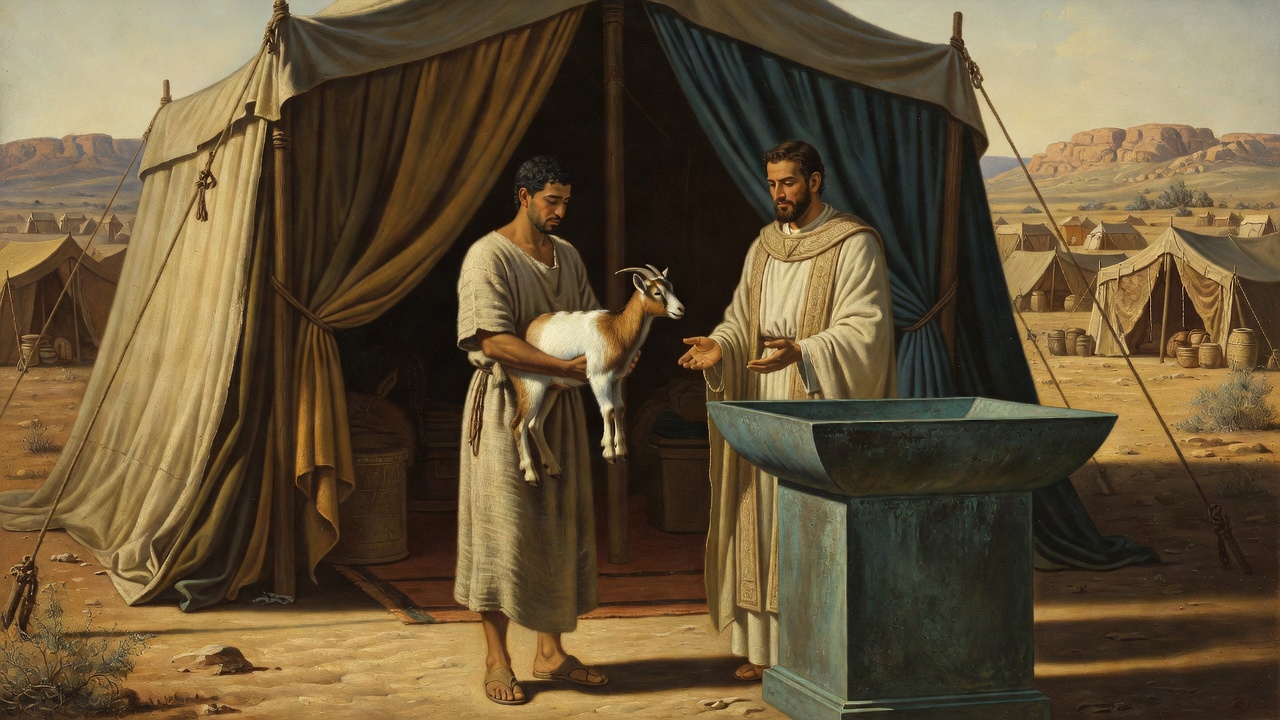
1And the Lord said to Moses, 2Say to Aaron and to his sons and to all the children of Israel: This is the order which the Lord has given. 3If any man of Israel puts to death an ox or a lamb or a goat, in or outside the tent-circle; 4And has not taken it to the door of the Tent of meeting, to make an offering to the Lord, before the Lord's House, its blood will be on him, for he has taken life, and he will be cut off from among his people: 5So that the children of Israel may take to the Lord, to the door of the Tent of meeting and to the priest, the offerings which they have put to death in the open country, and that they may make their peace-offerings to the Lord. 6And the priest will put blood on the altar of the Lord at the door of the Tent of meeting, burning the fat for a sweet smell to the Lord. 7And let them make no more offerings to evil spirits, after which they have gone, turning away from the Lord. Let this be a law to them for ever, through all their generations. 8And say to them, If any man of Israel, or any other living among them, makes a burned offering or other offering, 9And does not take it to the door of the Tent of meeting to make an offering to the Lord, that man will be cut off from among his people.
Laws against Eating Blood
10And if any man of Israel, or any other living among them, takes any sort of blood for food, my wrath will be turned against that man and he will be cut off from among his people. 11For the life of the flesh is in its blood; and I have given it to you on the altar to take away your sin: for it is the blood which makes free from sin because of the life in it. 12For this reason I have said to the children of Israel, No man among you, or any others living with you, may take blood as food. 13And any man of Israel, or any other living among them, who gets with his bow any beast or bird used for food, is to see that its blood is covered with earth. 14For the blood is the life of all flesh: and so I have said to the children of Israel, You may not take any sort of blood as food, and any man who does so will be cut of. 15And anyone who takes as food anything which has come to a natural end, or anything which has been put to death by beasts, if he is one of you by birth, or of another nation, will have to have his clothing washed and his body bathed in water and be unclean till evening, and then he will be clean. 16But if his clothing is not washed and his body bathed, his sin will be on him.
Did you know?
Sacrificial Slaughter and the Sacredness of Blood
- Leviticus mandates that domestic animals such as oxen, lambs, and goats be brought directly to the entrance of the Tent of Meeting rather than slaughtered in open fields. This rule ensured sacrifices were presented exclusively as peace offerings to the LORD and halted illicit sacrifices to goat demons.Sources: the Bible text itself
- Both native Israelites and resident foreigners were strictly prohibited from eating blood, on penalty of being cut off from the community. The text grounds this law in the theological principle that the life of the flesh is in the blood, which God appointed specifically for making atonement upon the altar.Sources: the Bible text itself
- When Israelites or resident aliens hunted wild animals or birds that were clean for food, they were commanded to drain the blood upon the ground and cover it with dirt. This instruction reinforced that life belongs to God and preserved the sanctity of blood outside the sacrificial sanctuary.Sources: the Bible text itself
Notes written with AI assistance from open sources (Theographic Bible Metadata, CC BY-SA 4.0; Easton’s Bible Dictionary, public domain) and reviewed before publishing.
Credits and license for this translation
Bible in Basic English
The Bible in Basic English
Public Domain
Language: English
Dialect: simple British
Translation by: Samuel Henry Hooke
The Bible In Basic English was printed in 1965 by Cambridge Press in England. Published without any copyright notice and distributed in America, this work fell immediately and irretrievably into the Public Domain in the United States according to the UCC convention of that time. A call to Cambridge prior to placing this work in etext resulted in an admission of this fact.
2020-04-17
Section headings adapted from the Berean Standard Bible (public domain); they are not part of this translation’s text.
Source: http://ebible.org/engBBE/ · eBible.org