Job 15
Bible in Basic English · Tap a verse to see its cross-references.
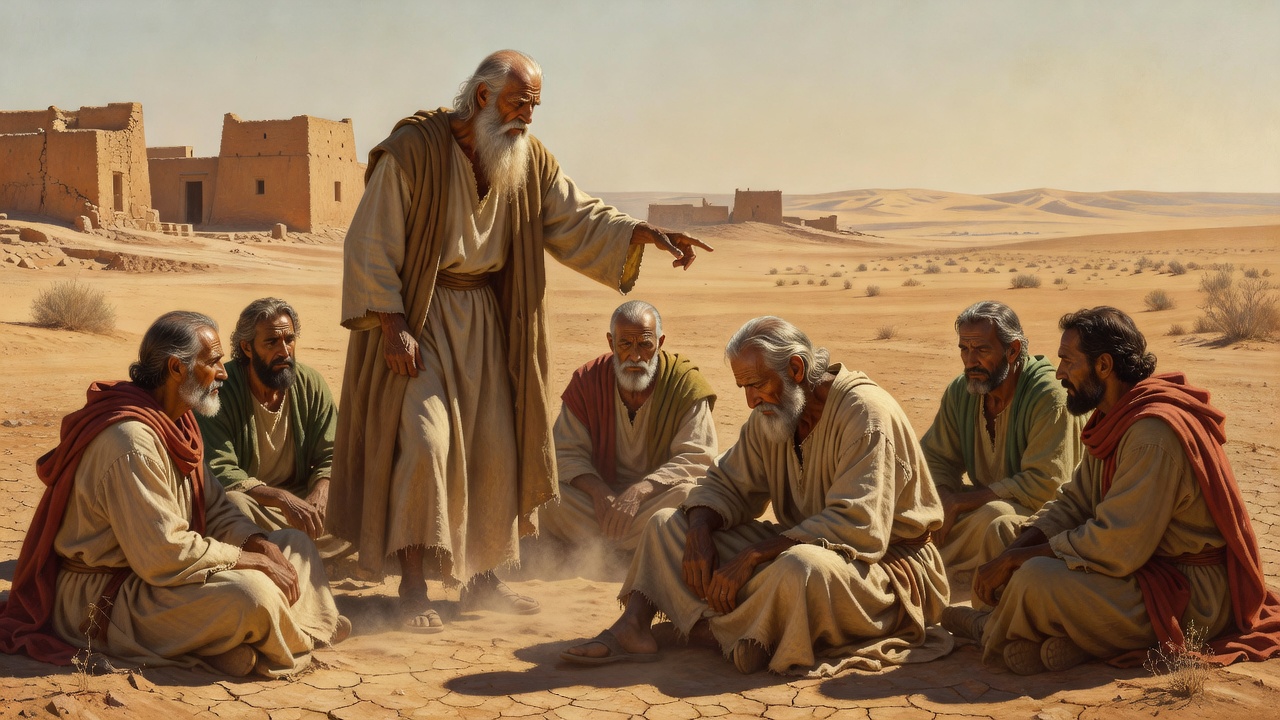
Eliphaz: Job Does Not Fear God
1And Eliphaz the Temanite made answer and said, 2Will a wise man make answer with knowledge of no value, or will he give birth to the east wind? 3Will he make arguments with words in which is no profit, and with sayings which have no value? 4Truly, you make the fear of God without effect, so that the time of quiet worship before God is made less by your outcry. 5For your mouth is guided by your sin, and you have taken the tongue of the false for yourself. 6It is by your mouth, even yours, that you are judged to be in the wrong, and not by me; and your lips give witness against you. 7Were you the first man to come into the world? or did you come into being before the hills? 8Were you present at the secret meeting of God? and have you taken all wisdom for yourself? 9What knowledge have you which we have not? is there anything in your mind which is not in ours? 10With us are men who are grey-haired and full of years, much older than your father. 11Are the comforts of God not enough for you, and the gentle word which was said to you? 12Why is your heart uncontrolled, and why are your eyes lifted up; 13So that you are turning your spirit against God, and letting such words go out of your mouth? 14What is man, that he may be clean? and how may the son of woman be upright? 15Truly, he puts no faith in his holy ones, and the heavens are not clean in his eyes; 16How much less one who is disgusting and unclean, a man who takes in evil like water! 17Take note and give ear to my words; and I will say what I have seen: 18(The things which wise men have got from their fathers, and have not kept secret from us; 19For only to them was the land given, and no strange people were among them:) 20The evil man is in pain all his days, and the number of the years stored up for the cruel is small. 21A sound of fear is in his ears; in time of peace destruction will come on him: 22He has no hope of coming safe out of the dark, and his fate will be the sword; 23He is wandering about in search of bread, saying, Where is it? and he is certain that the day of trouble is ready for him: 24He is greatly in fear of the dark day, trouble and pain overcome him: 25Because his hand is stretched out against God, and his heart is lifted up against the Ruler of all, 26Running against him like a man of war, covered by his thick breastplate; even like a king ready for the fight, 27Because his face is covered with fat, and his body has become thick; 28And he has made his resting-place in the towns which have been pulled down, in houses where no man had a right to be, whose fate was to become masses of broken walls. 29He does not get wealth for himself, and is unable to keep what he has got; the heads of his grain are not bent down to the earth. 30He does not come out of the dark; his branches are burned by the flame, and the wind takes away his bud. 31Let him not put his hope in what is false, falling into error: for he will get deceit as his reward. 32His branch is cut off before its time, and his leaf is no longer green. 33He is like a vine whose grapes do not come to full growth, or an olive-tree dropping its flowers. 34For the band of the evil-doers gives no fruit, and the tents of those who give wrong decisions for reward are burned with fire. 35Evil has made them with child, and they give birth to trouble; and the fruit of their body is shame for themselves.
Did you know?
Eliphaz's Second Speech and Ancestral Wisdom
- Eliphaz accuses Job of filling his belly with the hot east wind, invoking a familiar ancient Near Eastern metaphor for the dry, scorching desert wind that blights vegetation and brings destruction instead of sustenance.Sources: the Bible text itself
- To validate his view that the wicked inevitably suffer ruin, Eliphaz appeals to the authority of ancient, gray-haired sages and traditional lore handed down from a time before foreign influences entered the land.Sources: the Bible text itself · Eliphaz
Notes written with AI assistance from open sources (Theographic Bible Metadata, CC BY-SA 4.0; Easton’s Bible Dictionary, public domain) and reviewed before publishing.
Credits and license for this translation
Bible in Basic English
The Bible in Basic English
Public Domain
Language: English
Dialect: simple British
Translation by: Samuel Henry Hooke
The Bible In Basic English was printed in 1965 by Cambridge Press in England. Published without any copyright notice and distributed in America, this work fell immediately and irretrievably into the Public Domain in the United States according to the UCC convention of that time. A call to Cambridge prior to placing this work in etext resulted in an admission of this fact.
2020-04-17
Section headings adapted from the Berean Standard Bible (public domain); they are not part of this translation’s text.
Source: http://ebible.org/engBBE/ · eBible.org