Deuteronomy 17
Bible in Basic English · Tap a verse to see its cross-references.
Detestable Sacrifices
1No ox or sheep which has a mark on it or is damaged in any way may be offered to the Lord your God: for that is disgusting to the Lord your God.
Purge the Idolater
2If there is any man or woman among you, in any of the towns which the Lord your God gives you, who does evil in the eyes of the Lord your God, sinning against his agreement, 3By becoming a servant of other gods and worshipping them or the sun or the moon or all the stars of heaven, against my orders; 4If word of this comes to your ears, then let this thing be looked into with care, and if there is no doubt that it is true, and such evil has been done in Israel; 5Then you are to take the man or woman who has done the evil to the public place of your town, and they are to be stoned with stones till they are dead. 6On the word of two or three witnesses, a man may be given the punishment of death; but he is not to be put to death on the word of one witness. 7The hands of the witnesses will be the first to put him to death, and after them the hands of all the people. So you are to put away the evil from among you.
Courts of Law
8If you are not able to give a decision as to who is responsible for a death, or who is right in a cause, or who gave the first blow in a fight, and there is a division of opinion about it in your town: then go to the place marked out by the Lord your God; 9And come before the priests, the Levites, or before him who is judge at the time: and they will go into the question and give you a decision: 10And you are to be guided by the decision they give in the place named by the Lord, and do whatever they say: 11Acting in agreement with their teaching and the decision they give: not turning to one side or the other from the word they have given you. 12And any man who, in his pride, will not give ear to the priest whose place is there before the Lord your God, or to the judge, is to be put to death: you are to put away the evil from Israel. 13And all the people, hearing of it, will be full of fear and put away their pride.
Guidelines for a King
14When you have come into the land which the Lord your God is giving you, and have taken it for a heritage and are living in it, if it is your desire to have a king over you, like the other nations round about you; 15Then see that you take as your king the man named by the Lord your God: let your king be one of your countrymen, not a man of another nation who is not one of yourselves. 16And he is not to get together a great army of horses for himself, or make the people go back to Egypt to get horses for him: because the Lord has said, You will never again go back that way. 17And he is not to have a great number of wives, for fear that his heart may be turned away; or great wealth of silver and gold. 18And when he has taken his place on the seat of his kingdom, he is to make in a book a copy of this law, from that which the priests, the Levites, have in their care: 19And it is to be with him for his reading all the days of his life, so that he may be trained in the fear of the Lord his God to keep and do all the words of this teaching and these laws: 20So that his heart may not be lifted up over his countrymen, and he may not be turned away from the orders, to one side or the other: but that his life and the lives of his children may be long in his kingdom in Israel.
Did you know?
Justice and the Law of the King
- Legal matters required rigorous standards of evidence, mandating at least two or three witnesses for a capital conviction, with the witnesses required to cast the first stones. Difficult legal disputes over bloodshed, civil lawsuits, or assaults were escalated to a central tribunal composed of the Levitical priests and the presiding judge.Sources: the Bible text itself
- Anticipating Israel's desire for a monarchy, the text establishes strict boundaries for a king: he had to be a fellow Israelite and was prohibited from accumulating vast numbers of horses, sending people back to Egypt for trade, taking many wives, or hoarding excessive silver and gold.Sources: the Bible text itself · Egypt
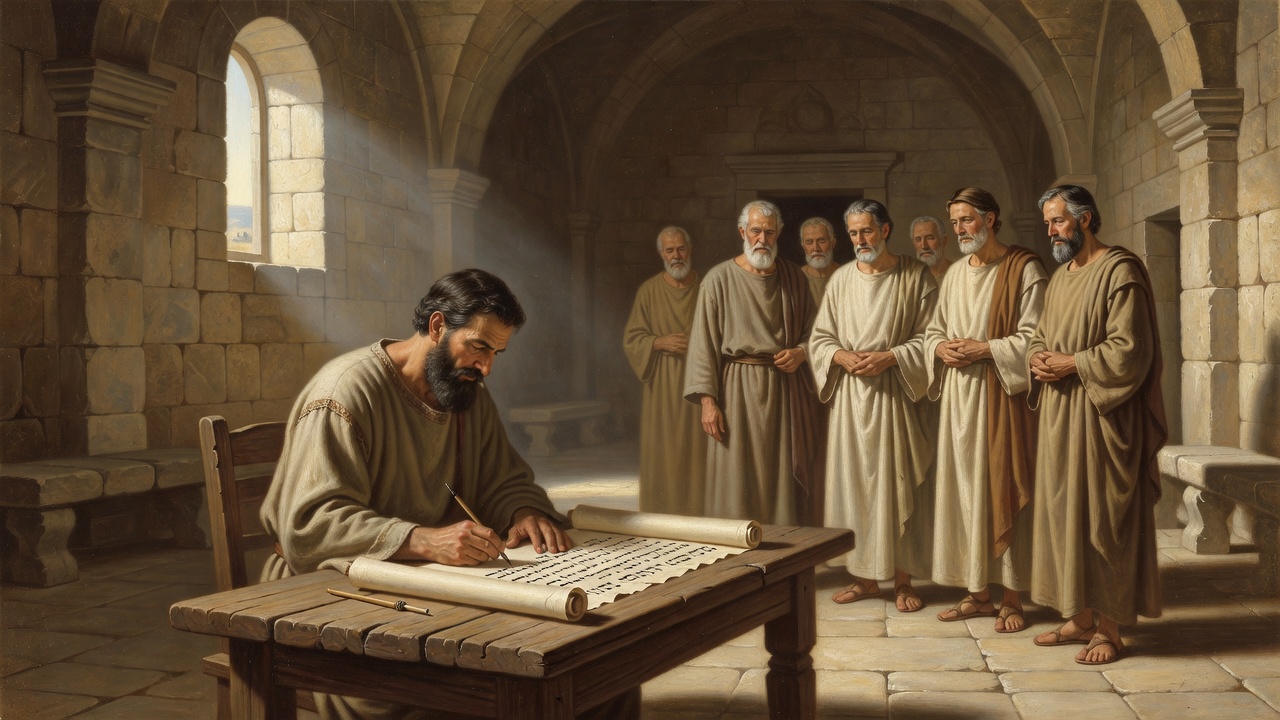
- Upon taking the throne, an Israelite king was required to write his own personal copy of the law on a scroll in the presence of the Levitical priests. He was instructed to read it daily throughout his life so that he would remain obedient to God and not view himself as superior to his countrymen.Sources: the Bible text itself
Notes written with AI assistance from open sources (Theographic Bible Metadata, CC BY-SA 4.0; Easton’s Bible Dictionary, public domain) and reviewed before publishing.
Places in this chapter
- Egypt · 30.129, 31.308 · verse 16
Only places identified with high confidence are shown (90% or more according to the scholarly sources compiled by OpenBible). Period map: DARE (Digital Atlas of the Roman Empire), CC BY 4.0; modern map: © OpenStreetMap contributors; places: OpenBible.info (CC BY 4.0).
Credits and license for this translation
Bible in Basic English
The Bible in Basic English
Public Domain
Language: English
Dialect: simple British
Translation by: Samuel Henry Hooke
The Bible In Basic English was printed in 1965 by Cambridge Press in England. Published without any copyright notice and distributed in America, this work fell immediately and irretrievably into the Public Domain in the United States according to the UCC convention of that time. A call to Cambridge prior to placing this work in etext resulted in an admission of this fact.
2020-04-17
Section headings adapted from the Berean Standard Bible (public domain); they are not part of this translation’s text.
Source: http://ebible.org/engBBE/ · eBible.org