Amos 7
Bible in Basic English · Tap a verse to see its cross-references.
The Locusts, Fire, and Plumb Line
1This is what the Lord God let me see: and I saw that, when the growth of the late grass was starting, he made locusts; it was the late growth after the king's cutting was done. 2And it came about that after they had taken all the grass of the land, I said, O Lord God, have mercy: how will Jacob be able to keep his place? for he is small. 3The Lord, changing his purpose about this, said, It will not be. 4This is what the Lord let me see: and I saw that the Lord God sent for a great fire to be the instrument of his punishment; and, after burning up the great deep, it was about to put an end to the Lord's heritage. 5Then said I, O Lord God, let there be an end: how will Jacob be able to keep his place? for he is small. 6The Lord, changing his purpose about this, said, And this will not be. 7This is what he let me see: and I saw the Lord stationed by a wall made straight by a weighted line, and he had a weighted line in his hand. 8And the Lord said to me, Amos, what do you see? And I said, A weighted line. Then the Lord said, See, I will let down a weighted line among my people Israel; never again will my eyes be shut to their sin: 9And the high places of Isaac will be unpeopled, and the holy places of Israel will be made waste; and I will come up against the family of Jeroboam with the sword.
Amaziah Accuses Amos
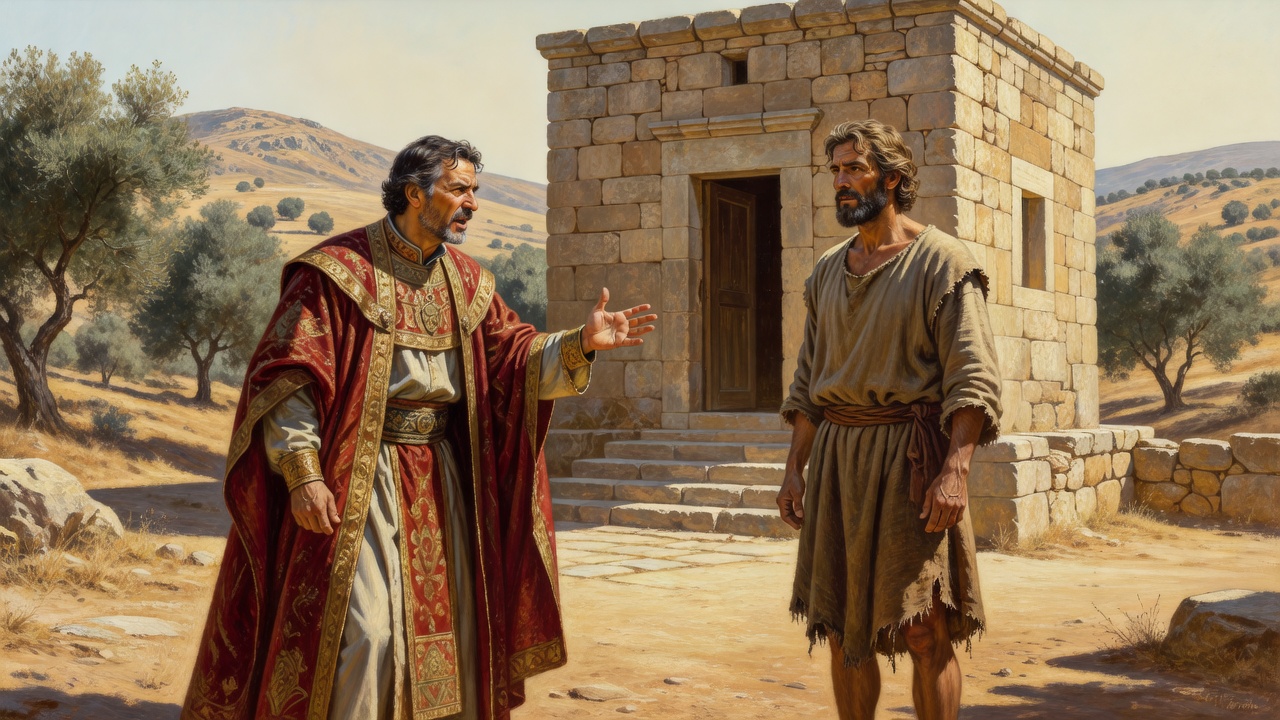
10Then Amaziah, the priest of Beth-el, sent to Jeroboam, king of Israel, saying, Amos has made designs against you among the people of Israel: the land is troubled by his words. 11For Amos has said, Jeroboam will be put to the sword, and Israel will certainly be taken away as a prisoner out of his land. 12And Amaziah said to Amos, O seer, go in flight into the land of Judah, and there get your living by working as a prophet: 13But be a prophet no longer at Beth-el: for it is the holy place of the king, and the king's house. 14Then Amos in answer said to Amaziah, I am no prophet, or one of the sons of the prophets; I am a herdman and one who takes care of sycamore-trees: 15And the Lord took me from the flock, and the Lord said to me, Go, be a prophet to my people Israel. 16Now then, give ear to the word of the Lord: You say, Be no prophet to Israel, and say not a word against the people of Isaac. 17So this is what the Lord has said: Your wife will be a loose woman in the town, and your sons and your daughters will be put to the sword, and your land will be cut up into parts by a line; and you yourself will come to your end in an unclean land, and Israel will certainly be taken away a prisoner out of his land.
Did you know?
Visions of Judgment and the Confrontation at Bethel
- Unlike professional court prophets of his era, Amos was a herdsman and a cultivator of sycamore-fig trees from Tekoa in Judah. He emphasized that he was not trained in a prophetic guild, but was called directly by God to leave his flock and deliver messages of judgment to the northern kingdom of Israel.Sources: the Bible text itself · Amos
- Bethel served as a primary royal sanctuary for the northern kingdom of Israel, where kings maintained state-sponsored shrines. Amaziah, the priest serving there under King Jeroboam II, viewed Amos's prophecies as political treason and attempted to banish him back to Judah.Sources: the Bible text itself · Amaziah · Jeroboam · Bethel (of Palestine)
- Although the reign of Jeroboam II brought significant territorial expansion and material prosperity to Israel, Amos's visions warned that national destruction, the collapse of royal shrines, and impending exile were unavoidable.Sources: the Bible text itself · Jeroboam
Notes written with AI assistance from open sources (Theographic Bible Metadata, CC BY-SA 4.0; Easton’s Bible Dictionary, public domain) and reviewed before publishing.
Credits and license for this translation
Bible in Basic English
The Bible in Basic English
Public Domain
Language: English
Dialect: simple British
Translation by: Samuel Henry Hooke
The Bible In Basic English was printed in 1965 by Cambridge Press in England. Published without any copyright notice and distributed in America, this work fell immediately and irretrievably into the Public Domain in the United States according to the UCC convention of that time. A call to Cambridge prior to placing this work in etext resulted in an admission of this fact.
2020-04-17
Section headings adapted from the Berean Standard Bible (public domain); they are not part of this translation’s text.
Source: http://ebible.org/engBBE/ · eBible.org