2 Chronicles 13
Bible in Basic English · Tap a verse to see its cross-references.
Abijah Reigns in Judah
1In the eighteenth year of King Jeroboam, Abijah became king over Judah. 2He was king in Jerusalem for three years; his mother's name was Maacah, the daughter of Uriel of Gibeah. And there was war between Abijah and Jeroboam. 3And Abijah went out to the fight with an army of men of war, four hundred thousand of his best men; and Jeroboam put his forces in line against him, eight hundred thousand of his best men of war.
Civil War against Jeroboam
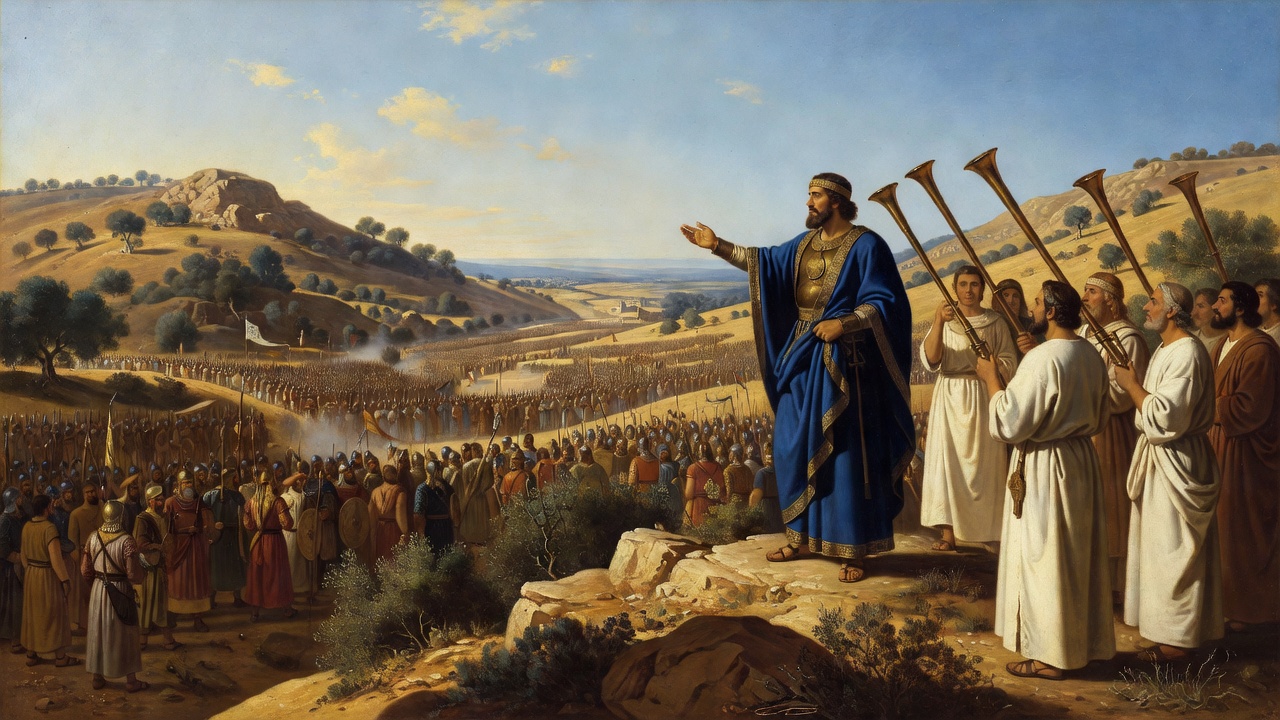
4And Abijah took up his position on Mount Zemaraim, in the hill-country of Ephraim, and said, Give ear to me, O Jeroboam and all Israel: 5Is it not clear to you that the Lord, the God of Israel, gave the rule over Israel to David and to his sons for ever, by an agreement made with salt? 6But Jeroboam, the son of Nebat, the servant of Solomon, the son of David, took up arms against his lord. 7And certain foolish and good-for-nothing men were joined with him, and made themselves strong against Rehoboam, the son of Solomon, when he was young and untested and not able to keep them back. 8And now it is your purpose to put yourselves against the authority which the Lord has put into the hands of the sons of David, and you are a very great number, and you have with you the gold oxen which Jeroboam made to be your gods. 9And after driving out the priests of the Lord, the sons of Aaron and the Levites, have you not made priests for yourselves as the people of other lands do? so that anyone who comes to make himself priest by offering an ox or seven sheep, may be a priest of those who are no gods. 10But as for us, the Lord is our God, and we have not been turned away from him; we have priests who do the work of the Lord, even the sons of Aaron and the Levites in their places; 11By whom burned offerings and perfumes are sent up in smoke before the Lord every morning and every evening; and they put out the holy bread on its table and the gold support for the lights with its lights burning every evening; for we keep the orders given to us by the Lord our God, but you have gone away from him. 12And now God is with us at our head, and his priests with their loud horns sounding against you. O children of Israel, do not make war on the Lord, the God of your fathers, for it will not go well for you. 13But Jeroboam had put some of his men to make a surprise attack on them from the back, so some were facing Judah and others were stationed secretly at their back. 14And Judah, turning their faces, saw that they were being attacked in front and at the back; and they gave a cry for help to the Lord, while the priests were sounding their horns. 15And the men of Judah gave a loud cry; and at their cry, God put fear into Jeroboam and all Israel before Abijah and Judah. 16And the children of Israel went in flight before Judah, and God gave them up into their hands. 17And Abijah and his people put them to death with great destruction: five hundred thousand of the best of Israel were put to the sword. 18So at that time the children of Israel were overcome, and the children of Judah got the better of them, because they put their faith in the Lord, the God of their fathers. 19And Abijah went after Jeroboam and took some of his towns, Beth-el with its small towns and Jeshanah with its small towns and Ephron with its small towns. 20And Jeroboam did not get back his power again in the life-time of Abijah; and the Lord sent death on him. 21But Abijah became great, and had fourteen wives, and became the father of twenty-two sons and sixteen daughters. 22And the rest of the acts of Abijah, and his ways and his sayings, are recorded in the account of the prophet Iddo.
Did you know?
Abijah’s Victory over Jeroboam
- Before the battle, King Abijah of Judah stood on Mount Zemaraim in the hill country of Ephraim to speak to Jeroboam and Israel, defending the Davidic dynasty by citing an enduring covenant of salt.Sources: the Bible text itself · Mount Zemaraim · Abijah
- Abijah contrasted the religious practices of the two kingdoms, noting that Judah retained the Aaronic priesthood and regular temple rituals, whereas Jeroboam had driven out the Levites and consecrated priests for golden calves.Sources: the Bible text itself · Aaron
- Even though Jeroboam set an ambush behind the army of Judah, Judah prevailed after crying out to God and blowing the sacred trumpets, subsequently taking control of towns such as Bethel, Jeshanah, and Ephron.Sources: the Bible text itself · Bethel (of Palestine) · Jeshanah
Notes written with AI assistance from open sources (Theographic Bible Metadata, CC BY-SA 4.0; Easton’s Bible Dictionary, public domain) and reviewed before publishing.
Places in this chapter
Only places identified with high confidence are shown (90% or more according to the scholarly sources compiled by OpenBible). Period map: DARE (Digital Atlas of the Roman Empire), CC BY 4.0; modern map: © OpenStreetMap contributors; places: OpenBible.info (CC BY 4.0).
Credits and license for this translation
Bible in Basic English
The Bible in Basic English
Public Domain
Language: English
Dialect: simple British
Translation by: Samuel Henry Hooke
The Bible In Basic English was printed in 1965 by Cambridge Press in England. Published without any copyright notice and distributed in America, this work fell immediately and irretrievably into the Public Domain in the United States according to the UCC convention of that time. A call to Cambridge prior to placing this work in etext resulted in an admission of this fact.
2020-04-17
Section headings adapted from the Berean Standard Bible (public domain); they are not part of this translation’s text.
Source: http://ebible.org/engBBE/ · eBible.org