1 Kings 1
Bible in Basic English · Tap a verse to see its cross-references.

About this book
About 1 Kings
- Easton's Bible Dictionary (1897) treats the authorship of the books of Kings as uncertain. A tradition that Jeremiah wrote them is, in Easton's view, supported by passages almost identical with parts of Jeremiah and by events Jeremiah knew personally, yet Easton thinks it more probable that Ezra, after the Captivity, compiled the books from earlier documents, perhaps written by David, Solomon, Nathan, Gad, and Iddo. Easton dates the composition between 561 B.C., when Jehoiachin was released from captivity by Evil-merodach, and 538 B.C., the decree of Cyrus.Sources: Easton: Kings, The Books of
- Easton says these books contain the annals of the kingdom from Solomon's accession until Nebuchadnezzar and the Babylonians subdued it, a period he estimates at about 453 years. 1 Kings opens while David is dying: Adonijah, his fourth son, who had become heir-apparent to the throne after the deaths of Amnon and Absalom, has himself proclaimed king, but Nathan and Bathsheba persuade David to enthrone Solomon at once. Solomon, David's son by Bathsheba, whose history is recorded in 1 Kings 1-11, came to the throne, Easton suggests, at about sixteen or eighteen.Sources: Easton: Kings, The Books of · Adonijah · Solomon
- In the Hebrew Scriptures the two books of Kings originally formed one book; the Septuagint first divided them and, with the Vulgate, numbers them as the third and fourth books of Kings, the books of Samuel being the first and second. Easton notes that Chronicles gives greater prominence to the priestly or Levitical office, while Kings gives greater prominence to the royal office, and that in the threefold division of the Scriptures by the Jews these books are ranked among the Prophets. The narrative points to earlier sources: the book of the acts of Solomon and the chronicles of the kings of Judah and of Israel.Sources: Easton: Kings, The Books of
- After Solomon's death the ten tribes revolted and invited Jeroboam, son of Nebat, to be their king; Easton calls him the first king of those tribes and dates his reign from 976 to 945 B.C. He had fled to Egypt under the protection of Shishak I, and later moved his residence from Shechem, his first capital, to Tirzah, which remained the chief residence of Israel's kings until Omri bought the hill of Shomeron from Shemer for two talents of silver and built Samaria. The later narrative includes Ahab, Omri's son and the seventh king of Israel, whose wife was Jezebel: to the calf worship introduced by Jeroboam he added the worship of Baal, and he was severely admonished by the prophet Elijah.Sources: Jeroboam · Tirzah · Samaria · Ahab
Notes written with AI assistance from open sources (Theographic Bible Metadata, CC BY-SA 4.0; Easton’s Bible Dictionary, public domain) and reviewed before publishing.
Abishag Cares for David
1Now King David was old and far on in years; and though they put covers over him, his body was cold. 2So his servants said to him, Let search be made for a young virgin for my lord the king, to take care of him and be waiting on him; and you may take her in your arms, and so my lord the king will be warm. 3So after searching through all the land of Israel for a fair young girl, they saw Abishag the Shunammite, and took her to the king. 4Now she was very beautiful; and she took care of the king, waiting on him at all times; but the king had no connection with her.
Adonijah Usurps the Kingdom
5Then Adonijah, the son of Haggith, lifting himself up in pride, said, I will become king; and he made ready his carriages of war and his horsemen, with fifty runners to go before him. 6Now all his life his father had never gone against him or said to him, Why have you done so? and he was a very good-looking man, and younger than Absalom. 7And he had talk with Joab, the son of Zeruiah, and with Abiathar the priest; and they were on his side and gave him their support. 8But Zadok the priest, and Benaiah, the son of Jehoiada, and Nathan the prophet and Shimei and Rei, and David's men of war did not take the side of Adonijah. 9Then Adonijah put to death sheep and oxen and fat beasts by the stone of Zoheleth, by En-rogel; and he sent for all his brothers, the king's sons, and all the men of Judah, the king's servants, to come to him: 10But he did not send for Nathan the prophet and Benaiah and the other men of war and Solomon his brother.
Nathan and Bathsheba before David
11Then Nathan said to Bath-sheba, the mother of Solomon, Has it not come to your ears that Adonijah, the son of Haggith, has made himself king without the knowledge of David our lord? 12So now, let me make a suggestion, so that you may keep your life safe and the life of your son Solomon. 13Come now, go to King David and say to him, Did you not, O my lord, take an oath to me, your servant, saying, Truly Solomon your son will be king after me, seated on the seat of my kingdom? why then is Adonijah acting as king? 14And while you are still talking there with the king, see, I will come in after you and say that your story is true. 15Then Bath-sheba went into the king's room; now the king was very old, and Abishag the Shunammite was waiting on him. 16And Bath-sheba went down on her face on the earth before the king giving him honour. And he said, What is your desire? 17And she said to him, My lord, you took an oath by the Lord your God and gave your word to your servant, saying, Truly, Solomon your son will be king after me, seated on the seat of my kingdom. 18And now, see, Adonijah has made himself king without my lord's knowledge; 19And has put to death oxen and fat beasts and sheep in great numbers, and has sent for all the sons of the king, and Abiathar the priest, and Joab, the captain of the army; but he has not sent for Solomon your servant. 20And now, my lord the king, the eyes of all Israel are on you, waiting for you to say who is to take the place of my lord the king after him. 21For as things are, it will come about, when my lord the king is sleeping with his fathers, that I and Solomon my son will be made outlaws. 22And while she was still talking with the king, Nathan the prophet came in. 23And they said to the king, Here is Nathan the prophet. And when he came in before the king, he went down on his face on the earth. 24And Nathan said, O my lord king, have you said, Adonijah is to be king after me, seated on the seat of my kingdom? 25Because today he has gone down and has put to death oxen and fat beasts and sheep in great numbers, and has sent for all the king's sons to come to him, with the captains of the army and Abiathar the priest; and they are feasting before him and crying, Long life to King Adonijah! 26But me, your servant, and Zadok the priest, and Benaiah, the son of Jehoiada, and your servant Solomon, he has not sent for. 27Has this thing been done by my lord the king, without giving word to your servants who was to be placed on my lord the king's seat after him?
David Renews His Oath to Bathsheba
28Then King David in answer said, Send for Bath-sheba to come to me. And she came in and took her place before the king. 29And the king took an oath, and said, By the living Lord, who has been my saviour from all my troubles, 30As I took an oath to you by the Lord, the God of Israel, saying, Certainly Solomon your son will become king after me, seated on my seat in my place; so will I do this day. 31Then Bath-sheba went down on her face on the earth before the king giving him honour, and said, May my lord King David go on living for ever.
Solomon Anointed King
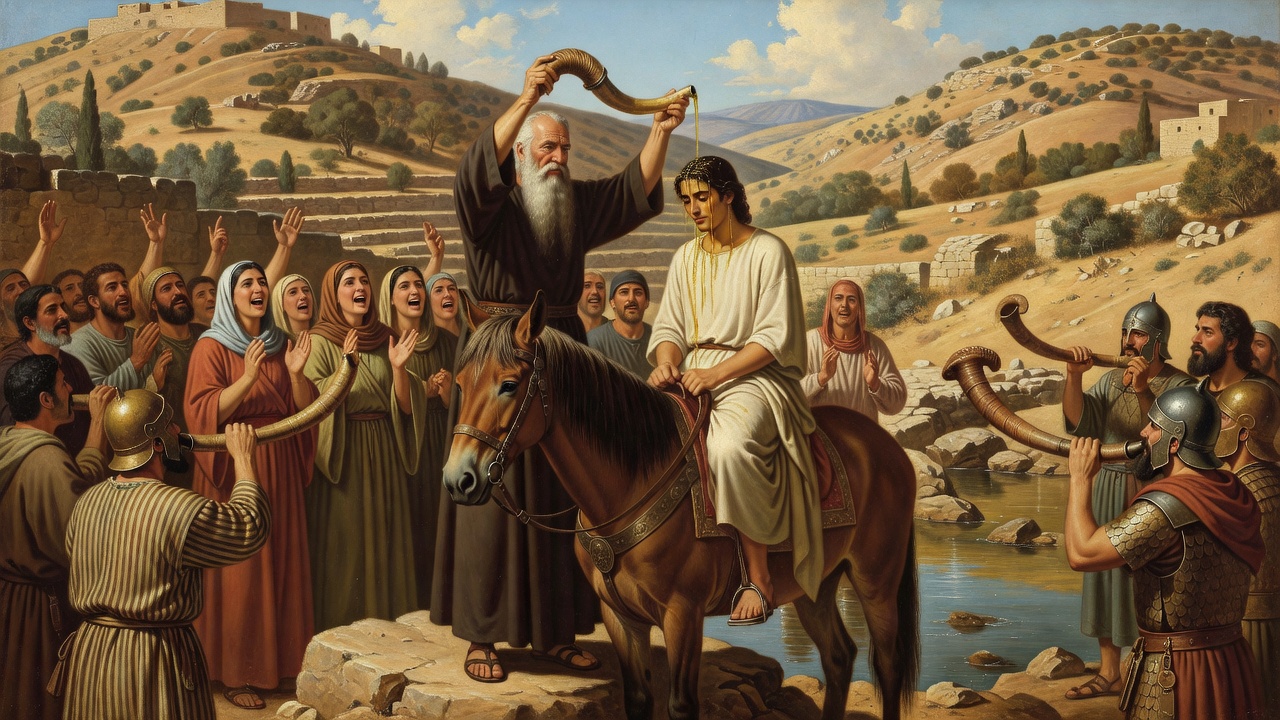
32And King David said, Send for Zadok the priest, and Nathan the prophet, and Benaiah, the son of Jehoiada. And they came before the king. 33And the king said to them, Take with you the servants of your lord, and put Solomon my son on my beast, yes, mine, and take him down to Gihon; 34And there let Zadok the priest and Nathan the prophet put the holy oil on him to make him king over Israel; and sounding the horn say, Long life to King Solomon! 35Then come up after him and he will come in and take his place on the seat of my kingdom; for he is to be king in my place, and I have given orders that he is to be ruler over Israel and over Judah. 36And Benaiah, the son of Jehoiada, answering the king, said, So be it: and may the Lord, the God of my lord the king, say so. 37As the Lord has been with my lord the king, even so may he be with Solomon and make the seat of his authority greater than that of my lord King David. 38So Zadok the priest, and Nathan the prophet, and Benaiah, the son of Jehoiada, and the Cherethites and the Pelethites, went down and put Solomon on King David's beast and took him to Gihon. 39And Zadok the priest took the vessel of oil out of the Tent, and put the holy oil on Solomon. And when the horn was sounded, all the people said, Long life to King Solomon! 40And all the people came up after him, piping with pipes, and they were glad with great joy, so that the earth was shaking with the sound.
Adonijah Learns of Solomon’s Kingship
41And it came to the ears of Adonijah and all the guests who were with him, when their meal was ended. And Joab, hearing the sound of the horn, said, What is the reason of this noise as if the town was worked up? 42And while the words were on his lips, Jonathan, the son of Abiathar the priest, came; and Adonijah said, Come in; for you are a man of good faith and the news which you have for us will be good. 43And Jonathan, answering, said to Adonijah, Not so, but our lord King David has made Solomon king: 44And he sent with him Zadok the priest, and Nathan the prophet, and Benaiah, the son of Jehoiada, and the Cherethites and the Pelethites; and they put him on the king's beast: 45And Zadok the priest and Nathan the prophet put the holy oil on him and made him king in Gihon; and they came back from there with joy, and the town was all worked up. This is the noise which has come to your ears. 46And now Solomon is seated on the seat of the kingdom. 47And the king's servants came to our lord King David, blessing him and saying, May God make the name of Solomon better than your name, and the seat of his authority greater than your seat; and the king was bent low in worship on his bed. 48Then the king said, May the God of Israel be praised, who has given one of my seed to be king in my place this day and has let my eyes see it. 49And all the guests of Adonijah got up in fear and went away, every man to his place. 50And Adonijah himself was full of fear because of Solomon; and he got up and went to the altar, and put his hands on its horns. 51And they gave Solomon word of it, saying, See, Adonijah goes in such fear of King Solomon, that he has put his hands on the horns of the altar, saying, Let King Solomon first give me his oath that he will not put his servant to death with the sword. 52And Solomon said, If he is seen to be a man of good faith, not a hair of him will be touched; but if any wrongdoing is seen in him, he is to be put to death. 53So King Solomon sent, and they took him down from the altar. And he came and gave honour to King Solomon; and Solomon said to him, Go to your house.
Did you know?
The Succession to David's Throne
- As David's oldest surviving son after the deaths of Amnon and Absalom, Adonijah claimed the royal succession, backed by the military commander Joab and the high priest Abiathar. However, David chose his younger son Solomon, who was supported by the prophet Nathan, the priest Zadok, and the royal bodyguard under Benaiah.Sources: Adonijah · Solomon · the Bible text itself
- Riding the king's own mule was a decisive public declaration of royal authority. By David's explicit instruction, Solomon was escorted down to the spring of Gihon, where Zadok anointed him king with oil taken from the tabernacle to the sound of ram's horns and popular celebration.Sources: Gihon · Zadok · the Bible text itself
- Upon hearing of Solomon's public coronation, Adonijah fled in terror and sought asylum by taking hold of the horns of the sacrificial altar. Solomon granted him conditional clemency, sparing his life so long as he proved himself a worthy man.Sources: Adonijah · the Bible text itself
Notes written with AI assistance from open sources (Theographic Bible Metadata, CC BY-SA 4.0; Easton’s Bible Dictionary, public domain) and reviewed before publishing.
Places in this chapter
- Shunem · Today: Sulam · 32.606, 35.334 · verse 3
- Serpent’s Stone · Today: within 100 m of Bir Ayub · 31.767, 35.236 · verse 9
- Gihon · Today: Gihon Spring · 31.773, 35.236 · verses 33, 38, 44, 45
- Jerusalem · 31.777, 35.234 · verse 40
Only places identified with high confidence are shown (90% or more according to the scholarly sources compiled by OpenBible). Period map: DARE (Digital Atlas of the Roman Empire), CC BY 4.0; modern map: © OpenStreetMap contributors; places: OpenBible.info (CC BY 4.0).
Credits and license for this translation
Bible in Basic English
The Bible in Basic English
Public Domain
Language: English
Dialect: simple British
Translation by: Samuel Henry Hooke
The Bible In Basic English was printed in 1965 by Cambridge Press in England. Published without any copyright notice and distributed in America, this work fell immediately and irretrievably into the Public Domain in the United States according to the UCC convention of that time. A call to Cambridge prior to placing this work in etext resulted in an admission of this fact.
2020-04-17
Section headings adapted from the Berean Standard Bible (public domain); they are not part of this translation’s text.
Source: http://ebible.org/engBBE/ · eBible.org