1 Chronicles 4
World English Bible Classic · Tap a verse to see its cross-references.
The Descendants of Judah
1The sons of Judah: Perez, Hezron, Carmi, Hur, and Shobal. 2Reaiah the son of Shobal became the father of Jahath; and Jahath became the father of Ahumai and Lahad. These are the families of the Zorathites. 3These were the sons of the father of Etam: Jezreel, Ishma, and Idbash. The name of their sister was Hazzelelponi. 4Penuel was the father of Gedor and Ezer the father of Hushah. These are the sons of Hur, the firstborn of Ephrathah, the father of Bethlehem. 5Ashhur the father of Tekoa had two wives, Helah and Naarah. 6Naarah bore him Ahuzzam, Hepher, Temeni, and Haahashtari. These were the sons of Naarah. 7The sons of Helah were Zereth, Izhar, and Ethnan. 8Hakkoz became the father of Anub, Zobebah, and the families of Aharhel the son of Harum.
The Prayer of Jabez
9Jabez was more honorable than his brothers. His mother named him Jabez, saying, “Because I bore him with sorrow.”
10Jabez called on the God of Israel, saying, “Oh that you would bless me indeed, and enlarge my border! May your hand be with me, and may you keep me from evil, that I may not cause pain!”
God granted him that which he requested.
More Descendants of Judah
11Chelub the brother of Shuhah became the father of Mehir, who was the father of Eshton. 12Eshton became the father of Beth Rapha, Paseah, and Tehinnah the father of Ir Nahash. These are the men of Recah. 13The sons of Kenaz: Othniel and Seraiah. The sons of Othniel: Hathath. 14Meonothai became the father of Ophrah: and Seraiah became the father of Joab the father of Ge Harashim, for they were craftsmen. 15The sons of Caleb the son of Jephunneh: Iru, Elah, and Naam. The son of Elah: Kenaz. 16The sons of Jehallelel: Ziph, Ziphah, Tiria, and Asarel. 17The sons of Ezrah: Jether, Mered, Epher, and Jalon; and Mered’s wife bore Miriam, Shammai, and Ishbah the father of Eshtemoa. 18His wife the Jewess bore Jered the father of Gedor, Heber the father of Soco, and Jekuthiel the father of Zanoah. These are the sons of Bithiah the daughter of Pharaoh, whom Mered took. 19The sons of the wife of Hodiah, the sister of Naham, were the fathers of Keilah the Garmite and Eshtemoa the Maacathite. 20The sons of Shimon: Amnon, Rinnah, Ben Hanan, and Tilon. The sons of Ishi: Zoheth, and Ben Zoheth. 21The sons of Shelah the son of Judah: Er the father of Lecah, Laadah the father of Mareshah, and the families of the house of those who worked fine linen, of the house of Ashbea; 22and Jokim, and the men of Cozeba, and Joash, and Saraph, who had dominion in Moab, and Jashubilehem. These records are ancient. 23These were the potters, and the inhabitants of Netaim and Gederah; they lived there with the king for his work.
The Descendants of Simeon
24The sons of Simeon: Nemuel, Jamin, Jarib, Zerah, Shaul; 25Shallum his son, Mibsam his son, and Mishma his son. 26The sons of Mishma: Hammuel his son, Zaccur his son, Shimei his son. 27Shimei had sixteen sons and six daughters; but his brothers didn’t have many children, and all their family didn’t multiply like the children of Judah. 28They lived at Beersheba, Moladah, Hazarshual, 29at Bilhah, at Ezem, at Tolad, 30at Bethuel, at Hormah, at Ziklag, 31at Beth Marcaboth, Hazar Susim, at Beth Biri, and at Shaaraim. These were their cities until David’s reign. 32Their villages were Etam, Ain, Rimmon, Tochen, and Ashan, five cities; 33and all their villages that were around the same cities, as far as Baal. These were their settlements, and they kept their genealogy. 34Meshobab, Jamlech, Joshah the son of Amaziah, 35Joel, Jehu the son of Joshibiah, the son of Seraiah, the son of Asiel, 36Elioenai, Jaakobah, Jeshohaiah, Asaiah, Adiel, Jesimiel, Benaiah, 37and Ziza the son of Shiphi, the son of Allon, the son of Jedaiah, the son of Shimri, the son of Shemaiah— 38these mentioned by name were princes in their families. Their fathers’ houses increased greatly.
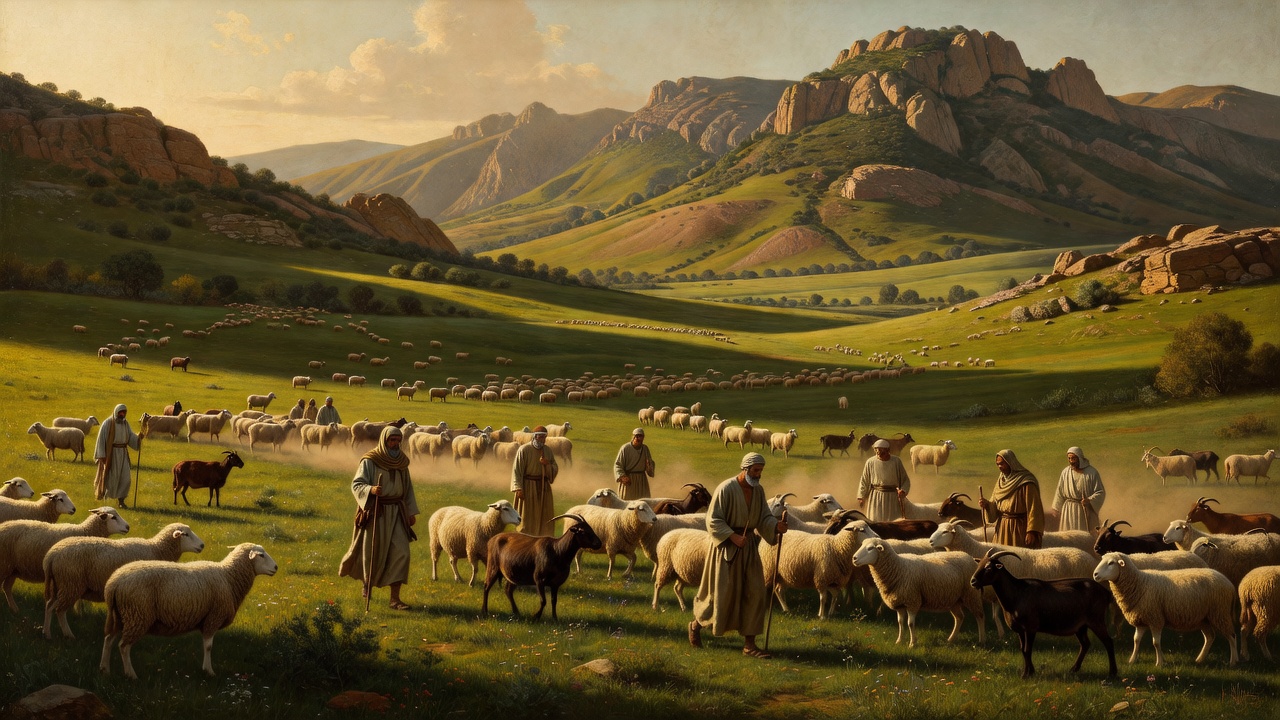
39They went to the entrance of Gedor, even to the east side of the valley, to seek pasture for their flocks. 40They found rich, good pasture, and the land was wide, and quiet, and peaceful, for those who lived there before were descended from Ham. 41These written by name came in the days of Hezekiah king of Judah, and struck their tents and the Meunim who were found there; and they destroyed them utterly to this day, and lived in their place, because there was pasture there for their flocks. 42Some of them, even of the sons of Simeon, five hundred men, went to Mount Seir, having for their captains Pelatiah, Neariah, Rephaiah, and Uzziel, the sons of Ishi. 43They struck the remnant of the Amalekites who escaped, and have lived there to this day.
Did you know?
Genealogies of Judah and Simeon
- The genealogy of Judah briefly pauses to highlight Jabez, whose name was associated with pain at birth. He prayed for God to bless him, enlarge his territory, and keep him from harm, and the biblical record notes that God granted his request.Sources: Jabez · the Bible text itself
- Unlike lists focusing solely on political rulers, this chapter records specific occupational guilds, including the craftsmen of Ge-harashim, linen workers at Beth-ashbea, and potters who resided at Netaim and Gederah in royal service.Sources: Beth-ashbea · Netaim · the Bible text itself
- During the reign of King Hezekiah of Judah, clan leaders from the tribe of Simeon migrated southward in search of fresh pasture for their livestock, establishing settlements in fertile areas near Gedor and Mount Seir.Sources: Simeon · the Bible text itself
Notes written with AI assistance from open sources (Theographic Bible Metadata, CC BY-SA 4.0; Easton’s Bible Dictionary, public domain) and reviewed before publishing.
Places in this chapter
- Bethlehem · 31.704, 35.208 · verse 4
- Tekoa · Today: Khirbet Teku’a · 31.632, 35.210 · verse 5
- Moab · Today: Moab 1 · 31.181, 35.701 · verse 22
Only places identified with high confidence are shown (90% or more according to the scholarly sources compiled by OpenBible). Period map: DARE (Digital Atlas of the Roman Empire), CC BY 4.0; modern map: © OpenStreetMap contributors; places: OpenBible.info (CC BY 4.0).
Credits and license for this translation
The World English Bible
The World English Bible is in the Public Domain. That means that it is not copyrighted. However, "World English Bible" is a Trademark of eBible.org.
You may copy, publish, proclaim, distribute, redistribute, sell, give away, quote, memorize, read publicly, broadcast, transmit, share, back up, post on the Internet, print, reproduce, preach, teach from, and use
the World English Bible as much as you want, and others may also do so. All we ask is that if you CHANGE the actual text of the World English Bible in any way, you not call the result the World English Bible any more.
This is to avoid confusion, not to limit your freedom. The Holy Bible is God's Word. It belongs to God. He gave it to us freely, and we who have worked on this translation freely give it to you by dedicating it to the
Public Domain.
Donations to help with the expenses of this project and thus help others have free access to the Word of God may be made to us, but are not required. Please see
https://MLJohnson.org/partner/ if you are interested in helping to fund this work.
This is the 2020 stable text edition of the World English Bible. The main editing/updating work is done on all books. Although we may
choose to consider corrections of obvious typos or problems in the text, we are done with style updates and modernization of the language used in this
Bible translation, preferring to leave the text stable.
New updates, if any, will be posted on https://eBible.org/web/ and at https://WorldEnglish.Bible .
Section headings adapted from the Berean Standard Bible (public domain); they are not part of this translation’s text.
Source: http://ebible.org/eng-web/ · eBible.org