Deuteronomy 14
World English Bible (Catholic) · Tap a verse to see its cross-references.
Clean and Unclean Animals
1You are the children of the LORD your God. You shall not cut yourselves, nor make any baldness between your eyes for the dead. 2For you are a holy people to the LORD your God, and the LORD has chosen you to be a people for his own possession, above all peoples who are on the face of the earth.
3You shall not eat any abominable thing. 4These are the animals which you may eat: the ox, the sheep, the goat, 5the deer, the gazelle, the roebuck, the wild goat, the ibex, the antelope, and the chamois. 6Every animal that parts the hoof, and has the hoof split in two and chews the cud, among the animals, you may eat. 7Nevertheless these you shall not eat of them that chew the cud, or of those who have the hoof split: the camel, the hare, and the rabbit. Because they chew the cud but don’t part the hoof, they are unclean to you. 8The pig, because it has a split hoof but doesn’t chew the cud, is unclean to you. You shall not eat their meat. You shall not touch their carcasses. 9These you may eat of all that are in the waters: you may eat whatever has fins and scales. 10You shall not eat whatever doesn’t have fins and scales. It is unclean to you. 11Of all clean birds you may eat. 12But these are they of which you shall not eat: the eagle, the vulture, the osprey, 13the red kite, the falcon, the kite of any kind, 14every raven of any kind, 15the ostrich, the owl, the seagull, the hawk of any kind, 16the little owl, the great owl, the horned owl, 17the pelican, the vulture, the cormorant, 18the stork, the heron after its kind, the hoopoe, and the bat. 19All winged creeping things are unclean to you. They shall not be eaten. 20Of all clean birds you may eat.
21You shall not eat of anything that dies of itself. You may give it to the foreigner living among you who is within your gates, that he may eat it; or you may sell it to a foreigner; for you are a holy people to the LORD your God.
You shall not boil a young goat in its mother’s milk.
Giving Tithes
22You shall surely tithe all the increase of your seed, that which comes out of the field year by year. 23You shall eat before the LORD your God, in the place which he chooses to cause his name to dwell, the tithe of your grain, of your new wine, and of your oil, and the firstborn of your herd and of your flock; that you may learn to fear the LORD your God always. 24If the way is too long for you, so that you are not able to carry it because the place which the LORD your God shall choose to set his name there is too far from you, when the LORD your God blesses you, 25then you shall turn it into money, bind up the money in your hand, and shall go to the place which the LORD your God shall choose. 26You shall trade the money for whatever your soul desires: for cattle, or for sheep, or for wine, or for strong drink, or for whatever your soul asks of you. You shall eat there before the LORD your God, and you shall rejoice, you and your household. 27You shall not forsake the Levite who is within your gates, for he has no portion nor inheritance with you. 28At the end of every three years you shall bring all the tithe of your increase in the same year, and shall store it within your gates. 29The Levite, because he has no portion nor inheritance with you, as well as the foreigner living among you, the fatherless, and the widow who are within your gates shall come, and shall eat and be satisfied; that the LORD your God may bless you in all the work of your hand which you do.
Did you know?
Dietary Regulations and Tithe Provisions
- The dietary laws in Deuteronomy 14 distinguish clean from unclean land animals based on two physical criteria: having completely divided hooves and chewing the cud. Aquatic creatures were considered clean for consumption only if they possessed both fins and scales.Sources: the Bible text itself
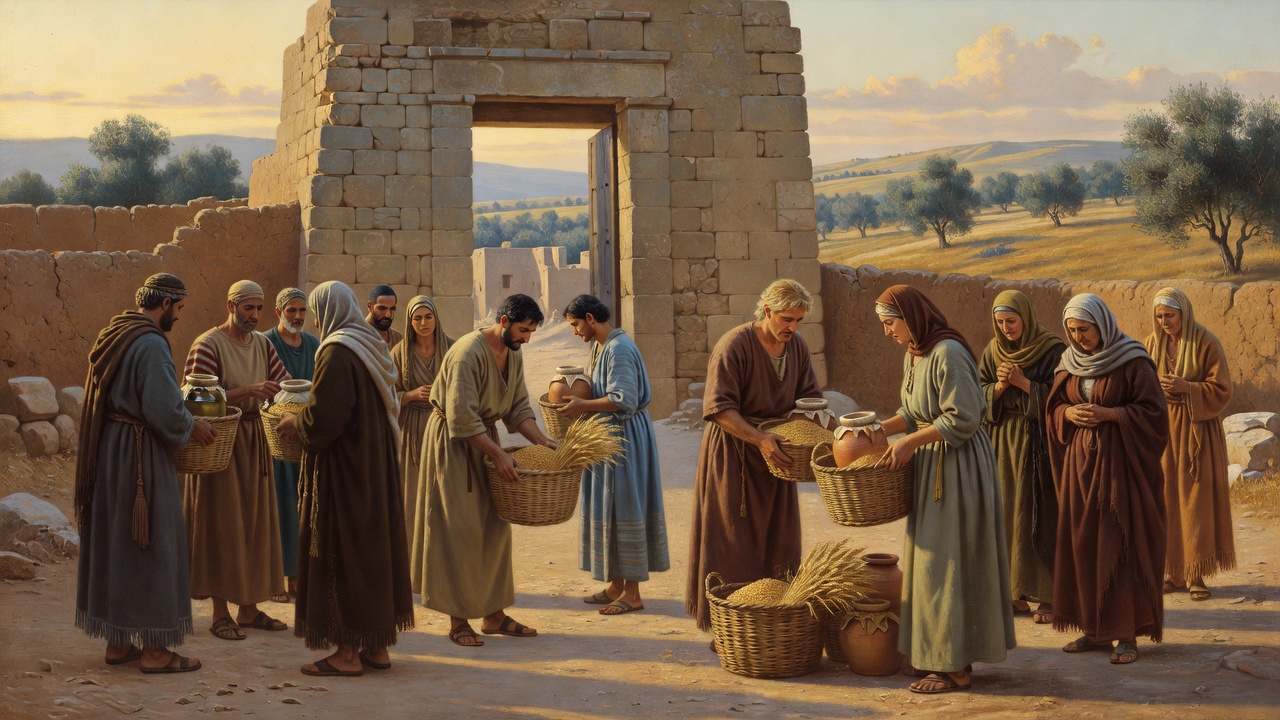
- To accommodate families who lived far from the designated sanctuary, the law allowed agricultural tithes to be converted into silver for travel. Upon arriving at the central sanctuary, worshippers could use the money to purchase festive food and drink to celebrate with their households.Sources: the Bible text itself
- Every third year, the annual tithe was gathered and stored within local towns rather than taken to the central sanctuary. This food was set aside to support community members without land inheritances, specifically Levites, resident foreigners, orphans, and widows.Sources: the Bible text itself
Notes written with AI assistance from open sources (Theographic Bible Metadata, CC BY-SA 4.0; Easton’s Bible Dictionary, public domain) and reviewed before publishing.
Credits and license for this translation
The World English Bible
Catholic Book Order
The World English Bible is in the Public Domain. That means that it is not copyrighted. However, "World English Bible" is a Trademark of eBible.org.
You may copy, publish, proclaim, distribute, redistribute, sell, give away, quote, memorize, read publicly, broadcast, transmit, share, back up, post on the Internet, print, reproduce, preach, teach from, and use
the World English Bible as much as you want, and others may also do so. All we ask is that if you CHANGE the actual text of the World English Bible in any way, you not call the result the World English Bible any more.
This is to avoid confusion, not to limit your freedom. The Holy Bible is God's Word. It belongs to God. He gave it to us freely, and we who have worked on this translation freely give it to you by dedicating it to the
Public Domain.
Donations to help with the expenses of this project and thus help others have free access to the Word of God may be made to us, but are not required. Please see
https://MLJohnson.org/partner/ for more about that.
Although we are done with the editing for language updates, we might choose to consider corrections of obvious typos or problems in the translation.
Any updates will be posted on https://eBible.org/web/ and at https://WorldEnglish.Bible .
2020 stable text edition
Section headings adapted from the Berean Standard Bible (public domain); they are not part of this translation’s text.
Source: http://ebible.org/eng-web-c/ · eBible.org