Psalms 68
LXX2012: Septuagint in British/International English 2012 · Tap a verse to see its cross-references.
(69) For the end, a Psalm of David, for alternate strains.
God’s Enemies Are Scattered
1Save me, O God; for the waters have come in to my soul.
2I am stuck fast in deep mire, and there is no standing: I am come in to the depths of the sea, and a storm has overwhelmed me.
3I am weary of crying, my throat has become hoarse; my eyes have failed by my waiting on my God.
4They that hate me without a cause are more than the hairs of my head: my enemies that persecute me unrighteously are strengthened: then I restored that which I took not away.
5O God, you know my foolishness; and my transgressions are not hidden from you.
6Let not them that wait on you, O Lord of hosts, be ashamed on my account: let not them that seek you, be ashamed on my account, O God of Israel.
7For I have suffered reproach for your sake; shame has covered my face.
8I became strange to my brethren, and a stranger to my mother's children.
9For the zeal of your house has eaten me up; and the reproaches of them that reproached you are fallen upon me.
10And I bowed down my soul with fasting, and that was made my reproach.
11And I put on sackcloth for my covering; and I became a proverb to them.
12They that sit in the gate talked against me, and they that drank wine sang against me.
13But I will cry to you, O Lord, in my prayer; O God, it is a propitious time: in the multitude of your mercy hear me, in the truth of your salvation.
14Save me from the mire, that I stick not in it: let me be delivered from them that hate me, and from the deep waters.
15Let not the waterflood drown me, nor let the deep swallow me up; neither let the well shut its mouth upon me.
16Hear me, O Lord; for your mercy is good: according to the multitude of your compassions look upon me.
17And turn not away your face from your servant; for I am afflicted: hear me speedily.
18Draw near to my soul and redeem it: deliver me because of my enemies.
19For you know my reproach, and my shame, and my confusion; all that afflict me are before you.
20My soul has waited for reproach and misery; and I waited for one to grieve with me, but there was none; and for one to comfort me, but I found none.
21They gave me also gall for my food, and made me drink vinegar for my thirst.
22Let their table before them be for a snare, and for a recompense, and for a stumbling block.
23Let their eyes be darkened that they should not see; and bow down their back continually.
24Pour out your wrath upon them, and let the fury of your anger take hold on them.
25Let their habitation be made desolate; and let there be no inhabitant in their tents:
26Because they persecuted him whom you have struck; and they have added to the grief of my wounds.
27Add iniquity to their iniquity; and let them not come into your righteousness.
28Let them be blotted out of the book of the living, and let them not be written with the righteous.
29I am poor and sorrowful; but the salvation of your countenance has helped me.
30I will praise the name of my God with a song, I will magnify him with praise;
31and this shall please God more than a young calf having horns and hoofs.
32Let the poor see and rejoice; seek the Lord diligently, and you⌃ shall live.
33For the Lord hears the poor, and does not set at nothing his fettered ones.
34Let the heavens and the earth raise him, the sea, and all things moving in them.
35For God will save Sion, and the cities of Judea shall be built; and men shall dwell there, and inherit it.
36And the seed of his servants shall possess it, and they that love his name shall dwell therein.
Did you know?
The Victorious God of Israel
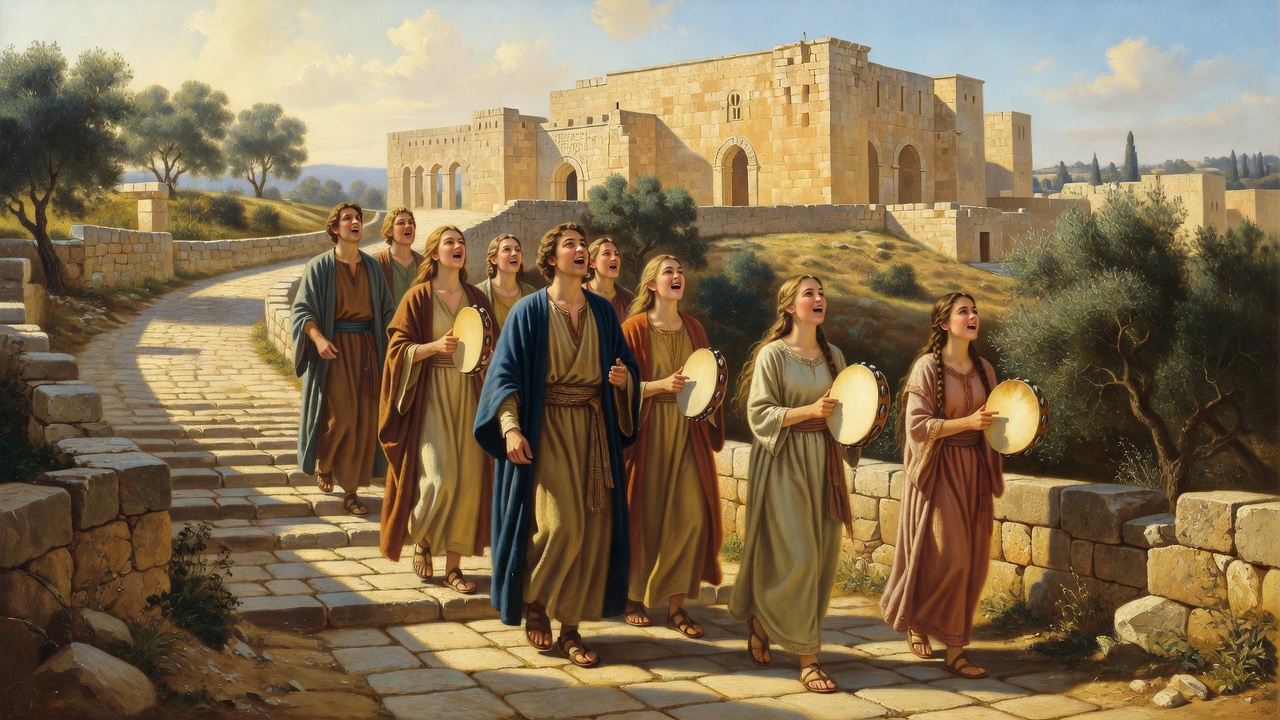
- The psalm describes a grand festival procession into the sanctuary led by singers, musicians, and young women playing tambourines. Representatives from both southern tribes, like little Benjamin and Judah, and northern tribes, like Zebulun and Naphtali, unite in the celebration.Sources: the Bible text itself · Benjamin (patriarch) · Zebulun · Naphtali
- The text contrasts the majestic, many-peaked mountain of Bashan with the mountain God chose for His dwelling in Jerusalem. It also compares the scattering of defeated kings across the land to snow falling on Zalmon, a wooded mountain near Shechem.Sources: the Bible text itself · Bashan · Zalmon · Jerusalem
- Beyond Israel, the psalm foresees foreign nations submitting and bringing gifts to Jerusalem. It explicitly mentions envoys arriving from Egypt and the southern land of Cush reaching out their hands to God.Sources: the Bible text itself · Egypt · Cush · Jerusalem
Notes written with AI assistance from open sources (Theographic Bible Metadata, CC BY-SA 4.0; Easton’s Bible Dictionary, public domain) and reviewed before publishing.
Places in this chapter
- Egypt · 30.129, 31.308 · verses 7, 31
- Mount Bashan · Today: Jebel Druze · 32.667, 36.733 · verse 15
- Mount Zion · 31.772, 35.229 · verse 16
- Holy Place · Today: on Mount Moriah · 31.778, 35.236 · verse 17
- Bashan · 32.781, 35.935 · verse 22
- Jerusalem · 31.777, 35.234 · verse 29
- Cush · Today: Cush 1 · 16.935, 33.751 · verse 31
Only places identified with high confidence are shown (90% or more according to the scholarly sources compiled by OpenBible). Period map: DARE (Digital Atlas of the Roman Empire), CC BY 4.0; modern map: © OpenStreetMap contributors; places: OpenBible.info (CC BY 4.0).
Credits and license for this translation
LXX2012: Septuagint in British/International English 2012
The Septuagint with Apocrypha, translated from Greek to English by Sir Lancelot C. L. Brenton and published in 1885, with some language updates (British/International English)
Public Domain
Language: English
Dialect (if applicable): British
Language in English: English
Translation by: Sir Lancelot Charles Lee Breton
LXX2012: Septuagint in English 2012, British/International English Edition
This is a translation of the Old Testament and Apocrypha/Deuterocanon from Hebrew to Greek to 19th Century British English, with some updates of spelling and word usage to contemporary British/International English. The original English translation was done by Sir Lancelot Charles Lee Brenton and published by Samuel Bagster & Sons, Ltd., in London in 1851. It has entered the Public Domain due to the passage of sufficient time. In the process of scanning and typing the text, the original poetry and prose formatting, as well as peripheral material like introductions and notes, have been omitted.
This edition of the Septuagint has some language updates. Brenton's word order and punctuation has been mostly retained, meaning that quotation marks are not used, and sentences within quotes may not start with capital letters, as was standard usage in 1851. Names transliterated from Greek to those transliterated from Hebrew in the common English Bibles often differ. These language updates are dedicated to the Public Domain by the author of those edits, Michael Paul Johnson. Therefore this edition may be freely copied, published, etc.
Before considering making changes to the text of this work, I recommend that you consult with God, because this is really His Book.
If you find errors in the text, please report them so that we can correct them.
Donations to help with the expenses of operating this web site and thus help others have free access to the Word of God may be made to us, but are not required. Please see http://MLJohnson.org/partner/ for more about that.
Section headings adapted from the Berean Standard Bible (public domain); they are not part of this translation’s text.
Source: http://ebible.org/eng-uk-lxx2012/ · eBible.org