Psalms 66
LXX2012: Septuagint in British/International English 2012 · Tap a verse to see its cross-references.
(67) For the end, a Psalm of David amongst the Hymns.
Make a Joyful Noise
1God be merciful to us, and bless us; and cause his face to shine upon us. Pause.
2That men may know your way on the earth, your salvation amongst all nations.
3Let the nations, O God, give thanks to you; let all the nations give thanks to you.
4Let the nations rejoice and exult, for you shall judge the peoples in equity, and shall guide the nations on the earth. Pause.
5Let the peoples, O God, give thanks to you; let all the peoples give thanks to you.
6The earth has yielded her fruit; let God, our God bless us.
7Let God bless us; and let all the ends of the earth fear him.
Did you know?
Praise for Deliverance and Fulfilled Vows
- Psalm 66 transitions from corporate praise celebrating Israel's historical deliverance, such as passing through the sea on dry land, to a personal testimony of answered prayer and gratitude.Sources: the Bible text itself
- The psalm uses the imagery of refining silver alongside experiences of nets, heavy burdens, fire, and water to describe how testing ultimately led the community into a place of abundance.Sources: the Bible text itself
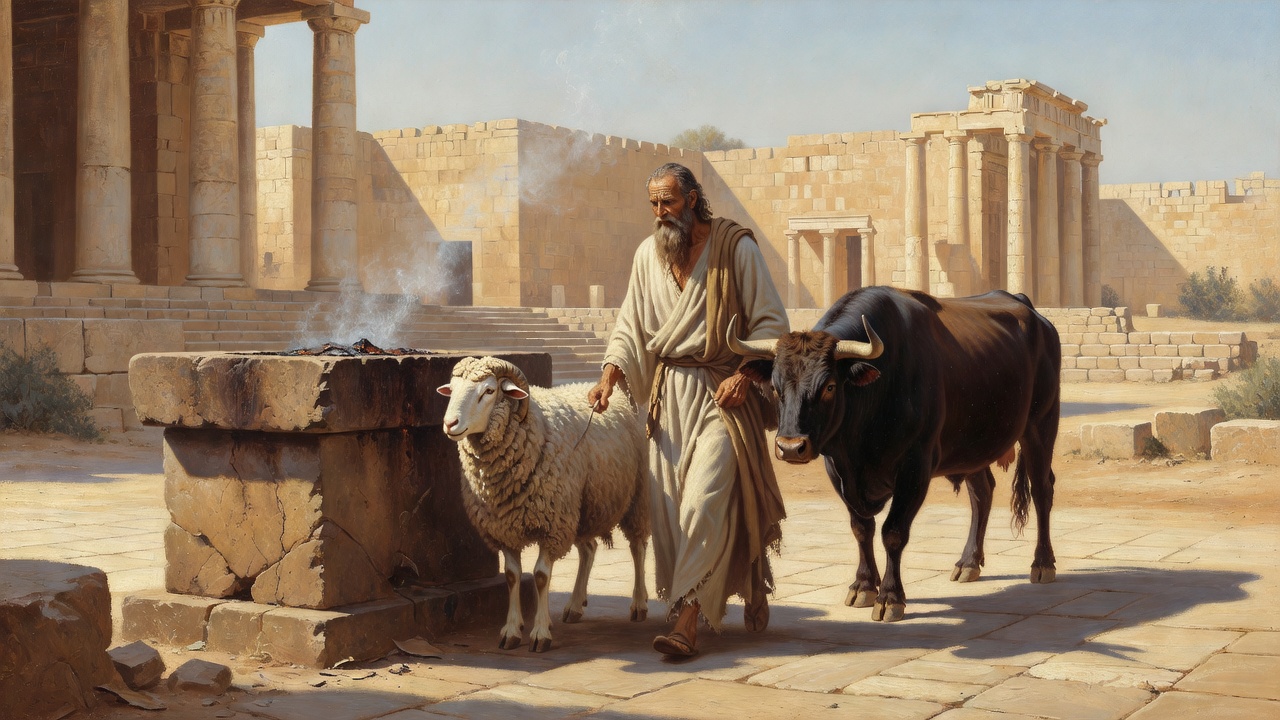
- In ancient Israelite worship, individuals frequently made solemn vows to God during times of distress, promising specific animal sacrifices, such as rams, bulls, and goats, once deliverance was granted.Sources: the Bible text itself
Notes written with AI assistance from open sources (Theographic Bible Metadata, CC BY-SA 4.0; Easton’s Bible Dictionary, public domain) and reviewed before publishing.
Credits and license for this translation
LXX2012: Septuagint in British/International English 2012
The Septuagint with Apocrypha, translated from Greek to English by Sir Lancelot C. L. Brenton and published in 1885, with some language updates (British/International English)
Public Domain
Language: English
Dialect (if applicable): British
Language in English: English
Translation by: Sir Lancelot Charles Lee Breton
LXX2012: Septuagint in English 2012, British/International English Edition
This is a translation of the Old Testament and Apocrypha/Deuterocanon from Hebrew to Greek to 19th Century British English, with some updates of spelling and word usage to contemporary British/International English. The original English translation was done by Sir Lancelot Charles Lee Brenton and published by Samuel Bagster & Sons, Ltd., in London in 1851. It has entered the Public Domain due to the passage of sufficient time. In the process of scanning and typing the text, the original poetry and prose formatting, as well as peripheral material like introductions and notes, have been omitted.
This edition of the Septuagint has some language updates. Brenton's word order and punctuation has been mostly retained, meaning that quotation marks are not used, and sentences within quotes may not start with capital letters, as was standard usage in 1851. Names transliterated from Greek to those transliterated from Hebrew in the common English Bibles often differ. These language updates are dedicated to the Public Domain by the author of those edits, Michael Paul Johnson. Therefore this edition may be freely copied, published, etc.
Before considering making changes to the text of this work, I recommend that you consult with God, because this is really His Book.
If you find errors in the text, please report them so that we can correct them.
Donations to help with the expenses of operating this web site and thus help others have free access to the Word of God may be made to us, but are not required. Please see http://MLJohnson.org/partner/ for more about that.
Section headings adapted from the Berean Standard Bible (public domain); they are not part of this translation’s text.
Source: http://ebible.org/eng-uk-lxx2012/ · eBible.org