Psalms 48
LXX2012: Septuagint in British/International English 2012 · Tap a verse to see its cross-references.
(49) For the end, a Psalm for the sons of Core.
Broken Bondage
1Hear these words, all you⌃ nations, listen, all you⌃ that dwell upon the earth:
2both the sons of mean men, and sons of great men; the rich and poor man together.
3My mouth shall speak of wisdom; and the meditation of my heart shall bring forth understanding.
4I will incline my ear to a parable: I will open my riddle on the harp.
5Therefore should I fear in the evil day? the iniquity of my heel shall compass me.
6They that trust in their strength, and boast themselves in the multitude of their wealth—
7A brother does not redeem, shall a man redeem? he shall not give to God a ransom for himself,
8or the price of the redemption of his soul, though he labour for ever,
9and live to the end, so that he should not see corruption.
10When he shall see wise men dying, the fool and the senseless one shall perish together; and they shall leave their wealth to strangers.
11And their sepulchres are their houses for ever, even their tabernacles to all generations: they have called their lands after their own names.
12And man being in honour, understands not: he is compared to the senseless cattle, and is like to them.
13This their way is an offence to them: yet afterwards men will commend their sayings. Pause.
14They have laid them as sheep in Hades; death shall feed on them; and the upright shall have dominion over them in the morning, and their help shall fail in Hades from their glory.
15But God shall deliver my soul from the power of Hades, when he shall receive me. Pause.
16Fear not when a man is enriched, and when the glory of his house is increased.
17For he shall take nothing when he dies; neither shall his glory descend with him.
18For his soul shall be blessed in his life: he shall give thanks to you when you do well to him.
19Yet he shall go in to the generation of his fathers; he shall never see light.
20Man that is in honour, understands not: he is compared to the senseless cattle, and is like them.
Did you know?
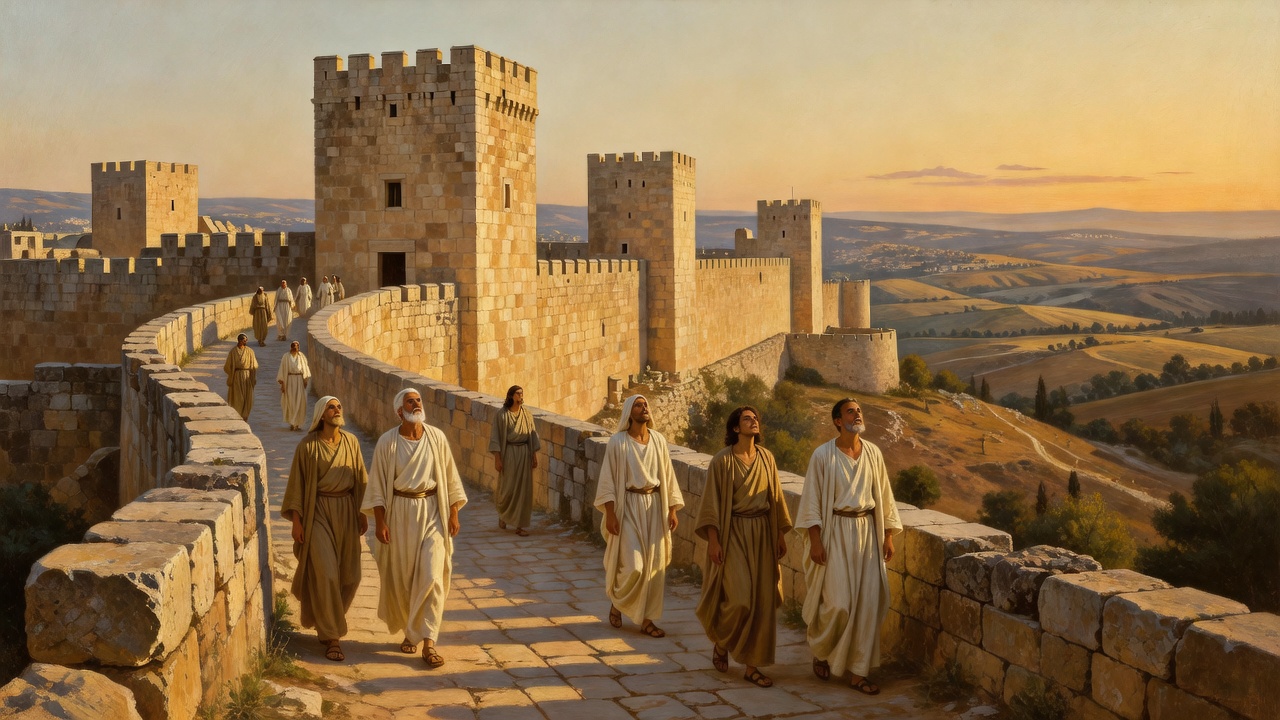
Zion, the City of the Great King
- Mount Zion, originally the fortified southeastern hill of Jerusalem captured by David from the Jebusites, became known as the City of David and the site of his citadel. In Psalm 48, it is celebrated as God's holy mountain, elevated and fortified against advancing enemy kings.Sources: the Bible text itself · Mount Zion · Zion
- The psalm depicts God's power shattering enemy forces like an east wind wrecking the ships of Tarshish. Many scholars identify Tarshish with a distant Phoenician trading port in southwestern Spain, while other ancient traditions proposed locations such as Carthage or ports in the east.Sources: the Bible text itself · Tarshish
- Worshippers are invited to walk around the perimeter of Zion to inspect its ramparts, count its towers, and view its citadels. This survey of the city's defenses was meant to be recounted to future generations as a witness of God's steadfast protection.Sources: the Bible text itself
Notes written with AI assistance from open sources (Theographic Bible Metadata, CC BY-SA 4.0; Easton’s Bible Dictionary, public domain) and reviewed before publishing.
Places in this chapter
- Mount Zion · 31.772, 35.229 · verses 2, 11
- Zaphon · Today: Jebel Aqra · 35.953, 35.969 · verse 2
- Jerusalem · 31.777, 35.234 · verse 3
- Zion · Today: Jerusalem · 31.777, 35.234 · verse 12
Only places identified with high confidence are shown (90% or more according to the scholarly sources compiled by OpenBible). Period map: DARE (Digital Atlas of the Roman Empire), CC BY 4.0; modern map: © OpenStreetMap contributors; places: OpenBible.info (CC BY 4.0).
Credits and license for this translation
LXX2012: Septuagint in British/International English 2012
The Septuagint with Apocrypha, translated from Greek to English by Sir Lancelot C. L. Brenton and published in 1885, with some language updates (British/International English)
Public Domain
Language: English
Dialect (if applicable): British
Language in English: English
Translation by: Sir Lancelot Charles Lee Breton
LXX2012: Septuagint in English 2012, British/International English Edition
This is a translation of the Old Testament and Apocrypha/Deuterocanon from Hebrew to Greek to 19th Century British English, with some updates of spelling and word usage to contemporary British/International English. The original English translation was done by Sir Lancelot Charles Lee Brenton and published by Samuel Bagster & Sons, Ltd., in London in 1851. It has entered the Public Domain due to the passage of sufficient time. In the process of scanning and typing the text, the original poetry and prose formatting, as well as peripheral material like introductions and notes, have been omitted.
This edition of the Septuagint has some language updates. Brenton's word order and punctuation has been mostly retained, meaning that quotation marks are not used, and sentences within quotes may not start with capital letters, as was standard usage in 1851. Names transliterated from Greek to those transliterated from Hebrew in the common English Bibles often differ. These language updates are dedicated to the Public Domain by the author of those edits, Michael Paul Johnson. Therefore this edition may be freely copied, published, etc.
Before considering making changes to the text of this work, I recommend that you consult with God, because this is really His Book.
If you find errors in the text, please report them so that we can correct them.
Donations to help with the expenses of operating this web site and thus help others have free access to the Word of God may be made to us, but are not required. Please see http://MLJohnson.org/partner/ for more about that.
Section headings adapted from the Berean Standard Bible (public domain); they are not part of this translation’s text.
Source: http://ebible.org/eng-uk-lxx2012/ · eBible.org