Proverbs 27
LXX2012: Septuagint in British/International English 2012 · Tap a verse to see its cross-references.
Do Not Boast about Tomorrow
1Boast not of to-morrow; for you know not what the next day shall bring forth. 2Let your neighbour, and not your own mouth, praise you; a stranger, and not your own lips. 3A stone is heavy, and sand cumbersome; but a fool's wrath is heavier than both. 4Wrath is merciless, and anger sharp: but envy can bear nothing. 5Open reproofs are better than secret love. 6The wounds of a friend are more to be trusted than the spontaneous kisses of an enemy. 7A full soul scorns honeycombs; but to a hungry soul even bitter things appear sweet. 8As when a bird flies down from its own nest, so a man is brought into bondage whenever he estranges himself from his own place. 9The heart delights in ointments and wines and perfumes: but the soul is broken by calamities. 10Your own friend, and your father's friend, forsake not; and when you are in distress go not into your brother's house: better is a friend that is near than a brother living far off. 11Son, be wise, that your heart may rejoice; and remove you from yourself reproachful words. 12A wise man, when evils are approaching, hides himself; but fools pass on, and will be punished. 13Take away the man's garment, (for a scorner has passed by) whoever lays waste another's goods. 14Whosoever shall bless a friend in the morning with a loud voice, shall seem to differ nothing from one who curses him. 15On a stormy day drops of rain drive a man out of his house; so also does a railing woman drive a man out of his own house. 16The north wind is sharp, but it is called by name propitious. 17Iron sharpens iron; and a man sharpens his friend's countenance. 18He that plants a fig tree shall eat the fruits of it: so he that waits on his own master shall be honoured. 19As faces are not like other faces, so neither are the thoughts of men. 20Hell and destruction are not filled; so also are the eyes of men insatiable. He that fixes his eye is an abomination to the Lord; and the uninstructed do not restrain their tongue. 21Fire is the trial for silver and gold; and a man is tried by the mouth of them that praise him. The heart of the transgressor seeks after mischiefs; but an upright heart seeks knowledge. 22Though you scourge a fool, disgracing him in the midst of the council, you will still in no wise remove his folly from him. 23Do you thoroughly know the number of your flock, and pay attention to your herds. 24For a man has not strength and power for ever; neither does he transmit it from generation to generation. 25Take care of the herbage in the field, and you shall cut grass, and gather the mountain hay; 26that you may have wool of sheep for clothing: pay attention to the land, that you may have lambs. 27My son, you have from me words very useful for your life, and for the life of your servants.
Did you know?
Friendship, Prudence, and Daily Diligence
- Proverbs 27 places a strong emphasis on authentic relationships, contrasting the deceitful kisses of an enemy with the faithful wounds of a friend. It famously describes constructive interpersonal interaction with the metaphor of iron sharpening iron, while also advising reliance on a nearby neighbor over a distant relative in times of crisis.Sources: the Bible text itself
- The chapter draws on practical illustrations from ancient daily crafts and domestic life, such as refining silver and gold in a crucible and furnace, grinding grain with a mortar and pestle, and observing one's reflection in water.Sources: the Bible text itself
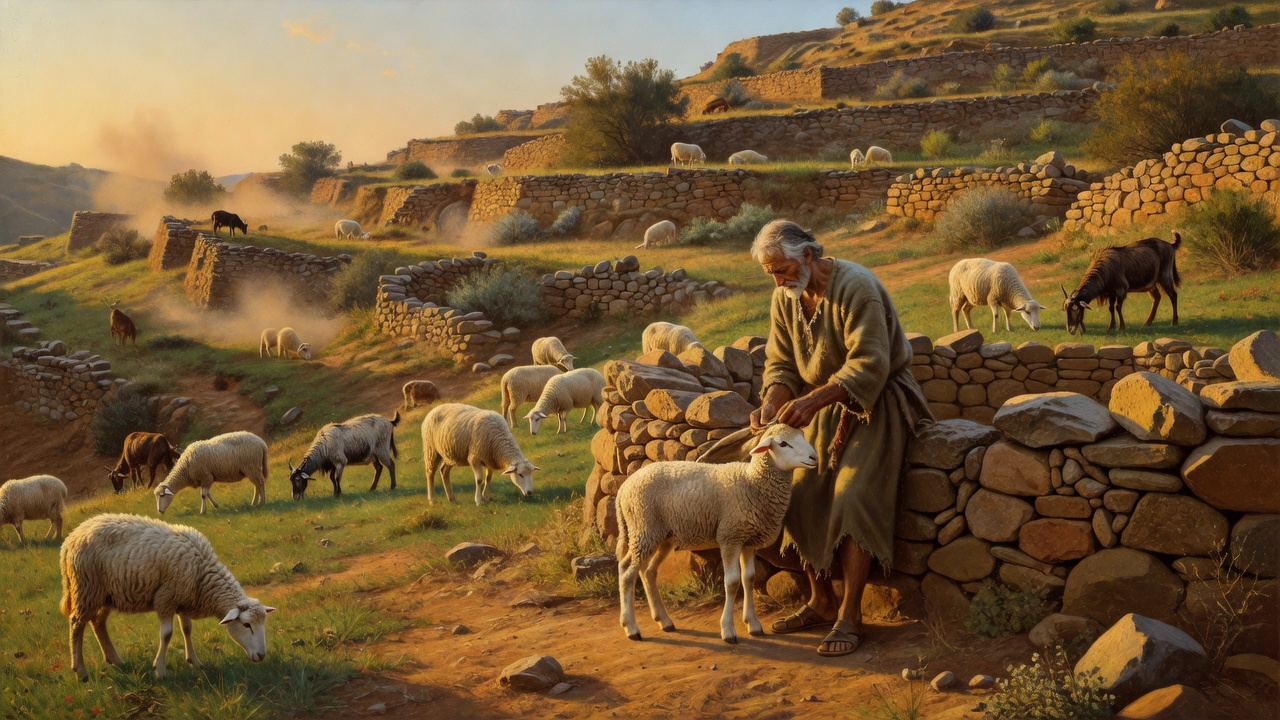
- The closing section outlines the seasonal realities of an agrarian and pastoral economy. It urges careful oversight of flocks and herds, noting that wealth and political crowns are fleeting, while diligent care of livestock and land reliably provides food, goat milk, and wool for the household.Sources: the Bible text itself
Notes written with AI assistance from open sources (Theographic Bible Metadata, CC BY-SA 4.0; Easton’s Bible Dictionary, public domain) and reviewed before publishing.
Credits and license for this translation
LXX2012: Septuagint in British/International English 2012
The Septuagint with Apocrypha, translated from Greek to English by Sir Lancelot C. L. Brenton and published in 1885, with some language updates (British/International English)
Public Domain
Language: English
Dialect (if applicable): British
Language in English: English
Translation by: Sir Lancelot Charles Lee Breton
LXX2012: Septuagint in English 2012, British/International English Edition
This is a translation of the Old Testament and Apocrypha/Deuterocanon from Hebrew to Greek to 19th Century British English, with some updates of spelling and word usage to contemporary British/International English. The original English translation was done by Sir Lancelot Charles Lee Brenton and published by Samuel Bagster & Sons, Ltd., in London in 1851. It has entered the Public Domain due to the passage of sufficient time. In the process of scanning and typing the text, the original poetry and prose formatting, as well as peripheral material like introductions and notes, have been omitted.
This edition of the Septuagint has some language updates. Brenton's word order and punctuation has been mostly retained, meaning that quotation marks are not used, and sentences within quotes may not start with capital letters, as was standard usage in 1851. Names transliterated from Greek to those transliterated from Hebrew in the common English Bibles often differ. These language updates are dedicated to the Public Domain by the author of those edits, Michael Paul Johnson. Therefore this edition may be freely copied, published, etc.
Before considering making changes to the text of this work, I recommend that you consult with God, because this is really His Book.
If you find errors in the text, please report them so that we can correct them.
Donations to help with the expenses of operating this web site and thus help others have free access to the Word of God may be made to us, but are not required. Please see http://MLJohnson.org/partner/ for more about that.
Section headings adapted from the Berean Standard Bible (public domain); they are not part of this translation’s text.
Source: http://ebible.org/eng-uk-lxx2012/ · eBible.org