Leviticus 2
LXX2012: Septuagint in British/International English 2012 · Tap a verse to see its cross-references.
Laws for Grain Offerings
1And if a soul bring a gift, a sacrifice to the Lord, his gift shall be fine flour; and he shall pour oil upon it, and shall put frankincense on it: it is a sacrifice. 2And he shall bring it to the priests the sons of Aaron: and having taken from it a handful of the fine flour with the oil, and all its frankincense, then the priest shall put the memorial of it on the altar: it is a sacrifice, an odour of sweet savour to the Lord. 3And the remainder of the sacrifice shall be for Aaron and his sons, a most holy portion from the sacrifices of the Lord. 4And if he bring as a gift a sacrifice baked from the oven, a gift to the Lord of fine flour, he shall bring unleavened bread kneaded with oil, and unleavened cakes anointed with oil. 5And if your gift be a sacrifice from a pan, it is fine flour mingled with oil, unleavened offerings. 6And you shall break them into fragments and pour oil upon them: it is a sacrifice to the Lord. 7And if your gift be a sacrifice from the hearth, it shall be made of fine flour with oil. 8And he shall offer the sacrifice which he shall make of these to the Lord, and shall bring it to the priest. 9And the priest shall approach the altar, and shall take away from the sacrifice a memorial of it, and the priest shall place it on the altar: a burnt offering, a smell of sweet savour to the Lord. 10And that which is left of the sacrifice shall be for Aaron and his sons, most holy from the burnt offerings of the Lord. 11You⌃ shall not leaven any sacrifice which you⌃ shall bring to the Lord; for as to any leaven, or any honey, you⌃ shall not bring of it to offer a gift to the Lord. 12You⌃ shall bring them in the way of fruits to the Lord, but they shall not be offered on the altar for a sweet smelling savour to the Lord. 13And every gift of your sacrifice shall be seasoned with salt; omit not the salt of the covenant of the Lord from your sacrifices: on every gift of yours you⌃ shall offer salt to the Lord your God. 14And if you would offer a sacrifice of first fruits to the Lord, it shall be new grains ground and roasted for the Lord; so shall you bring the sacrifice of the first fruits. 15And you shall pour oil upon it, and shall put frankincense on it: it is a sacrifice. 16And the priest shall offer the memorial of it taken from the grains with the oil, and all its frankincense: it is a burnt offering to the Lord.
Did you know?
Regulations for the Grain Offering
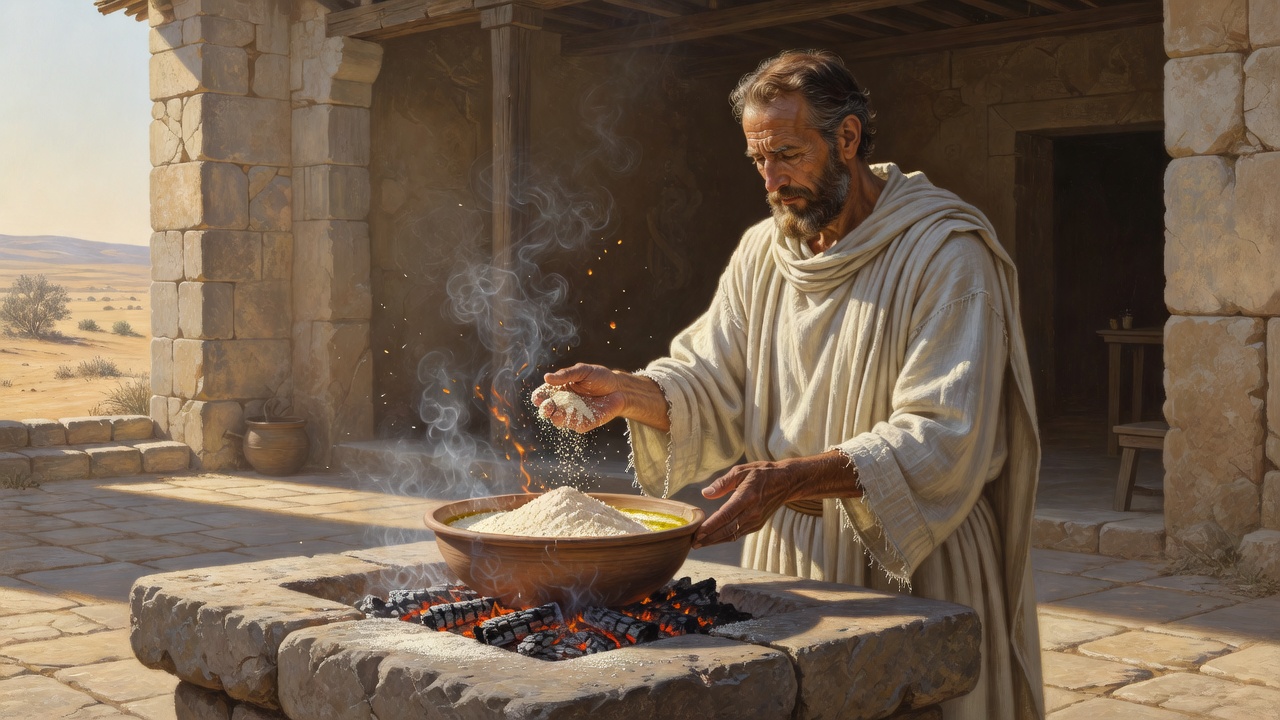
- The grain offering could be brought in various forms, including uncooked fine flour, bread baked in an oven, cakes prepared on a griddle or pan, or crushed heads of fresh grain roasted over fire. In each case, it was accompanied by olive oil.Sources: the Bible text itself
- Only a handful of the grain offering, called the memorial portion, along with all of its frankincense, was burned on the altar. The rest was designated as a most holy portion set aside for Aaron and his sons.Sources: the Bible text itself · Aaron
- The law strictly forbade leaven and honey in any offering burned on the altar, but it required every grain offering to be seasoned with the salt of the covenant.Sources: the Bible text itself
Notes written with AI assistance from open sources (Theographic Bible Metadata, CC BY-SA 4.0; Easton’s Bible Dictionary, public domain) and reviewed before publishing.
Credits and license for this translation
LXX2012: Septuagint in British/International English 2012
The Septuagint with Apocrypha, translated from Greek to English by Sir Lancelot C. L. Brenton and published in 1885, with some language updates (British/International English)
Public Domain
Language: English
Dialect (if applicable): British
Language in English: English
Translation by: Sir Lancelot Charles Lee Breton
LXX2012: Septuagint in English 2012, British/International English Edition
This is a translation of the Old Testament and Apocrypha/Deuterocanon from Hebrew to Greek to 19th Century British English, with some updates of spelling and word usage to contemporary British/International English. The original English translation was done by Sir Lancelot Charles Lee Brenton and published by Samuel Bagster & Sons, Ltd., in London in 1851. It has entered the Public Domain due to the passage of sufficient time. In the process of scanning and typing the text, the original poetry and prose formatting, as well as peripheral material like introductions and notes, have been omitted.
This edition of the Septuagint has some language updates. Brenton's word order and punctuation has been mostly retained, meaning that quotation marks are not used, and sentences within quotes may not start with capital letters, as was standard usage in 1851. Names transliterated from Greek to those transliterated from Hebrew in the common English Bibles often differ. These language updates are dedicated to the Public Domain by the author of those edits, Michael Paul Johnson. Therefore this edition may be freely copied, published, etc.
Before considering making changes to the text of this work, I recommend that you consult with God, because this is really His Book.
If you find errors in the text, please report them so that we can correct them.
Donations to help with the expenses of operating this web site and thus help others have free access to the Word of God may be made to us, but are not required. Please see http://MLJohnson.org/partner/ for more about that.
Section headings adapted from the Berean Standard Bible (public domain); they are not part of this translation’s text.
Source: http://ebible.org/eng-uk-lxx2012/ · eBible.org