Lamentations 4
LXX2012: Septuagint in British/International English 2012 · Tap a verse to see its cross-references.
The Distress of Zion
1ALEPH. How will the gold be tarnished, and the fine silver changed! the sacred stones have been poured forth at the top of all the streets. 2BETH. The precious sons of Zion, who were equalled in value with gold, how are they counted as earthen vessels, the works of the hands of the potter! 3GIMEL. Nay, serpents have drawn out the breasts, they give suck to their young, the daughters of my people are incurably cruel, as an ostrich in a desert. 4DALETH. The tongue of the sucking child cleaves to the roof of its mouth for thirst: the little children ask for bread, and there is none to break it to them. 5HE. They that feed on dainties are desolate in the streets: they that used to be nursed in scarlet have clothed themselves with dung. 6VAU. And the iniquity of the daughter of my people has been increased beyond the iniquities of Sodoma, the city that was overthrown very suddenly, and none laboured against her with their hands. 7ZAIN. Her Nazarites were made purer than snow, they were whiter than milk, they were purified as with fire, their polishing was superior to sapphire stone. 8HETH. Their countenance is become blacker than smoke; they are not known in the streets: their skin has cleaved to their bones; they are withered, they are become as a stick. 9TETH. The slain with the sword were better than they that were slain with hunger: they have departed, pierced through from lack of the fruits of the field. 10JOD. The hands of tender-hearted women have sodden their own children: they became meat for them in the destruction of the daughter of my people. 11CHAPH. The Lord has accomplished his wrath; he has poured out fierce anger, and has kindled a fire in Sion, and it has devoured her foundations. 12LAMED. The kings of the earth, even all that dwell in the world, believed not that an enemy and oppressor would enter through the gates of Jerusalem. 13MEM. For the sins of her prophets, and iniquities of her priests, who shed righteous blood in the midst of her, 14NUN. her watchmen staggered in the streets, they were defiled with blood in their weakness, they touched their raiment with it. 15SAMECH. Depart you⌃ from the unclean ones: call you⌃ them: depart, depart, touch them not: for they are on fire, yes, they stagger: say you⌃ amongst the nations, They shall no more sojourn there. 16AIN. The presence of the Lord was their portion; but he will not again look upon them: they regarded not the person of the priests, they pitied not the prophets. 17PHE. While we yet lived our eyes failed, while we looked in vain for our help. TSADE. We looked to a nation that could not save. 18We have hunted for our little ones, that they should not walk in our streets. KOPH. Our time has drawn near, our days are fulfilled, our time is come. 19Our pursuers were swifter than the eagles of the sky, they flew on the mountains, in the wilderness they laid wait for us. 20RECHS. The breath of our nostrils, our anointed Lord, was taken in their destructive snares, of whom we said, In his shadow we shall live amongst the Gentiles. 21CHSEN. Rejoice and be glad, O daughter of Idumea, that dwell in the land: yet the cup of the Lord shall pass through to you: you shall be drunken, and pour forth. 22THAU. O daughter of Sion, your iniquity has come to an end; he shall no more carry you captive: he has visited your iniquities, O daughter of Edom; he has revealed your sins.
Did you know?
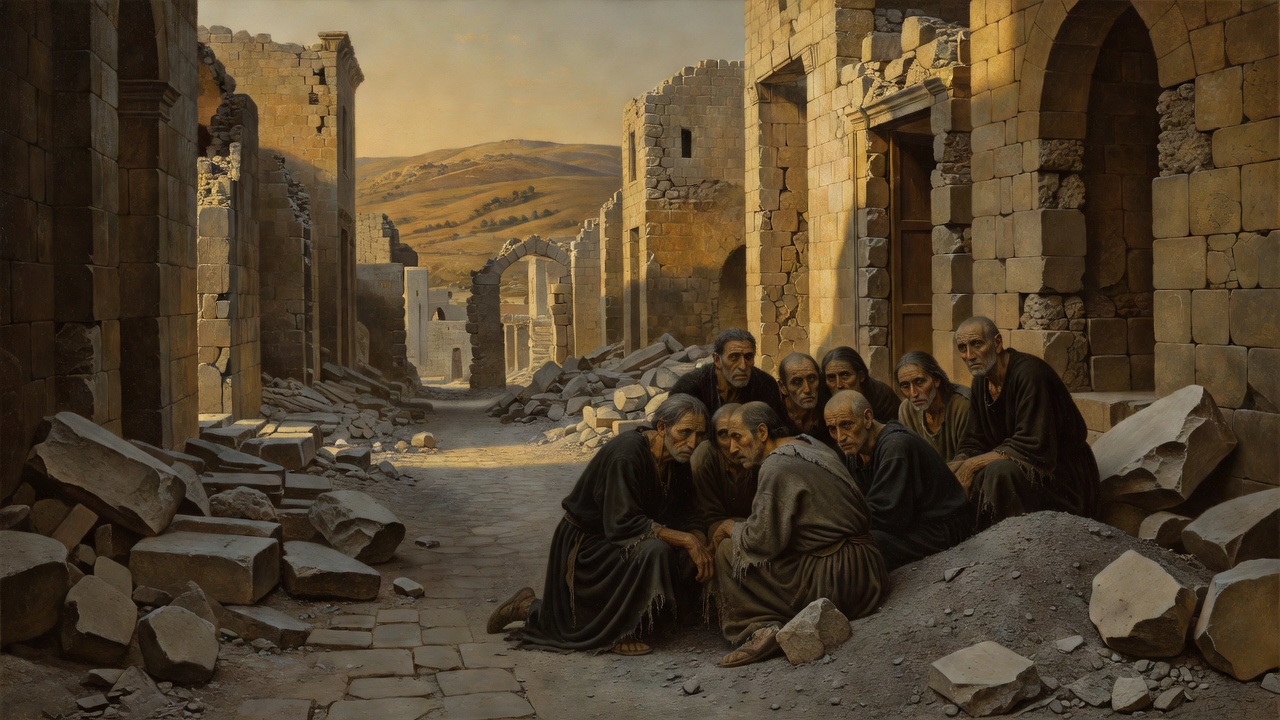
The Agony of the Fallen City
- The poet considers Jerusalem's prolonged suffering worse than the fate of Sodom. While Sodom was overthrown in an instant by divine fire, the inhabitants of Jerusalem endured the agonizing and drawn-out torment of siege and starvation.Sources: the Bible text itself · Sodom
- Before its capture, Jerusalem was widely regarded as an impenetrable mountain city. The text observes that foreign kings and surrounding nations never believed an enemy could breach its fortified gates.Sources: the Bible text itself · Jerusalem
- The chapter closes with an address to Edom dwelling in the land of Uz, warning that judgment will soon overtake her. Uz is mentioned in only three biblical books: Job, Jeremiah, and Lamentations.Sources: the Bible text itself · Uz · Edom
Notes written with AI assistance from open sources (Theographic Bible Metadata, CC BY-SA 4.0; Easton’s Bible Dictionary, public domain) and reviewed before publishing.
Places in this chapter
- Zion · Today: Jerusalem · 31.777, 35.234 · verses 2, 11, 22
- Jerusalem · 31.777, 35.234 · verse 12
- Edom · 30.746, 35.604 · verses 21, 22
Only places identified with high confidence are shown (90% or more according to the scholarly sources compiled by OpenBible). Period map: DARE (Digital Atlas of the Roman Empire), CC BY 4.0; modern map: © OpenStreetMap contributors; places: OpenBible.info (CC BY 4.0).
Credits and license for this translation
LXX2012: Septuagint in British/International English 2012
The Septuagint with Apocrypha, translated from Greek to English by Sir Lancelot C. L. Brenton and published in 1885, with some language updates (British/International English)
Public Domain
Language: English
Dialect (if applicable): British
Language in English: English
Translation by: Sir Lancelot Charles Lee Breton
LXX2012: Septuagint in English 2012, British/International English Edition
This is a translation of the Old Testament and Apocrypha/Deuterocanon from Hebrew to Greek to 19th Century British English, with some updates of spelling and word usage to contemporary British/International English. The original English translation was done by Sir Lancelot Charles Lee Brenton and published by Samuel Bagster & Sons, Ltd., in London in 1851. It has entered the Public Domain due to the passage of sufficient time. In the process of scanning and typing the text, the original poetry and prose formatting, as well as peripheral material like introductions and notes, have been omitted.
This edition of the Septuagint has some language updates. Brenton's word order and punctuation has been mostly retained, meaning that quotation marks are not used, and sentences within quotes may not start with capital letters, as was standard usage in 1851. Names transliterated from Greek to those transliterated from Hebrew in the common English Bibles often differ. These language updates are dedicated to the Public Domain by the author of those edits, Michael Paul Johnson. Therefore this edition may be freely copied, published, etc.
Before considering making changes to the text of this work, I recommend that you consult with God, because this is really His Book.
If you find errors in the text, please report them so that we can correct them.
Donations to help with the expenses of operating this web site and thus help others have free access to the Word of God may be made to us, but are not required. Please see http://MLJohnson.org/partner/ for more about that.
Section headings adapted from the Berean Standard Bible (public domain); they are not part of this translation’s text.
Source: http://ebible.org/eng-uk-lxx2012/ · eBible.org