Joshua 9
LXX2012: Septuagint in British/International English 2012 · Tap a verse to see its cross-references.
The Deceit of the Gibeonites
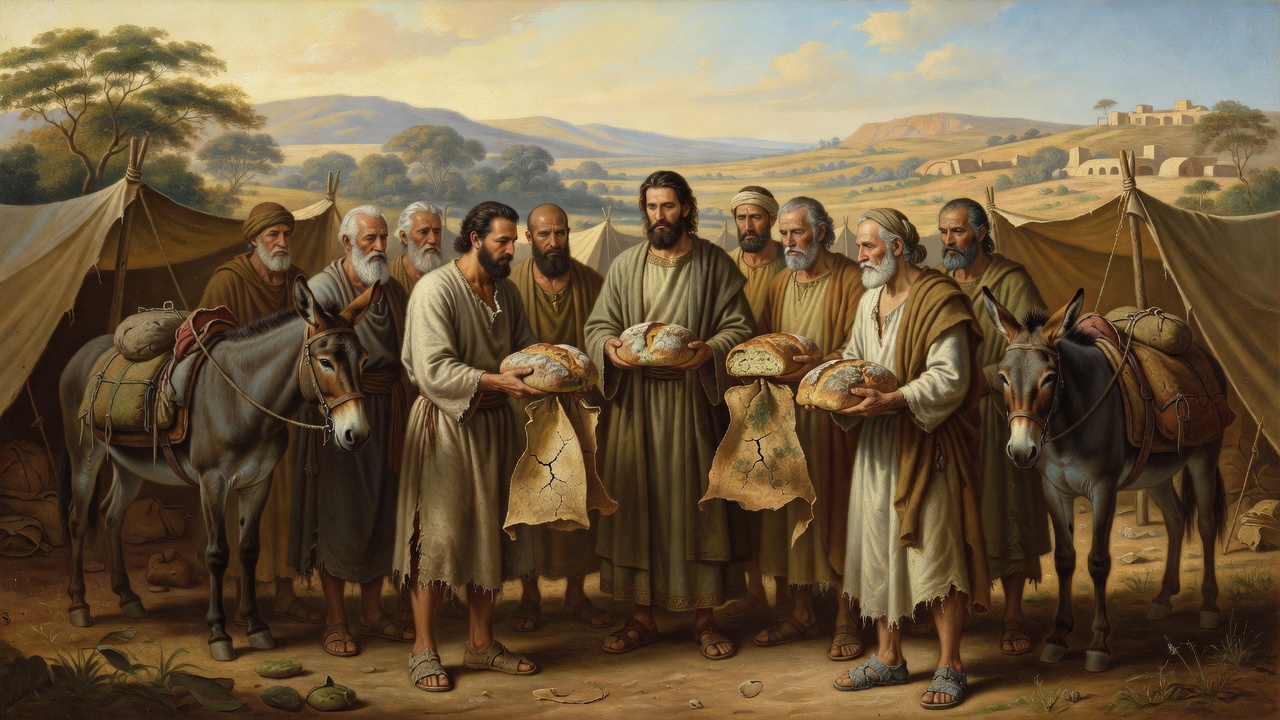
1And when the kings of the Amorites on the other side of Jordan, who were in the mountain country, and in the plain, and in all the coast of the great sea, and those who were near Antilibanus, and the Chettites, and the Chananites, and the Pherezites, and the Evites, and the Amorites, and the Gergesites, and the Jebusites, heard of it, 2they came all together at the same time to make war against Joshua and Israel. 3And the inhabitants of Gabaon heard of all that the Lord did to Jericho and Gai. 4And they also wrought craftily, and they went and made provision and prepared themselves; and having taken old sacks on their shoulders, and old and torn and patched bottles of wine, 5and the upper part of their shoes and their sandals old and clouted on their feet, and their garments old upon them—and the bread of their provision was dry and mouldy and corrupt. 6And they came to Joshua into the camp of Israel to Galgala, and said to Joshua and Israel, We are come from a far land: now then make a covenant with us. 7And the children of Israel said to the Chorrhaean, Peradventure you dwell amongst us; and how should I make a covenant with you? 8And they said to Joshua, We are your servants: and Joshua said to them, Whence are you⌃, and whence have you⌃ come? 9And they said, Your servants are come from a very far country in the name of the Lord your God: for we have heard his name, and all that he did in Egypt, 10and all that he did to the kings of the Amorites, who were beyond Jordan, to Seon king of the Amorites, and Og king of Basan, who lived in Astaroth and in Edrain. 11And our elders and all that inhabit our land when they heard spoke to us, saying, Take to yourselves provision for the way, and go to meet them; and you⌃ shall say to them, We are your servants, and now make a covenant with us. 12These are the loaves—we took them hot for our journey on the day on which we came out to come to you; and now they are dried and become mouldy. 13And these are the skins of wine which we filled when new, and they are torn; and our garments and our shoes are worn out because of the very long journey. 14And the chiefs took of their provision, and asked not counsel of the Lord. 15And Joshua made peace with them, and they made a covenant with them to preserve them; and the princes of the congregation swore to them. 16And it came to pass three days after they had made a covenant with them, they heard that they were near neighbours, and that they lived amongst them. 17And the children of Israel departed and came to their cities; and their cities were Gabaon, and Kephira, and Berot, and the cities of Jarin. 18And the children of Israel fought not with them, because all the princes swore to them by the Lord God of Israel; and all the congregation murmured at the princes. 19And the princes said to all the congregation: We have sworn to them by the Lord God of Israel, and now we shall not be able to touch them. 20This we will do; take them alive, and we will preserve them: so there shall not be wrath against us by reason of the oath which we swore to them. 21They shall live, and shall be hewers of wood and drawers of water to all the congregation, as the princes said to them. 22And Joshua called them together and said to them, Why have you⌃ deceived me, saying, We live very far from you; whereas you⌃ are fellow-countrymen of those who dwell amongst us? 23And now you⌃ are cursed: there shall not fail of you a slave, or a hewer of wood, or a drawer of water to me and my God. 24And they answered Joshua, saying, It was reported to us what the Lord your God charged his servant Moses, to give you this land, and to destroy us and all that lived on it from before you; and we feared very much for our lives because of you, and therefore we did this thing. 25And now, behold, we are in your power; do to us as it is pleasing to you, and as it seems good to you. 26And they did so to them; and Joshua rescued them in that day out of the hands of the children of Israel, and they did not kill them. 27And Joshua made them in that day hewers of wood and drawers of water to the whole congregation, and for the altar of God: therefore the inhabitants of Gabaon became hewers of wood and drawers of water for the altar of God until this day, even for the place which the Lord should choose. 30Then Joshua built an altar to the Lord God of Israel in mount Gebal, 31as Moses the servant of the Lord commanded the children of Israel, as it was written in the law of Moses, an altar of unhewn stones, on which iron had not been lifted up: and he offered there whole burnt offerings to the Lord, and a piece offering. And Joshua wrote upon the stones a copy of the law, even the law of Moses, before the children of Israel. 33And all Israel, and their elders, and their judges, and their scribes, passed on one side and on the other, before the ark; and the priests and the levites took up the ark of the covenant of the Lord; and the stranger and the native were there, who were half of them near mount Gebal, as Moses the servant of the Lord commanded at first, to bless the people.
Did you know?
The Gibeonite Treaty
- The inhabitants of Gibeon were Hivites whose territory included four cities: Gibeon, Chephirah, Beeroth, and Kiriath-jearim. Located only about five and a half miles northwest of Jerusalem, Gibeon was a major hill-city that chose diplomacy over the military alliance formed by neighboring Canaanite rulers.Sources: the Bible text itself · Gibeon · Hivite
- To fabricate evidence of a long journey, the Gibeonites carried cracked wineskins, worn sandals, threadbare clothes, and dry, moldy bread. The Israelite leaders examined the physical provisions but neglected to seek counsel from the Lord, leading them to agree to a covenant of peace.Sources: the Bible text itself
- In ancient Israel, an oath sworn in the name of the Lord was binding even when secured through deception. Because the leaders had sworn by God, the Israelites spared the Gibeonites from death and instead assigned them as woodcutters and water carriers for the community and the altar.Sources: the Bible text itself
Notes written with AI assistance from open sources (Theographic Bible Metadata, CC BY-SA 4.0; Easton’s Bible Dictionary, public domain) and reviewed before publishing.
Places in this chapter
- Great Sea · Today: Mediterranean Sea · 31.805, 34.170 · verse 1
- Jericho · Today: Tell es Sultan · 31.872, 35.445 · verses 1, 3
- Jordan · Today: Jordan River · 31.761, 35.558 · verses 1, 10
- Lebanon · 33.540, 35.584 · verse 1
- Shephelah · 31.692, 34.875 · verse 1
- Gibeon · Today: El Jib · 31.847, 35.183 · verses 3, 17
- Egypt · 30.129, 31.308 · verse 9
- Bashan · 32.781, 35.935 · verse 10
- Kiriath-jearim · Today: Deir el Azar · 31.809, 35.104 · verse 17
Only places identified with high confidence are shown (90% or more according to the scholarly sources compiled by OpenBible). Period map: DARE (Digital Atlas of the Roman Empire), CC BY 4.0; modern map: © OpenStreetMap contributors; places: OpenBible.info (CC BY 4.0).
Credits and license for this translation
LXX2012: Septuagint in British/International English 2012
The Septuagint with Apocrypha, translated from Greek to English by Sir Lancelot C. L. Brenton and published in 1885, with some language updates (British/International English)
Public Domain
Language: English
Dialect (if applicable): British
Language in English: English
Translation by: Sir Lancelot Charles Lee Breton
LXX2012: Septuagint in English 2012, British/International English Edition
This is a translation of the Old Testament and Apocrypha/Deuterocanon from Hebrew to Greek to 19th Century British English, with some updates of spelling and word usage to contemporary British/International English. The original English translation was done by Sir Lancelot Charles Lee Brenton and published by Samuel Bagster & Sons, Ltd., in London in 1851. It has entered the Public Domain due to the passage of sufficient time. In the process of scanning and typing the text, the original poetry and prose formatting, as well as peripheral material like introductions and notes, have been omitted.
This edition of the Septuagint has some language updates. Brenton's word order and punctuation has been mostly retained, meaning that quotation marks are not used, and sentences within quotes may not start with capital letters, as was standard usage in 1851. Names transliterated from Greek to those transliterated from Hebrew in the common English Bibles often differ. These language updates are dedicated to the Public Domain by the author of those edits, Michael Paul Johnson. Therefore this edition may be freely copied, published, etc.
Before considering making changes to the text of this work, I recommend that you consult with God, because this is really His Book.
If you find errors in the text, please report them so that we can correct them.
Donations to help with the expenses of operating this web site and thus help others have free access to the Word of God may be made to us, but are not required. Please see http://MLJohnson.org/partner/ for more about that.
Section headings adapted from the Berean Standard Bible (public domain); they are not part of this translation’s text.
Source: http://ebible.org/eng-uk-lxx2012/ · eBible.org