Job 17
LXX2012: Septuagint in British/International English 2012 · Tap a verse to see its cross-references.
Job Prepares for Death
1I perish, carried away by the wind, and I seek for burial, and obtain it not. 2Weary I entreat; and what have I done? and strangers have stolen my goods. 3Who is this? let him join hands with me. 4For you have hid their heart from wisdom; therefore you shall not exalt them. 5He shall promise mischief to his companions: but their eyes have failed for their children. 6But you have made me a byword amongst the nations, and I am become a scorn to them. 7For my eyes are dimmed through pain; I have been grievously beset by all. 8Wonder has seized true men upon this; and let the just rise up against the transgressor. 9But let the faithful hold on his own way, and let him that is pure of hands take courage. 10Howbeit, do you⌃ all strengthen yourselves and come now, for I do not find truth in you. 11My days have passed in groaning, and my heart-strings are broken. 12I have turned the night into day: the light is short because of darkness. 13For if I remain, Hades is my habitation: and my bed has been made in darkness. 14I have called upon death to be my father, and corruption to be my mother and sister. 15Where then is yet my hope? or where shall I see my good? 16Will they go down with me to Hades, or shall we go down together to the tomb?
Did you know?
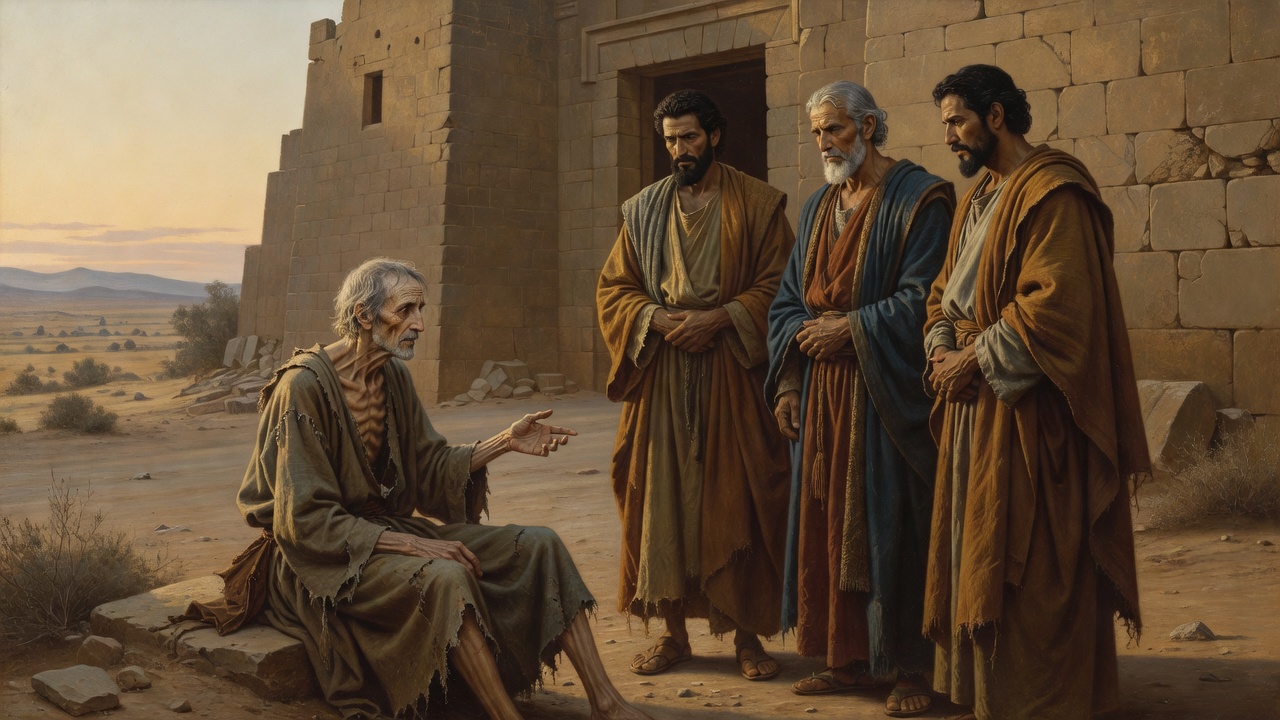
Job's Despair and the Prospect of the Grave
- Job appeals directly to God to act as his pledge or guarantor. In ancient legal practice, a guarantor assumed responsibility for someone accused or indebted, and Job found no human ally willing or able to defend him.Sources: the Bible text itself
- Job describes himself as becoming a byword among the people, a status where an individual's suffering turns into an object of public mockery, contempt, and proverb-like warning.Sources: the Bible text itself
- In his grief, Job speaks of the realm of the dead (Sheol) and the grave as his only remaining home, metaphorically adopting the pit and worms as his closest family members.Sources: the Bible text itself
Notes written with AI assistance from open sources (Theographic Bible Metadata, CC BY-SA 4.0; Easton’s Bible Dictionary, public domain) and reviewed before publishing.
Credits and license for this translation
LXX2012: Septuagint in British/International English 2012
The Septuagint with Apocrypha, translated from Greek to English by Sir Lancelot C. L. Brenton and published in 1885, with some language updates (British/International English)
Public Domain
Language: English
Dialect (if applicable): British
Language in English: English
Translation by: Sir Lancelot Charles Lee Breton
LXX2012: Septuagint in English 2012, British/International English Edition
This is a translation of the Old Testament and Apocrypha/Deuterocanon from Hebrew to Greek to 19th Century British English, with some updates of spelling and word usage to contemporary British/International English. The original English translation was done by Sir Lancelot Charles Lee Brenton and published by Samuel Bagster & Sons, Ltd., in London in 1851. It has entered the Public Domain due to the passage of sufficient time. In the process of scanning and typing the text, the original poetry and prose formatting, as well as peripheral material like introductions and notes, have been omitted.
This edition of the Septuagint has some language updates. Brenton's word order and punctuation has been mostly retained, meaning that quotation marks are not used, and sentences within quotes may not start with capital letters, as was standard usage in 1851. Names transliterated from Greek to those transliterated from Hebrew in the common English Bibles often differ. These language updates are dedicated to the Public Domain by the author of those edits, Michael Paul Johnson. Therefore this edition may be freely copied, published, etc.
Before considering making changes to the text of this work, I recommend that you consult with God, because this is really His Book.
If you find errors in the text, please report them so that we can correct them.
Donations to help with the expenses of operating this web site and thus help others have free access to the Word of God may be made to us, but are not required. Please see http://MLJohnson.org/partner/ for more about that.
Section headings adapted from the Berean Standard Bible (public domain); they are not part of this translation’s text.
Source: http://ebible.org/eng-uk-lxx2012/ · eBible.org