Job 14
LXX2012: Septuagint in British/International English 2012 · Tap a verse to see its cross-references.
Job Laments the Finality of Death
1For a mortal born of a woman is short lived, and full of wrath. 2Or he falls like a flower that has bloomed; and he departs like a shadow, and can’t continue. 3Have you not taken account even of him, and caused him to enter into judgement before you? 4For who shall be pure from uncleanness? not even one; 5if even his life should be but one day upon the earth: and his months are numbered by him: you have appointed him for a time, and he shall by no means exceed it. 6Depart from him, that he may be quiet, and take pleasure in his life, though as a hireling. 7For there is hope for a tree, even if it should be cut down, that it shall blossom again, and its branch shall not fail. 8For though its root should grow old in the earth, and its stem die in the rock; 9it will blossom from the scent of water, and will produce a crop, as one newly planted. 10But a man that has died is utterly gone; and when a mortal has fallen, he is no more. 11For the sea wastes in length of time, and a river fails and is dried up. 12And man that has lain down in death shall certainly not rise again till the heaven be dissolved, and they shall not awake from their sleep. 13For oh that you had kept me in the grave, and had hidden me until your wrath should cease, and you should set me a time in which you would remember me! 14For if a man should die, shall he live again, having accomplished the days of his life? I will wait till I exist again? 15Then shall you call, and I will listen to you: but do not you reject the work of your hands. 16But you have numbered my devices: and not one of my sins shall escape you? 17And you have sealed up my transgressions in a bag, and marked if I have been guilty of any transgression unawares. 18And verily a mountain falling will utterly be destroyed, and a rock shall be worn out of its place. 19The waters wear the stones, and waters falling headlong overflow a heap of the earth: and you destroy the hope of man. 20You drive him to an end, and he is gone: you set your face against him, and send him away; 21and though his children be multiplied, he knows it not; and if they be few, he is not aware. 22But his flesh is in pain, and his soul mourns.
Did you know?
The Frailty of Life and the Hope of Renewal
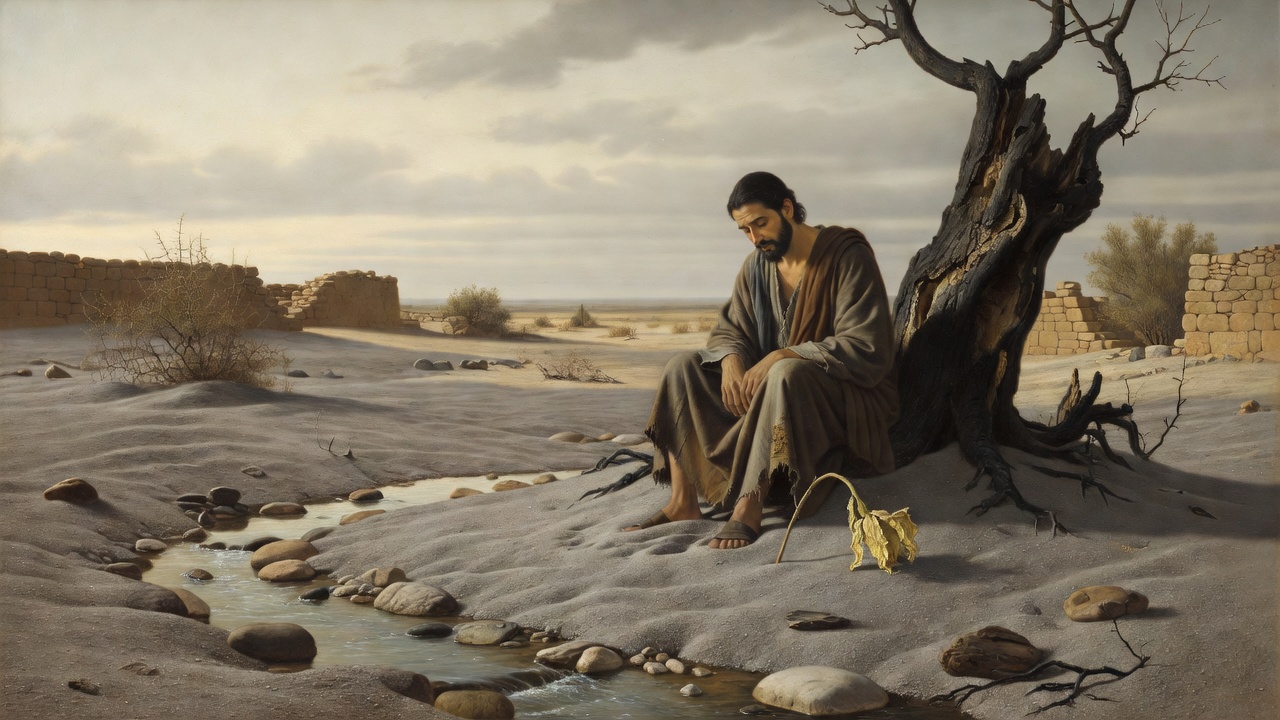
- In this speech, Job contrasts the fate of mortals with that of a tree. While a felled tree can sprout new shoots at the scent of water even after its stump seems dead, a human being dies, lies down, and does not rise again to life on earth.Sources: the Bible text itself
- Job contemplates Sheol as a potential hiding place where he might be sheltered until divine anger passes, imagining a longing in which God would seal his transgressions in a bag and call upon the work of His hands.Sources: the Bible text itself
- To capture the brevity and decay of human existence, the chapter draws upon natural metaphors of erosion and transience, comparing human life to a fleeting shadow, a withered flower, and rocks worn down by water.Sources: the Bible text itself
Notes written with AI assistance from open sources (Theographic Bible Metadata, CC BY-SA 4.0; Easton’s Bible Dictionary, public domain) and reviewed before publishing.
Credits and license for this translation
LXX2012: Septuagint in British/International English 2012
The Septuagint with Apocrypha, translated from Greek to English by Sir Lancelot C. L. Brenton and published in 1885, with some language updates (British/International English)
Public Domain
Language: English
Dialect (if applicable): British
Language in English: English
Translation by: Sir Lancelot Charles Lee Breton
LXX2012: Septuagint in English 2012, British/International English Edition
This is a translation of the Old Testament and Apocrypha/Deuterocanon from Hebrew to Greek to 19th Century British English, with some updates of spelling and word usage to contemporary British/International English. The original English translation was done by Sir Lancelot Charles Lee Brenton and published by Samuel Bagster & Sons, Ltd., in London in 1851. It has entered the Public Domain due to the passage of sufficient time. In the process of scanning and typing the text, the original poetry and prose formatting, as well as peripheral material like introductions and notes, have been omitted.
This edition of the Septuagint has some language updates. Brenton's word order and punctuation has been mostly retained, meaning that quotation marks are not used, and sentences within quotes may not start with capital letters, as was standard usage in 1851. Names transliterated from Greek to those transliterated from Hebrew in the common English Bibles often differ. These language updates are dedicated to the Public Domain by the author of those edits, Michael Paul Johnson. Therefore this edition may be freely copied, published, etc.
Before considering making changes to the text of this work, I recommend that you consult with God, because this is really His Book.
If you find errors in the text, please report them so that we can correct them.
Donations to help with the expenses of operating this web site and thus help others have free access to the Word of God may be made to us, but are not required. Please see http://MLJohnson.org/partner/ for more about that.
Section headings adapted from the Berean Standard Bible (public domain); they are not part of this translation’s text.
Source: http://ebible.org/eng-uk-lxx2012/ · eBible.org