Jeremiah 32
LXX2012: Septuagint in British/International English 2012 · Tap a verse to see its cross-references.
15Thus said the Lord God of Israel; Take the cup of this unmixed wine from my hand, and you shall cause all the nations to drink, to whom I send you.
Jeremiah Prays for Understanding
16And they shall drink, and vomit, and be mad, because of the sword which I send amongst them. 17So I took the cup out of the Lord's hand, and caused the nations to whom the Lord sent me to drink: 18Jerusalem, and the cities of Juda, and the kings of Juda, and his princes, to make them a desert place, a desolation, and a hissing; 19and Pharao king of Egypt, and his servants, and his nobles, and all his people; 20and all the mingled people, and all the kings of the Philistines, and Ascalon, and Gaza, and Accaron, and the remnant of Azotus, 21and Idumea, and the land of Moab, and the children of Ammon, 22and the kings of Tyre, and the kings of Sidon, and the kings in the country beyond the sea, 23and Daedan, and Thaeman, and Ros, and every one that is shaved round about the face, 24and all the mingled people lodging in the wilderness, 25and all the kings of Aelam, and all the kings of the Persians,
The LORD Answers Jeremiah
26and all the kings from the north, the far and the near, each one with his brother, and all the kingdoms which are on the face of the earth. 27And you shall say to them, Thus said the Lord Almighty; Drink you⌃, be you⌃ drunken; and you⌃ shall vomit, and shall fall, and shall in nowise rise, because of the sword which I send amongst you. 28And it shall come to pass, when they refuse to take the cup out of your hand, to drink it, that you shall say, Thus said the Lord; You⌃ shall surely drink. 29For I am beginning to afflict the city whereon my name is called, and you⌃ shall by no means be held guiltless: for I am calling a sword upon all that dwell upon the earth. 30And you shall prophesy against them these words, and shall say, The Lord shall speak from on high, from his sanctuary he will utter his voice; he will pronounce a declaration on his place; and these shall answer like men gathering grapes: and destruction is coming on them that dwell on the earth, 31even upon the extreme part of the earth; for the Lord has a controversy with the nations, he is pleading with all flesh, and the ungodly are given to the sword, says the Lord. 32Thus said the Lord; Behold, evils are proceeding from nation to nation, and a great whirlwind goes forth from the end of the earth. 33And the slain of the Lord shall be in the day of the Lord from one end of the earth even to the other end of the earth: they shall not be buried; they shall be as dung on the face of the earth. 34Howl, you⌃ shepherds, and cry; and lament, you⌃ rams of the flock: for your days have been completed for slaughter, and you⌃ shall fall as the choice rams. 35And flight shall perish from the shepherds, and safety from the rams of the flock.
A Promise of Restoration
36A voice of the crying of the shepherds, and a moaning of the sheep and the rams: for the Lord has destroyed their pastures. 37And the peaceful abodes that remain shall be destroyed before the fierceness of my anger. 38He has forsaken his lair, as a lion: for their land is become desolate before the great sword.
Did you know?
A Purchase of Land During the Siege of Jerusalem
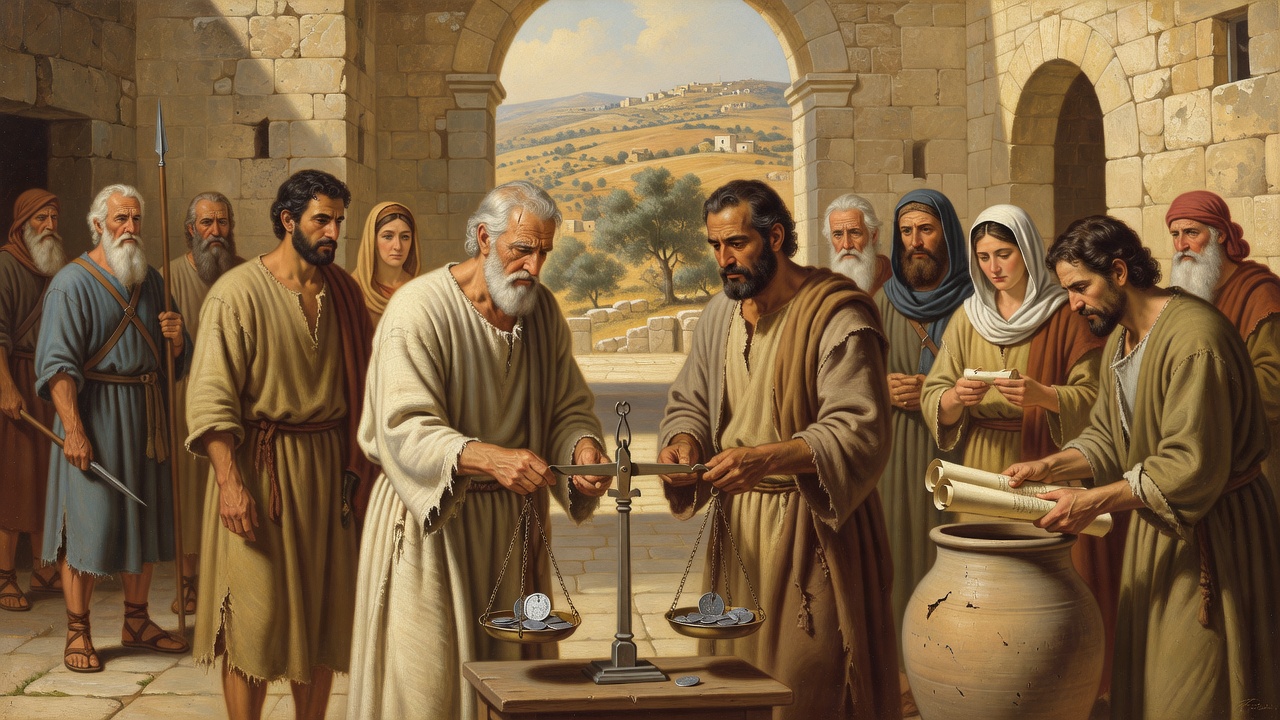
- The events of this chapter took place during the Babylonian siege of Jerusalem in the tenth year of King Zedekiah. Jeremiah had been confined by the king to the courtyard of the royal guard because he prophesied that the city would fall to King Nebuchadnezzar and that Zedekiah would be taken to Babylon.Sources: the Bible text itself · Zedekiah · Nebuchadnezzar
- While still confined, Jeremiah exercised his family right of redemption to purchase a field in his hometown of Anathoth from his cousin Hanamel for seventeen shekels of silver. Following ancient legal practices, Jeremiah signed sealed and open deeds before witnesses and entrusted them to his scribe Baruch to be preserved in a clay jar.Sources: the Bible text itself · Hanameel · Baruch · Anathoth
- The purchase served as a prophetic sign during a desperate military crisis. Although the city was facing imminent destruction and exile because of its idolatry, God assured Jeremiah that fields, houses, and vineyards would once again be bought and sold in the land.Sources: the Bible text itself
Notes written with AI assistance from open sources (Theographic Bible Metadata, CC BY-SA 4.0; Easton’s Bible Dictionary, public domain) and reviewed before publishing.
Places in this chapter
- Babylon · 32.543, 44.422 · verses 2, 3, 4, 5, 28, 36
- Jerusalem · 31.777, 35.234 · verses 2, 32, 44
- Chaldea · 30.962, 46.104 · verses 4, 5, 24, 25, 28, 29, 43
- Egypt · 30.129, 31.308 · verses 20, 21
- Valley of Hinnom · Today: Hinnom Valley · 31.769, 35.228 · verse 35
- Negeb · 31.245, 34.841 · verse 44
- Shephelah · 31.692, 34.875 · verse 44
Only places identified with high confidence are shown (90% or more according to the scholarly sources compiled by OpenBible). Period map: DARE (Digital Atlas of the Roman Empire), CC BY 4.0; modern map: © OpenStreetMap contributors; places: OpenBible.info (CC BY 4.0).
Credits and license for this translation
LXX2012: Septuagint in British/International English 2012
The Septuagint with Apocrypha, translated from Greek to English by Sir Lancelot C. L. Brenton and published in 1885, with some language updates (British/International English)
Public Domain
Language: English
Dialect (if applicable): British
Language in English: English
Translation by: Sir Lancelot Charles Lee Breton
LXX2012: Septuagint in English 2012, British/International English Edition
This is a translation of the Old Testament and Apocrypha/Deuterocanon from Hebrew to Greek to 19th Century British English, with some updates of spelling and word usage to contemporary British/International English. The original English translation was done by Sir Lancelot Charles Lee Brenton and published by Samuel Bagster & Sons, Ltd., in London in 1851. It has entered the Public Domain due to the passage of sufficient time. In the process of scanning and typing the text, the original poetry and prose formatting, as well as peripheral material like introductions and notes, have been omitted.
This edition of the Septuagint has some language updates. Brenton's word order and punctuation has been mostly retained, meaning that quotation marks are not used, and sentences within quotes may not start with capital letters, as was standard usage in 1851. Names transliterated from Greek to those transliterated from Hebrew in the common English Bibles often differ. These language updates are dedicated to the Public Domain by the author of those edits, Michael Paul Johnson. Therefore this edition may be freely copied, published, etc.
Before considering making changes to the text of this work, I recommend that you consult with God, because this is really His Book.
If you find errors in the text, please report them so that we can correct them.
Donations to help with the expenses of operating this web site and thus help others have free access to the Word of God may be made to us, but are not required. Please see http://MLJohnson.org/partner/ for more about that.
Section headings adapted from the Berean Standard Bible (public domain); they are not part of this translation’s text.
Source: http://ebible.org/eng-uk-lxx2012/ · eBible.org