Jeremiah 20
LXX2012: Septuagint in British/International English 2012 · Tap a verse to see its cross-references.
Pashhur Persecutes Jeremiah
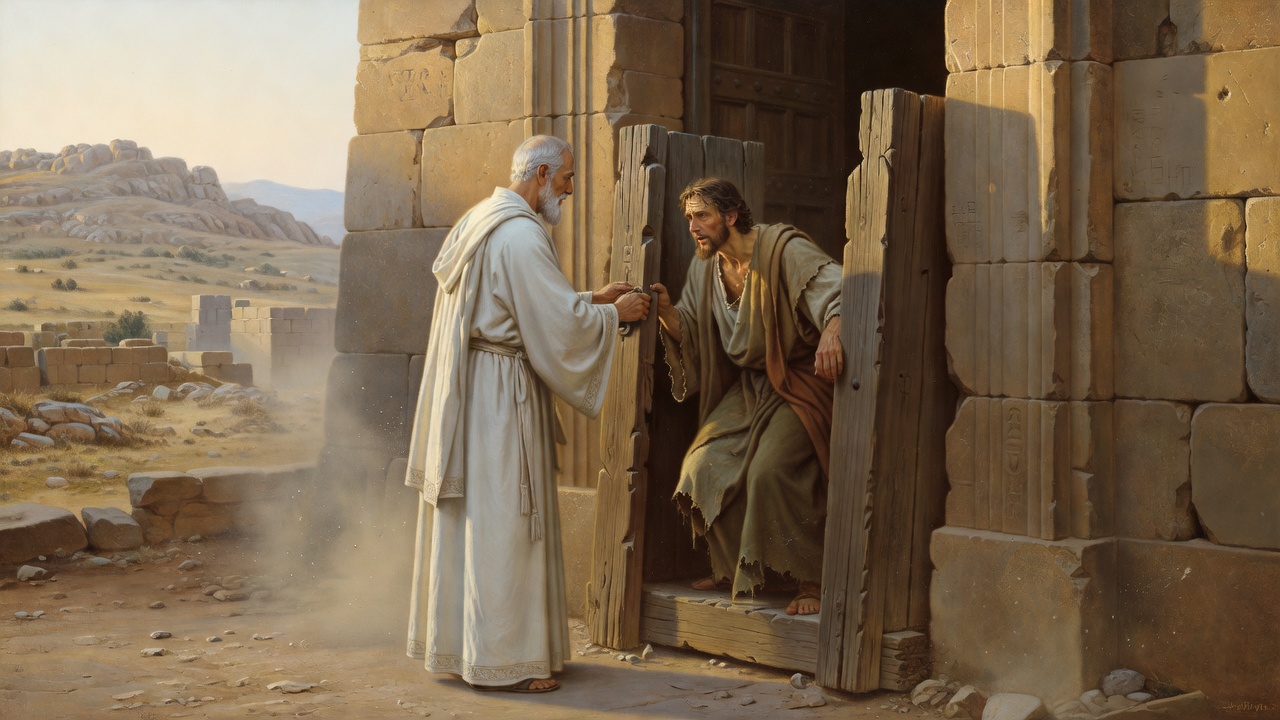
1Now Paschor the son of Emmer, the priest, who also had been appointed chief of the house of the Lord, heard Jeremias prophesying these words. 2And he struck him, and cast him into the dungeon which was by the gate of the upper house that was set apart, which was by the house of the Lord. 3And Paschor brought Jeremias out of the dungeon: and Jeremias said to him, The Lord has not called your name Paschor, but Exile. 4For thus says the Lord, Behold, I will give you up to captivity with all your friends: and they shall fall by the sword of their enemies, and your eyes shall see it: and I will give you and all Juda into the hands of the king of Babylon, and they shall carry them captives, and cut them in pieces with swords. 5And I will give all the strength of this city, and all the labours of it, and all the treasures of the king of Juda, into the hands of his enemies, and they shall bring them to Babylon. 6And you and all the dwellers in your house shall go into captivity: and you shall die in Babylon, and there you and all your friends shall be buried, to whom you have prophesied lies.
Jeremiah’s Complaint
7You have deceived me, O Lord, and I have been deceived: you have been strong, and has prevailed: I am become a laughing stock, I am continually mocked every day. 8For I will laugh with my bitter speech, I will call upon rebellion and misery: for the word of the Lord is become a reproach to me and a mockery all my days. 9Then I said, I will by no means name the name of the Lord, and I will no more at all speak in his name. But it was a burning fire flaming in my bones, and I am utterly weakened on all sides, and can’t bear up. 10For I have heard the reproach of many gathering round, saying, Conspire you⌃, and let us conspire together against him, even all his friends: watch his intentions, if perhaps he shall be deceived, and we shall prevail against him, and we shall be avenged on him. 11But the Lord was with me as a mighty man of war: therefore they persecuted me, but could not perceive anything against me; they were greatly confounded, for they perceived not their disgrace, which shall never be forgotten. 12O Lord, that prove just deeds, understanding the reins and hearts, let me see your vengeance upon them: for to you I have revealed my cause. 13Sing you⌃ to the Lord, sing praise to him: for he has rescued the soul of the poor from the hand of evil-doers. 14Cursed be the day wherein I was born: the day wherein my mother brought me forth, let it not be blessed. 15Cursed be the man who brought the glad tidings to my father, saying, A male child is born to you. 16Let that man rejoice as the cities which the Lord overthrew in wrath, and repented not: let him hear crying in the morning, and loud lamentation at noon; 17because he killed me not in the womb, and my mother became not my tomb, and her womb always great with me. 18Why is it that I came forth of the womb to see troubles and distresses, and my days are spent in shame?
Did you know?
Jeremiah's Persecution and Inner Turmoil
- Pashhur, the priest who arrested and beat Jeremiah, was the son of Immer—the ancestral head of the sixteenth priestly division—and served as chief official in the house of the LORD. His high administrative post gave him the authority to punish Jeremiah and confine him in wooden stocks at the Upper Gate of Benjamin near the temple.Sources: Immer · Gate of Benjamin · the Bible text itself
- Upon being released, Jeremiah announced that God gave Pashhur the symbolic name 'Magor-missabib' ('terror on every side'). Jeremiah prophesied that Pashhur, his household, and his friends would be carried away captive into Babylon to die, alongside the plunder of Judah's wealth.Sources: Babylon · the Bible text itself
- The chapter reveals Jeremiah's intense emotional struggle between public derision and prophetic compulsion. Although mocked and betrayed by close friends, he confessed that holding back God's message felt like a fire burning in his heart and shut up within his bones.Sources: Jeremiah · the Bible text itself
Notes written with AI assistance from open sources (Theographic Bible Metadata, CC BY-SA 4.0; Easton’s Bible Dictionary, public domain) and reviewed before publishing.
Places in this chapter
- Benjamin Gate · Today: in Jerusalem · 31.777, 35.234 · verse 2
- Babylon · 32.543, 44.422 · verses 4, 5, 6
- Jerusalem · 31.777, 35.234 · verse 5
Only places identified with high confidence are shown (90% or more according to the scholarly sources compiled by OpenBible). Period map: DARE (Digital Atlas of the Roman Empire), CC BY 4.0; modern map: © OpenStreetMap contributors; places: OpenBible.info (CC BY 4.0).
Credits and license for this translation
LXX2012: Septuagint in British/International English 2012
The Septuagint with Apocrypha, translated from Greek to English by Sir Lancelot C. L. Brenton and published in 1885, with some language updates (British/International English)
Public Domain
Language: English
Dialect (if applicable): British
Language in English: English
Translation by: Sir Lancelot Charles Lee Breton
LXX2012: Septuagint in English 2012, British/International English Edition
This is a translation of the Old Testament and Apocrypha/Deuterocanon from Hebrew to Greek to 19th Century British English, with some updates of spelling and word usage to contemporary British/International English. The original English translation was done by Sir Lancelot Charles Lee Brenton and published by Samuel Bagster & Sons, Ltd., in London in 1851. It has entered the Public Domain due to the passage of sufficient time. In the process of scanning and typing the text, the original poetry and prose formatting, as well as peripheral material like introductions and notes, have been omitted.
This edition of the Septuagint has some language updates. Brenton's word order and punctuation has been mostly retained, meaning that quotation marks are not used, and sentences within quotes may not start with capital letters, as was standard usage in 1851. Names transliterated from Greek to those transliterated from Hebrew in the common English Bibles often differ. These language updates are dedicated to the Public Domain by the author of those edits, Michael Paul Johnson. Therefore this edition may be freely copied, published, etc.
Before considering making changes to the text of this work, I recommend that you consult with God, because this is really His Book.
If you find errors in the text, please report them so that we can correct them.
Donations to help with the expenses of operating this web site and thus help others have free access to the Word of God may be made to us, but are not required. Please see http://MLJohnson.org/partner/ for more about that.
Section headings adapted from the Berean Standard Bible (public domain); they are not part of this translation’s text.
Source: http://ebible.org/eng-uk-lxx2012/ · eBible.org