Judges 18
LXX2012: Septuagint in British/International English 2012 · Tap a verse to see its cross-references.
The Danites Settle in Laish
1In those days there was no king in Israel; and in those days the tribe of Dan sought for itself an inheritance to inhabit, because no inheritance had fallen to it until that day in the midst of the tribes of the children of Israel. 2And the sons of Dan sent from their families five men of valour, from Saraa and from Esthaol, to spy out the land and to search it; and they said to them, Go and search out the land. And they came as far as the mount of Ephraim to the house of Michaias and they lodged there, 3in the house of Michaias, and they recognised the voice of the young man the Levite, and turned in there; and said to him, Who brought you in hither? and what do you in this place? and what have you here? 4And he said to them, Thus and thus did Michaias to me, and he hired me, and I became his priest. 5And they said to him, Enquire now of God, and we shall know whether our way will prosper, on which we are going. 6And the priest said to them, Go in peace; your way in which you⌃ go, is before the Lord. 7And the five men went on, and came to Laisa; and they saw the people in the midst of it dwelling securely, at ease as is the manner of the Sidonians, and there is no one perverting or shaming a matter in the land, no heir extorting treasures; and they are far from the Sidonians, and they have no intercourse with any one. 8And the five men came to their brethren to Saraa and Esthaol, and said to their brethren, Why sit you⌃ here idle? 9And they said, Arise, and let us go up against them, for we have seen the land, and, behold, it is very good, yet you⌃ are still: delay not to go, and to enter in to possess the land. 10And whenever you⌃ shall go, you⌃ shall come in upon a people secure, and the land is extensive, for God has given it into your hand; a place where there is no lack of anything that the earth affords. 11And there departed thence of the families of Dan, from Saraa and from Esthaol, six hundred men, girded with weapons of war. 12And they went up, and encamped in Cariathiarim in Juda; therefore it was called in that place the camp of Dan, until this day: behold, it is behind Cariathiarim. 13And they went on thence to the mount of Ephraim, and came to the house of Michaias.
The Danites Take Micah’s Idols
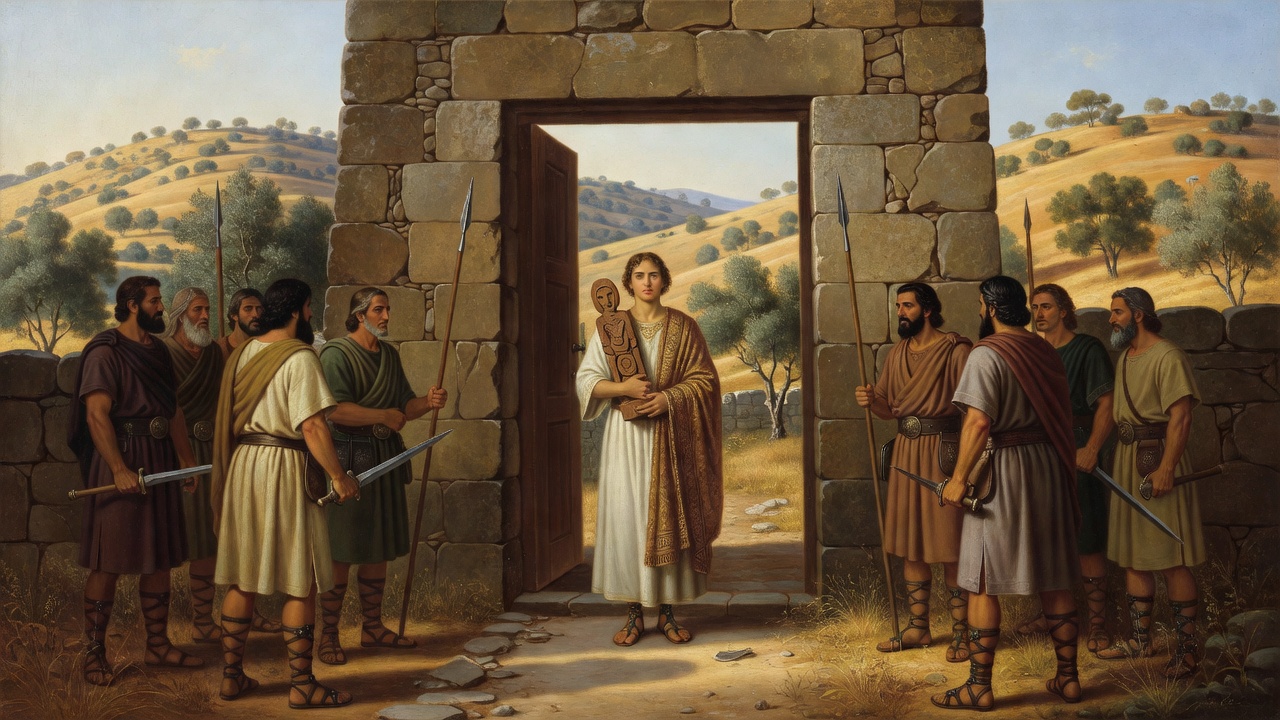
14And the five men who went to spy out the land of Laisa answered, and said to their brethren, You⌃ know that there is in this place an ephod, and theraphin, and a graven and a molten image; and now consider what you⌃ shall do. 15And they turned aside there, and went into the house of the young man, the Levite, even into the house of Michaias, and asked him how he was. 16And the six hundred men of the sons of Dan who were girded with their weapons of war stood by the door of the gate. 17And the five men who went to spy out the land went up, and entered into the house of Michaias, and the priest stood. 18And they took the graven image, and the ephod, and the theraphin, and the molten image; and the priest said to them, What are you⌃ doing? 19And they said to him, Be silent, lay your hand upon your mouth, and come with us, and be to us a father and a priest: is it better for you to be the priest of the house of one man, or to be the priest of a tribe and house for a family of Israel? 20And the heart of the priest was glad, and he took the ephod, and the theraphin, and the graven image, and the molten image, and went in the midst of the people. 21So they turned and departed, and put their children and their property and their baggage before them. 22They went some distance from the house of Michaias, and, behold, Michaias and the men in the houses near Michaias' house, cried out, and overtook the children of Dan. 23And the children of Dan turned their face, and said to Michaias, What is the matter with you that you have cried out? 24And Michaias said, Because you⌃ have taken my graven image which I made, and my priest, and are gone; and what have I remaining? and what is this that you⌃ say to me, Why cry you? 25And the children of Dan said to him, Let not your voice be heard with us, lest angry men run upon you, and take away your life, and the lives of your house. 26And the children of Dan went their way; and Michaias saw that they were stronger than himself, and he returned to his house. 27And the children of Dan took what Michaias had made, and the priest that he had, and they came to Laisa, to a people quiet and secure; and they struck them with the edge of the sword, and burnt the city with fire. 28And there was no deliverer, because the city is far from the Sidonians, and they have no intercourse with men, and it is in the valley of the house of Raab; and they built the city, and lived in it. 29And they called the name of the city Dan, after the name of Dan their father, who was born to Israel; and the name of the city was Ulamais before. 30And the children of Dan set up the graven image for themselves; and Jonathan son of Gerson son of Manasse, he and his sons were priests to the tribe of Dan till the time of the carrying away of the nation. 31And they set up for themselves the graven image which Michaias made, all the days that the house of God was in Selom; and it was so in those days that there was no king in Israel.
Did you know?
The Migration of Dan and the Stolen Sanctuary
- Seeking territory of their own, Danite scouts identified Laish, a tranquil and isolated settlement in the far north near the sources of the Jordan. Because the city had no military alliances and was far from the Phoenician city of Sidon, six hundred Danite warriors easily captured and burned it, rebuilding the settlement and renaming it Dan.Sources: the Bible text itself · Laish · Dan · Sidon
- On their march northward, the Danites confiscated Micah's carved idol, ephod, and household gods, convincing his young Levite priest to join them as tribal priest. At the end of the narrative, the priest is identified as Jonathan, son of Gershom, a descendant of Moses, whose family maintained this northern priesthood for generations.Sources: the Bible text itself · Jonathan · Gershom · Micah
- The six hundred armed Danites mobilized from the towns of Zorah and Eshtaol. Their temporary encampment west of Kiriath-jearim in the territory of Judah became known as Mahaneh-dan, which means 'Camp of Dan.'Sources: the Bible text itself · Mahaneh-dan · Zorah · Eshtaol
Notes written with AI assistance from open sources (Theographic Bible Metadata, CC BY-SA 4.0; Easton’s Bible Dictionary, public domain) and reviewed before publishing.
Places in this chapter
- Aram · 33.511, 36.306 · verses 7, 28
- Dan · Today: Tel Dan · 33.249, 35.652 · verses 7, 14, 27, 29
- Sidon · Today: Sandikli archaeological site in Sidon · 33.561, 35.372 · verses 7, 28
- Kiriath-jearim · Today: Deir el Azar · 31.809, 35.104 · verse 12
- Shiloh · Today: Khirbet Seilun · 32.056, 35.290 · verse 31
Only places identified with high confidence are shown (90% or more according to the scholarly sources compiled by OpenBible). Period map: DARE (Digital Atlas of the Roman Empire), CC BY 4.0; modern map: © OpenStreetMap contributors; places: OpenBible.info (CC BY 4.0).
Credits and license for this translation
LXX2012: Septuagint in British/International English 2012
The Septuagint with Apocrypha, translated from Greek to English by Sir Lancelot C. L. Brenton and published in 1885, with some language updates (British/International English)
Public Domain
Language: English
Dialect (if applicable): British
Language in English: English
Translation by: Sir Lancelot Charles Lee Breton
LXX2012: Septuagint in English 2012, British/International English Edition
This is a translation of the Old Testament and Apocrypha/Deuterocanon from Hebrew to Greek to 19th Century British English, with some updates of spelling and word usage to contemporary British/International English. The original English translation was done by Sir Lancelot Charles Lee Brenton and published by Samuel Bagster & Sons, Ltd., in London in 1851. It has entered the Public Domain due to the passage of sufficient time. In the process of scanning and typing the text, the original poetry and prose formatting, as well as peripheral material like introductions and notes, have been omitted.
This edition of the Septuagint has some language updates. Brenton's word order and punctuation has been mostly retained, meaning that quotation marks are not used, and sentences within quotes may not start with capital letters, as was standard usage in 1851. Names transliterated from Greek to those transliterated from Hebrew in the common English Bibles often differ. These language updates are dedicated to the Public Domain by the author of those edits, Michael Paul Johnson. Therefore this edition may be freely copied, published, etc.
Before considering making changes to the text of this work, I recommend that you consult with God, because this is really His Book.
If you find errors in the text, please report them so that we can correct them.
Donations to help with the expenses of operating this web site and thus help others have free access to the Word of God may be made to us, but are not required. Please see http://MLJohnson.org/partner/ for more about that.
Section headings adapted from the Berean Standard Bible (public domain); they are not part of this translation’s text.
Source: http://ebible.org/eng-uk-lxx2012/ · eBible.org