Isaiah 55
LXX2012: Septuagint in British/International English 2012 · Tap a verse to see its cross-references.
Invitation to the Needy
1You⌃ that thirst, go to the water, and all that have no money, go and buy; and eat and drink wine and fat without money or price. 2Therefore do you⌃ value at the price of money, and give your labour for that which will not satisfy? listen to me, and you⌃ shall eat that which is good, and your soul shall feast itself on good things. 3Give heed with your ears, and follow my ways: listen to me, and your soul shall live in prosperity; and I will make with you an everlasting covenant, the sure mercies of David. 4Behold I have made him a testimony amongst the Gentiles, a prince and commander to the Gentiles. 5Nations which know you not, shall call upon you, and peoples which are not acquainted with you, shall flee to you for refuge, for the sake of the Lord your God, the Holy One of Israel; for he has glorified you. 6Seek you⌃ the Lord, and when you⌃ find him, call upon him; and when he shall draw near to you, 7let the ungodly leave his ways, and the transgressor his counsels: and let him return to the Lord, and he shall find mercy; for he shall abundantly pardon your sins. 8For my counsels are not as your counsels, nor are my ways as your ways, says the Lord. 9But as the heaven is distant from the earth, so is my way distant from your ways, and your thoughts from my mind. 10For as rain shall come down, or snow, from heaven, and shall not return until it have saturated the earth, and it bring forth, and bud, and give seed to the sower, and bread for food: 11so shall my word be, whatever shall proceed out of my mouth, it shall by no means turn back, until all the things which I willed shall have been accomplished; and I will make your ways prosperous, and will effect my commands. 12For you⌃ shall go forth with joy, and shall be taught with gladness: for the mountains and the hills shall exult to welcome you with joy, and all the trees of the field shall applaud with their branches. 13And instead of the bramble shall come up the cypress, and instead of the nettle shall come up the myrtle: and the Lord shall be for a name, and for an everlasting sign, and shall not fail.
Did you know?
A Free Invitation and an Everlasting Covenant
- Isaiah 55 opens with a marketplace metaphor, inviting the thirsty and impoverished to receive water, wine, milk, and bread without money. It contrasts costly labor that fails to nourish with listening to God, which brings true life and delight.Sources: the Bible text itself
- The passage promises an everlasting covenant grounded in the faithful devotion shown to David. According to biblical tradition, David was the youngest son of Jesse from Bethlehem who was appointed as a leader and witness to the nations.Sources: the Bible text itself · David
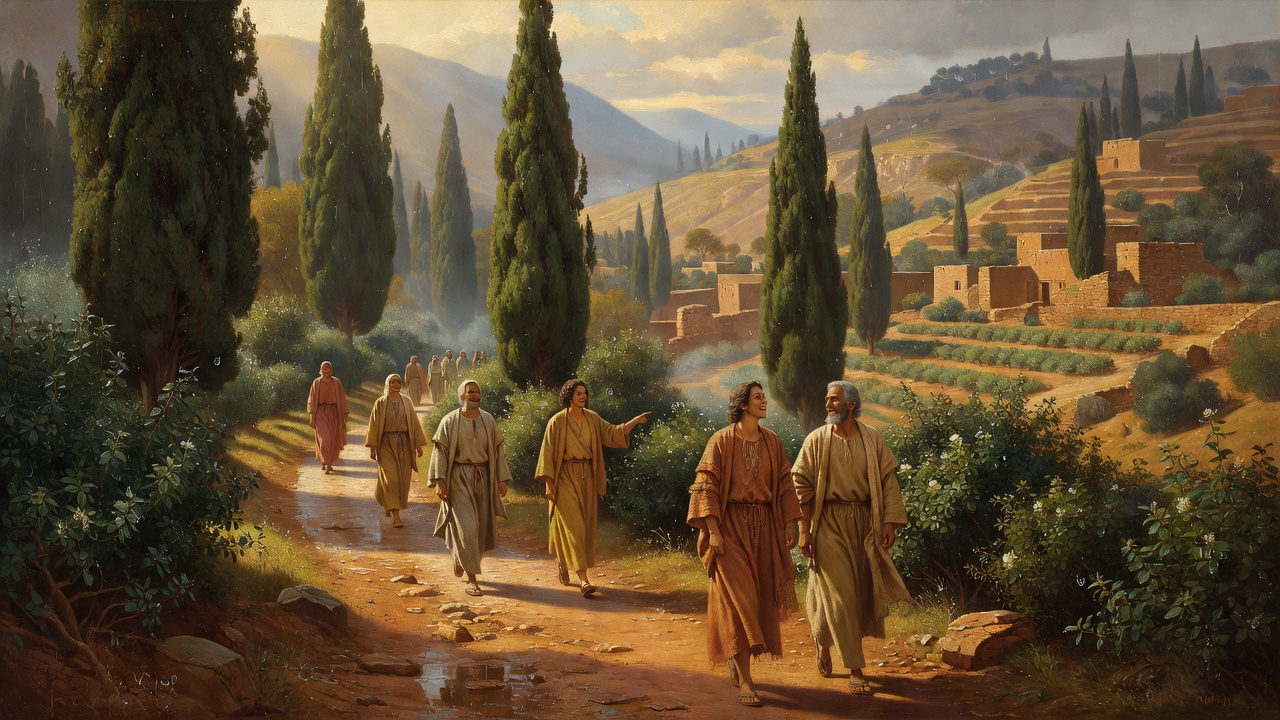
- The prophet compares the effectiveness of the divine word to rain and snow that water the earth, ensuring growth and harvest. This transformation is pictured as lush cypress and myrtle replacing desert thornbushes and briers.Sources: the Bible text itself
Notes written with AI assistance from open sources (Theographic Bible Metadata, CC BY-SA 4.0; Easton’s Bible Dictionary, public domain) and reviewed before publishing.
Credits and license for this translation
LXX2012: Septuagint in British/International English 2012
The Septuagint with Apocrypha, translated from Greek to English by Sir Lancelot C. L. Brenton and published in 1885, with some language updates (British/International English)
Public Domain
Language: English
Dialect (if applicable): British
Language in English: English
Translation by: Sir Lancelot Charles Lee Breton
LXX2012: Septuagint in English 2012, British/International English Edition
This is a translation of the Old Testament and Apocrypha/Deuterocanon from Hebrew to Greek to 19th Century British English, with some updates of spelling and word usage to contemporary British/International English. The original English translation was done by Sir Lancelot Charles Lee Brenton and published by Samuel Bagster & Sons, Ltd., in London in 1851. It has entered the Public Domain due to the passage of sufficient time. In the process of scanning and typing the text, the original poetry and prose formatting, as well as peripheral material like introductions and notes, have been omitted.
This edition of the Septuagint has some language updates. Brenton's word order and punctuation has been mostly retained, meaning that quotation marks are not used, and sentences within quotes may not start with capital letters, as was standard usage in 1851. Names transliterated from Greek to those transliterated from Hebrew in the common English Bibles often differ. These language updates are dedicated to the Public Domain by the author of those edits, Michael Paul Johnson. Therefore this edition may be freely copied, published, etc.
Before considering making changes to the text of this work, I recommend that you consult with God, because this is really His Book.
If you find errors in the text, please report them so that we can correct them.
Donations to help with the expenses of operating this web site and thus help others have free access to the Word of God may be made to us, but are not required. Please see http://MLJohnson.org/partner/ for more about that.
Section headings adapted from the Berean Standard Bible (public domain); they are not part of this translation’s text.
Source: http://ebible.org/eng-uk-lxx2012/ · eBible.org