Isaiah 51
LXX2012: Septuagint in British/International English 2012 · Tap a verse to see its cross-references.
Salvation for Zion
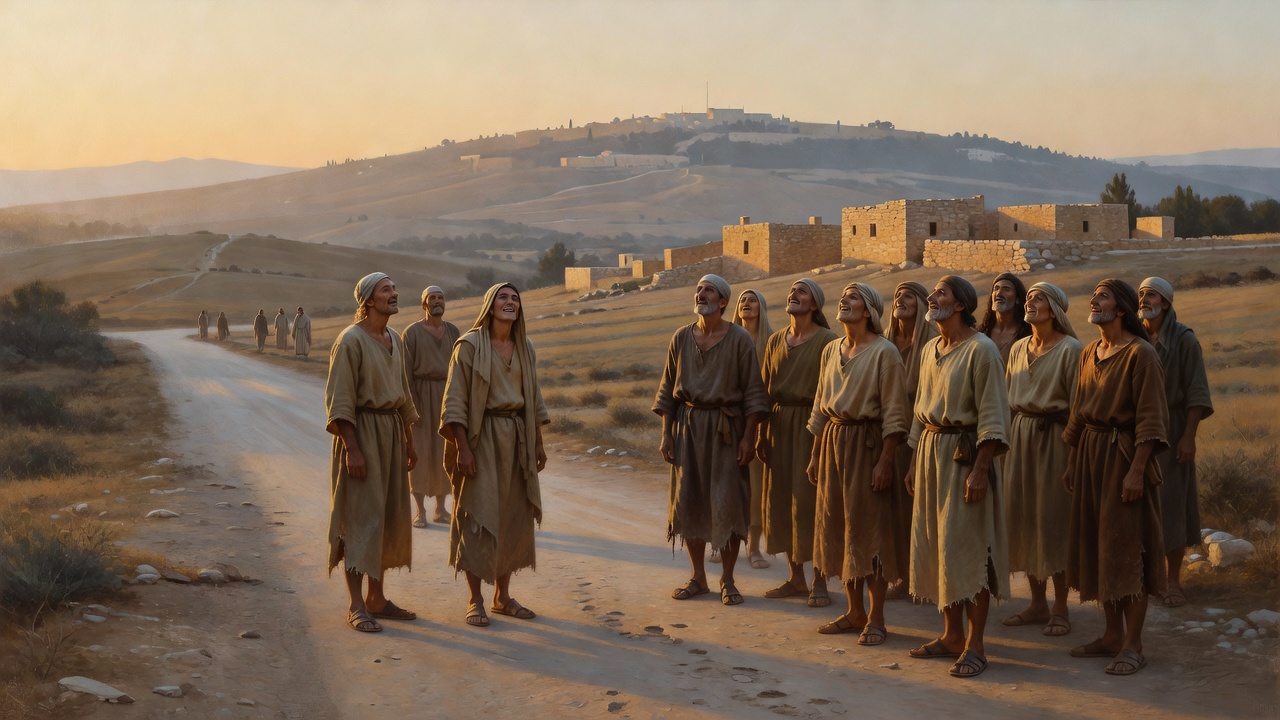
1Listen to me, you⌃ that follow after righteousness, and seek the Lord: look to the solid rock, which you⌃ have hewn, and to the hole of the pit which you⌃ have dug. 2Look to Abraam your father, and to Sarrha that bore you: for he was alone when I called him, and blessed him, and loved him, and multiplied him. 3And now I will comfort you, O Sion: and I have comforted all her desert places; and I will make her desert places as a garden, and her western places as the garden of the Lord; they shall find in her gladness and exultation, thanksgiving and the voice of praise. 4Hear me, hear me, my people; and you⌃ kings, listen to me: for a law shall proceed from me, and my judgement shall be for a light of the nations. 5My righteousness speedily draws near, and my salvation shall go forth as light, and on my arm shall the Gentiles trust: the isles shall wait for me, and on my arm shall they trust. 6Lift up your eyes to the sky, and look on the earth beneath: for the sky was darkened like smoke, and the earth shall wax old like a garment, and the inhabitants shall die in like manner: but my righteousness shall not fail. 7Hear me, you⌃ that know judgement, the people in whose heart is my law: fear not the reproach of men, and be not overcome by their contempt. 8For as a garment will be devoured by time, and as wool will be devoured by a moth, so shall they be consumed; but my righteousness shall be for ever, and my salvation for all generations. 9Awake, awake, O Jerusalem, and put on the strength of your arm; awake as in the early time, as the ancient generation. 10Are you not it that dried the sea, the water, even the abundance of the deep; that made the depths of the sea a way of passage for the delivered and redeemed? 11for by the help of the Lord they shall return, and come to Sion with joy and everlasting exultation, for praise and joy shall come upon their head: pain, and grief, and groaning, have fled away. 12I, even I, am he that comforts you: consider who you are, that you were afraid of mortal man, and of the son of man, who are withered as grass. 13And you have forgotten God who made you, who made the sky and founded the earth; and you were continually afraid because of the wrath of him that afflicted you: for whereas he counselled to take you away, yet now where is the wrath of him that afflicted you? 14For in your deliverance he shall not halt, nor wait; 15for I am your God, that troubles the sea, and causes the waves thereof to roar: the Lord of hosts is my name. 16I will put my words into your mouth, and I will shelter you under the shadow of my hand, with which I fixed the sky, and founded the earth: and the Lord shall say to Sion, You are my people.
God’s Fury Removed
17Awake, awake, stand up, O Jerusalem, that have drunk at the hand of the Lord the cup of his fury: for you have drunk out and drained the cup of calamity, the cup of wrath: 18and there was none to comfort you of all the children whom you bore; and there was none to take hold of your hand, not even of all the children whom you have reared. 19Therefore these things are against you; who shall sympathise with you in your grief? downfall, and destruction, famine, and sword: who shall comfort you? 20Your sons are the perplexed ones, that sleep at the top of every street as a half-boiled beet; they that are full of the anger of the Lord, caused to faint by the Lord God. 21Therefore hear, you afflicted one, and drunken, but not with wine; 22thus says the Lord God that judges his people, Behold, I have taken out of your hand the cup of calamity, the cup of my wrath; and you shall not drink it any more. 23And I will give it into the hands of them that injured you, and them that afflicted you; who said to your soul, Bow down, that we may pass over: and you did level your body with the ground to them passing by without.
Did you know?
Comfort for Zion and the Memory of Origins
- Isaiah 51 urges listeners who seek the Lord to look back to their ancestral roots in Abraham and Sarah. The text recalls how Abraham was called as a single individual before God blessed and multiplied his descendants.Sources: the Bible text itself · Abraham · Sarah
- In verse 9, the name Rahab is a poetic designation applied to Egypt, signifying pride or insolence. The passage evokes God striking this symbolic monster and drying the sea waters during the exodus as a sign of power to redeem captives.Sources: the Bible text itself · Rahab
- The prophecy compares the future renewal of ruined Zion to the lush wilderness of Eden, the garden of the Lord. The text assures Jerusalem that the cup of suffering will be taken from her hands and placed into the hands of her oppressors.Sources: the Bible text itself · Zion · Eden · Jerusalem
Notes written with AI assistance from open sources (Theographic Bible Metadata, CC BY-SA 4.0; Easton’s Bible Dictionary, public domain) and reviewed before publishing.
Places in this chapter
- Zion · Today: Jerusalem · 31.777, 35.234 · verses 3, 11, 16
- Egypt · 30.129, 31.308 · verse 9
- Nile · Today: Nile River · 31.465, 30.367 · verse 9
- Jerusalem · 31.777, 35.234 · verse 17
Only places identified with high confidence are shown (90% or more according to the scholarly sources compiled by OpenBible). Period map: DARE (Digital Atlas of the Roman Empire), CC BY 4.0; modern map: © OpenStreetMap contributors; places: OpenBible.info (CC BY 4.0).
Credits and license for this translation
LXX2012: Septuagint in British/International English 2012
The Septuagint with Apocrypha, translated from Greek to English by Sir Lancelot C. L. Brenton and published in 1885, with some language updates (British/International English)
Public Domain
Language: English
Dialect (if applicable): British
Language in English: English
Translation by: Sir Lancelot Charles Lee Breton
LXX2012: Septuagint in English 2012, British/International English Edition
This is a translation of the Old Testament and Apocrypha/Deuterocanon from Hebrew to Greek to 19th Century British English, with some updates of spelling and word usage to contemporary British/International English. The original English translation was done by Sir Lancelot Charles Lee Brenton and published by Samuel Bagster & Sons, Ltd., in London in 1851. It has entered the Public Domain due to the passage of sufficient time. In the process of scanning and typing the text, the original poetry and prose formatting, as well as peripheral material like introductions and notes, have been omitted.
This edition of the Septuagint has some language updates. Brenton's word order and punctuation has been mostly retained, meaning that quotation marks are not used, and sentences within quotes may not start with capital letters, as was standard usage in 1851. Names transliterated from Greek to those transliterated from Hebrew in the common English Bibles often differ. These language updates are dedicated to the Public Domain by the author of those edits, Michael Paul Johnson. Therefore this edition may be freely copied, published, etc.
Before considering making changes to the text of this work, I recommend that you consult with God, because this is really His Book.
If you find errors in the text, please report them so that we can correct them.
Donations to help with the expenses of operating this web site and thus help others have free access to the Word of God may be made to us, but are not required. Please see http://MLJohnson.org/partner/ for more about that.
Section headings adapted from the Berean Standard Bible (public domain); they are not part of this translation’s text.
Source: http://ebible.org/eng-uk-lxx2012/ · eBible.org