Isaiah 27
LXX2012: Septuagint in British/International English 2012 · Tap a verse to see its cross-references.
The LORD’s Vineyard
1In that day God shall bring his holy and great and strong sword upon the dragon, even the serpent that flees, upon the dragon, the crooked serpent: he shall destroy the dragon. 2In that day there shall be a fair vineyard, and a desire to commence a song concerning it. 3I am a strong city, a city in a siege: in vain shall I water it; for it shall be taken by night, and by day the wall shall fall. 4There is no woman that has not taken hold of it; who will set me to watch stubble in the field? because of this enemy I have set her aside; therefore on this account the Lord has done all that he appointed. 5I am burnt up; they that dwell in her shall cry, Let us make peace with him, let us make peace, 6they that are coming are the children of Jacob. Israel shall bud and blossom, and the world shall be filled with his fruit. 7Shall he himself be thus struck, even as he struck? and as he killed, shall he be thus slain? 8Fighting and reproaching he will dismiss them; did you not meditate with a harsh spirit, to kill them with a wrathful spirit? 9Therefore shall the iniquity of Jacob be taken away; and this is his blessing, when I shall have taken away his sin; when they shall have broken to pieces all the stones of the altars as fine dust, and their trees shall not remain, and their idols shall be cut off, as a thicket afar off. 10The flock that lived there shall be left, as a deserted flock; and the ground shall be for a long time for pasture, and there shall flocks lie down to rest. 11And after a time there shall be in it no green thing because of the grass being parched. Come hither, you⌃ women that come from a sight; for it is a people of no understanding; therefore he that made them shall have no pity upon them, and he that formed them shall have no mercy upon them. 12And it shall come to pass in that day that God shall fence men off from the channel of the river as far as Rhinocorura; but do you⌃ gather one by one the children of Israel. 13And it shall come to pass in that day that they shall blow the great trumpet, and the lost ones in the land of the Assyrians shall come, and the lost ones in Egypt, and shall worship the Lord on the holy mountain in Jerusalem.
Did you know?
The Fruitful Vineyard and the Return of the Exiles
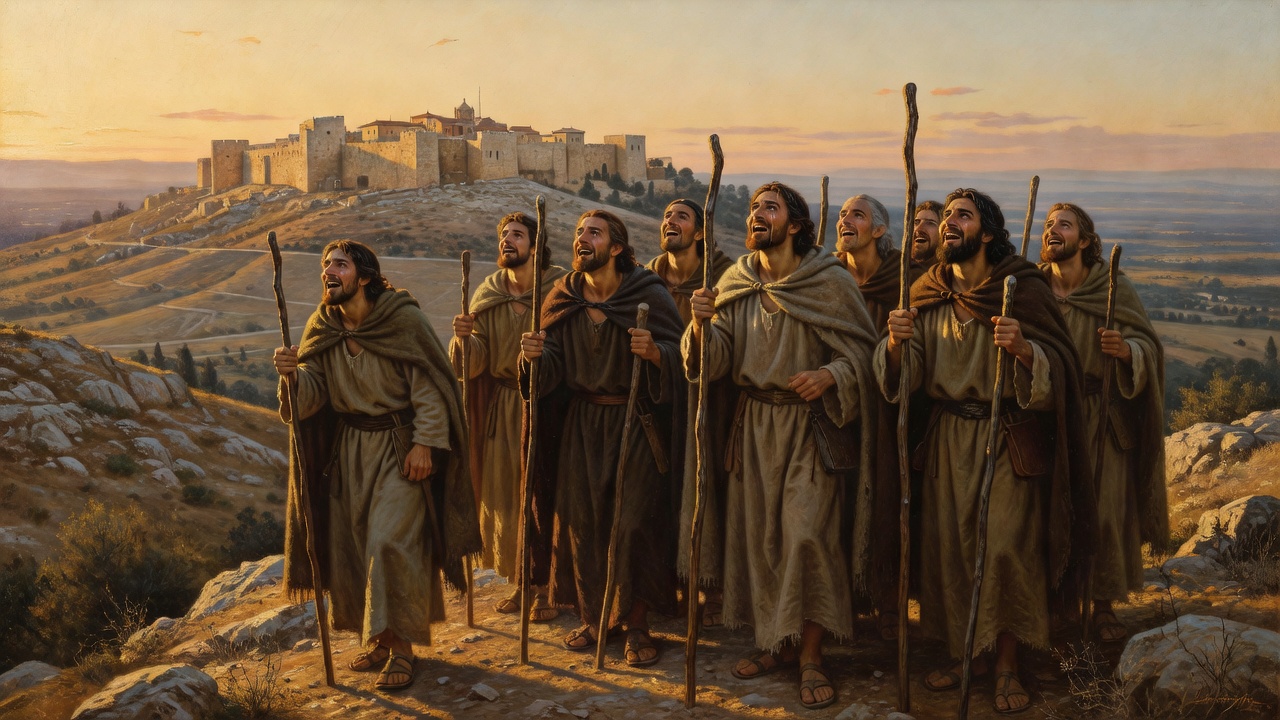
- In Isaiah 27, Israel is portrayed as a fruitful vineyard carefully guarded and continually watered by the Lord so that it will take root and fill the world with fruit. This picture of divine protection and flourishing stands in contrast to the earlier depiction of an unfruitful vineyard in the book.Sources: the Bible text itself
- The prophecy describes the gathering of Israelites between the flowing Euphrates River and the Brook of Egypt. In biblical tradition, these two geographical landmarks defined the expansive borders of the land promised to Abraham's descendants.Sources: the Bible text itself · Euphrates · Brook of Egypt
- The sounding of a great ram's horn is foretold to call back exiles who were dispersed in the powerful empires of Assyria and Egypt. The returning survivors are summoned to worship the Lord together upon the holy mountain in Jerusalem.Sources: the Bible text itself · Assyria · Egypt · Jerusalem
Notes written with AI assistance from open sources (Theographic Bible Metadata, CC BY-SA 4.0; Easton’s Bible Dictionary, public domain) and reviewed before publishing.
Places in this chapter
- Euphrates · Today: Euphrates River · 31.004, 47.442 · verse 12
- Assyria · 36.359, 43.153 · verse 13
- Egypt · 30.129, 31.308 · verse 13
- Jerusalem · 31.777, 35.234 · verse 13
Only places identified with high confidence are shown (90% or more according to the scholarly sources compiled by OpenBible). Period map: DARE (Digital Atlas of the Roman Empire), CC BY 4.0; modern map: © OpenStreetMap contributors; places: OpenBible.info (CC BY 4.0).
Credits and license for this translation
LXX2012: Septuagint in British/International English 2012
The Septuagint with Apocrypha, translated from Greek to English by Sir Lancelot C. L. Brenton and published in 1885, with some language updates (British/International English)
Public Domain
Language: English
Dialect (if applicable): British
Language in English: English
Translation by: Sir Lancelot Charles Lee Breton
LXX2012: Septuagint in English 2012, British/International English Edition
This is a translation of the Old Testament and Apocrypha/Deuterocanon from Hebrew to Greek to 19th Century British English, with some updates of spelling and word usage to contemporary British/International English. The original English translation was done by Sir Lancelot Charles Lee Brenton and published by Samuel Bagster & Sons, Ltd., in London in 1851. It has entered the Public Domain due to the passage of sufficient time. In the process of scanning and typing the text, the original poetry and prose formatting, as well as peripheral material like introductions and notes, have been omitted.
This edition of the Septuagint has some language updates. Brenton's word order and punctuation has been mostly retained, meaning that quotation marks are not used, and sentences within quotes may not start with capital letters, as was standard usage in 1851. Names transliterated from Greek to those transliterated from Hebrew in the common English Bibles often differ. These language updates are dedicated to the Public Domain by the author of those edits, Michael Paul Johnson. Therefore this edition may be freely copied, published, etc.
Before considering making changes to the text of this work, I recommend that you consult with God, because this is really His Book.
If you find errors in the text, please report them so that we can correct them.
Donations to help with the expenses of operating this web site and thus help others have free access to the Word of God may be made to us, but are not required. Please see http://MLJohnson.org/partner/ for more about that.
Section headings adapted from the Berean Standard Bible (public domain); they are not part of this translation’s text.
Source: http://ebible.org/eng-uk-lxx2012/ · eBible.org