Isaiah 11
LXX2012: Septuagint in British/International English 2012 · Tap a verse to see its cross-references.
The Root of Jesse
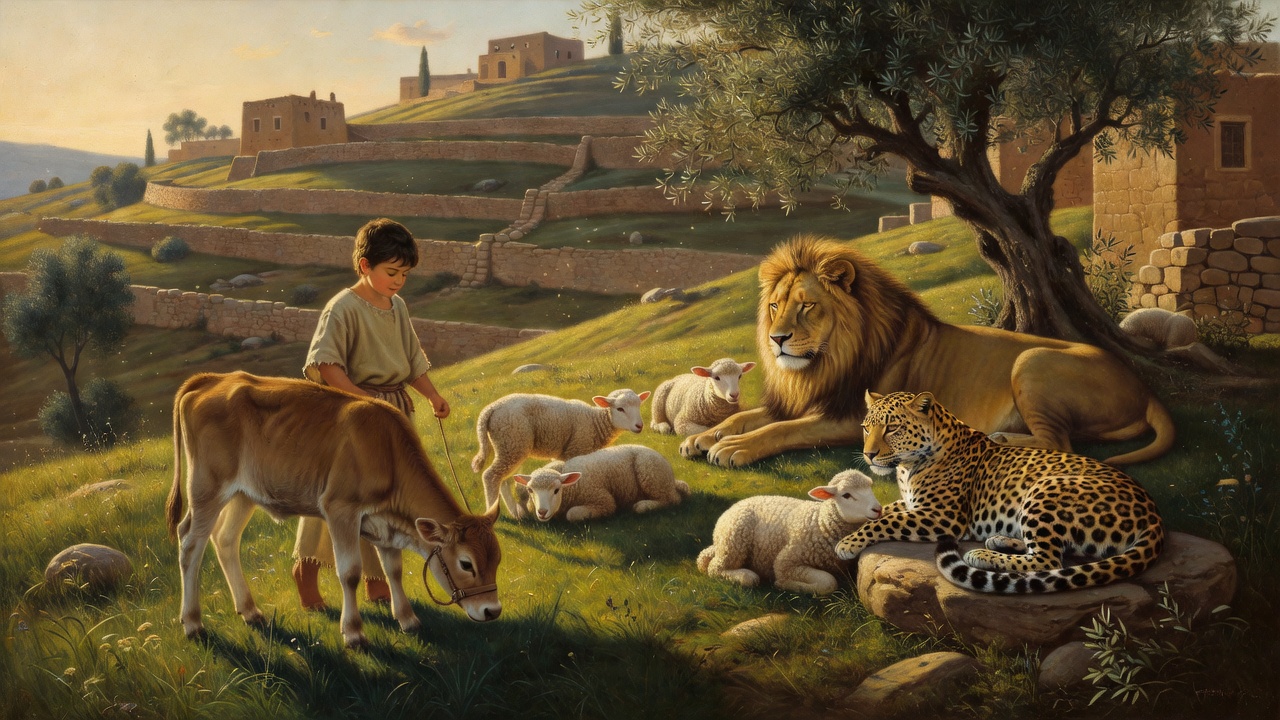
1And there shall come forth a rod out of the root of Jesse, and a blossom shall come up from his root: 2and the Spirit of God shall rest upon him, the spirit of wisdom and understanding, the spirit of counsel and strength, the spirit of knowledge and godliness shall fill him; 3the spirit of the fear of God. He shall not judge according to appearance, nor reprove according to report: 4but he shall judge the cause of the lowly, and shall reprove the lowly of the earth: and he shall strike the earth with the word of his mouth, and with the breath of his lips shall he destroy the ungodly one. 5And he shall have his loins girded with righteousness, and his sides clothed with truth. 6And the wolf shall feed with the lamb, and the leopard shall lie down with the kid; and the young calf and bull and lion shall feed together; and a little child shall lead them. 7And the ox and bear shall feed together; and their young shall be together: and the lion shall eat straw like the ox. 8And an infant shall put his hand on the holes of asps, and on the nest of young asps. 9And they shall not hurt, nor shall they at all be able to destroy any one on my holy mountain: for the whole world is filled with the knowledge of the Lord, as much water covers the seas. 10And in that day there shall be a root of Jesse, and he that shall arise to rule over the Gentiles; in him shall the Gentiles trust, and his rest shall be glorious. 11And it shall be in that day, that the Lord shall again show his hand, to be zealous for the remnant that is left of the people, which shall be left by the Assyrians, and that from Egypt, and from the country of Babylon, and from Ethiopia, and from the Elamites, and from the rising of the sun, and out of Arabia. 12And he shall lift up a standard for the nations, and he shall gather the lost ones of Israel, and he shall gather the dispersed of Juda from the four corners of the earth. 13And the envy of Ephraim shall be taken away, and the enemies of Juda shall perish: Ephraim shall not envy Juda, and Juda shall not afflict Ephraim. 14And they shall fly in the ships of the Philistines: they shall at the same time spoil the sea, and them that come from the east, and Idumea: and they shall lay their hands on Moab first; but the children of Ammon shall first obey them. 15And the Lord shall make desolate the sea of Egypt; and he shall lay his hand on the river with a strong wind, and he shall strike the seven channels, so that men shall pass through it dry-shod. 16And there shall be a passage for my people that is left in Egypt: and it shall be to Israel as the day when he came forth out of the land of Egypt.
Did you know?
The Peaceful Kingdom and the Restored Remnant
- Jesse of Bethlehem was the father of King David. By describing the coming ruler as a shoot from the stump of Jesse and as the root of Jesse, the prophecy points to a renewal of the Davidic line even after the royal house appeared cut down.Sources: Jesse · the Bible text itself
- The places listed for the gathering of the remnant reflect the ancient Near Eastern world: Pathros designates Upper Egypt, Shinar is an ancient name for Babylonia in southern Mesopotamia, and Elam was a highland territory east of Babylon.Sources: Pathros · Shinar · Elam · the Bible text itself
- Ephraim, named for the second son of Joseph, was often used in prophetic literature to represent the northern kingdom of Israel. Isaiah foresees a time of lasting reconciliation that ends the long-standing jealousy and conflict between the northern tribes and Judah.Sources: Ephraim · the Bible text itself
Notes written with AI assistance from open sources (Theographic Bible Metadata, CC BY-SA 4.0; Easton’s Bible Dictionary, public domain) and reviewed before publishing.
Places in this chapter
- Assyria · 36.359, 43.153 · verses 11, 16
- Cush · Today: Cush 1 · 16.935, 33.751 · verse 11
- Egypt · 30.129, 31.308 · verses 11, 16
- Elam · 32.189, 48.258 · verse 11
- Great Sea · Today: Mediterranean Sea · 31.805, 34.170 · verse 11
- Hamath · Today: Hama · 35.136, 36.750 · verse 11
- Pathros · Today: Upper Egypt · 24.100, 32.700 · verse 11
- Shinar · Today: Babylonia · 32.543, 44.422 · verse 11
- Ammon · 31.955, 35.934 · verse 14
- East · Today: region around Amman · 31.955, 35.934 · verse 14
- Edom · 30.746, 35.604 · verse 14
- Moab · Today: Moab 1 · 31.181, 35.701 · verse 14
- Philistia · 31.664, 34.546 · verse 14
- Euphrates · Today: Euphrates River · 31.004, 47.442 · verse 15
Only places identified with high confidence are shown (90% or more according to the scholarly sources compiled by OpenBible). Period map: DARE (Digital Atlas of the Roman Empire), CC BY 4.0; modern map: © OpenStreetMap contributors; places: OpenBible.info (CC BY 4.0).
Credits and license for this translation
LXX2012: Septuagint in British/International English 2012
The Septuagint with Apocrypha, translated from Greek to English by Sir Lancelot C. L. Brenton and published in 1885, with some language updates (British/International English)
Public Domain
Language: English
Dialect (if applicable): British
Language in English: English
Translation by: Sir Lancelot Charles Lee Breton
LXX2012: Septuagint in English 2012, British/International English Edition
This is a translation of the Old Testament and Apocrypha/Deuterocanon from Hebrew to Greek to 19th Century British English, with some updates of spelling and word usage to contemporary British/International English. The original English translation was done by Sir Lancelot Charles Lee Brenton and published by Samuel Bagster & Sons, Ltd., in London in 1851. It has entered the Public Domain due to the passage of sufficient time. In the process of scanning and typing the text, the original poetry and prose formatting, as well as peripheral material like introductions and notes, have been omitted.
This edition of the Septuagint has some language updates. Brenton's word order and punctuation has been mostly retained, meaning that quotation marks are not used, and sentences within quotes may not start with capital letters, as was standard usage in 1851. Names transliterated from Greek to those transliterated from Hebrew in the common English Bibles often differ. These language updates are dedicated to the Public Domain by the author of those edits, Michael Paul Johnson. Therefore this edition may be freely copied, published, etc.
Before considering making changes to the text of this work, I recommend that you consult with God, because this is really His Book.
If you find errors in the text, please report them so that we can correct them.
Donations to help with the expenses of operating this web site and thus help others have free access to the Word of God may be made to us, but are not required. Please see http://MLJohnson.org/partner/ for more about that.
Section headings adapted from the Berean Standard Bible (public domain); they are not part of this translation’s text.
Source: http://ebible.org/eng-uk-lxx2012/ · eBible.org