Genesis 3
LXX2012: Septuagint in British/International English 2012 · Tap a verse to see its cross-references.
The Serpent’s Deception
1And the two were naked, both Adam and his wife, and were not ashamed. Now the serpent was the most crafty of all the brutes on the earth, which the Lord God made, and the serpent said to the woman, Therefore has God said, Eat not of every tree of the garden? 2And the woman said to the serpent, We may eat of the fruit of the trees of the garden, 3but of the fruit of the tree which is in the midst of the garden, God said, You⌃ shall not eat of it, neither shall you⌃ touch it, lest you⌃ die. 4And the serpent said to the woman, You⌃ shall not surely die. 5For God knew that in whatever day you⌃ should eat of it your eyes would be opened, and you⌃ would be as gods, knowing good and evil. 6And the woman saw that the tree was good for food, and that it was pleasant to the eyes to look upon and beautiful to contemplate, and having taken of its fruit she ate, and she gave to her husband also with her, and they ate. 7And the eyes of both were opened, and they perceived that they were naked, and they sewed fig leaves together, and made themselves aprons to go round them.
God Arraigns Adam and Eve
8And they heard the voice of the Lord God walking in the garden in the afternoon; and both Adam and his wife hid themselves from the face of the Lord God in the midst of the trees of the garden. 9And the Lord God called Adam and said to him, Adam, where are you? 10And he said to him, I heard your voice as you walked in the garden, and I feared because I was naked and I hid myself. 11And God said to him, Who told you that you were naked, unless you have eaten of the tree concerning which I charged you of it alone not to eat? 12And Adam said, The woman whom you gave to be with me—she gave me of the tree and I ate. 13And the Lord God said to the woman, Why have you done this? And the woman said, The serpent deceived me and I ate.
The Fate of the Serpent
14And the Lord God said to the serpent, Because you have done this you are cursed above all cattle and all the brutes of the earth, on your breast and belly you shall go, and you shall eat earth all the days of your life. 15And I will put enmity between you and the woman and between your seed and her seed, he shall watch against your head, and you shall watch against his heel.
The Punishment of Mankind
16And to the woman he said, I will greatly multiply your pains and your groanings; in pain you shall bring forth children, and your submission shall be to your husband, and he shall rule over you. 17And to Adam he said, Because you have listened to the voice of your wife, and eaten of the tree concerning which I charged you of it only not to eat—of that you have eaten, cursed is the ground in your labours, in pain shall you eat of it all the days of your life. 18Thorns and thistles shall it bring forth to you, and you shall eat the herb of the field. 19In the sweat of your face shall you eat your bread until you return to the earth out of which you were taken, for earth you are and to earth you shall return. 20And Adam called the name of his wife Life, because she was the mother of all living.
The Expulsion from Paradise
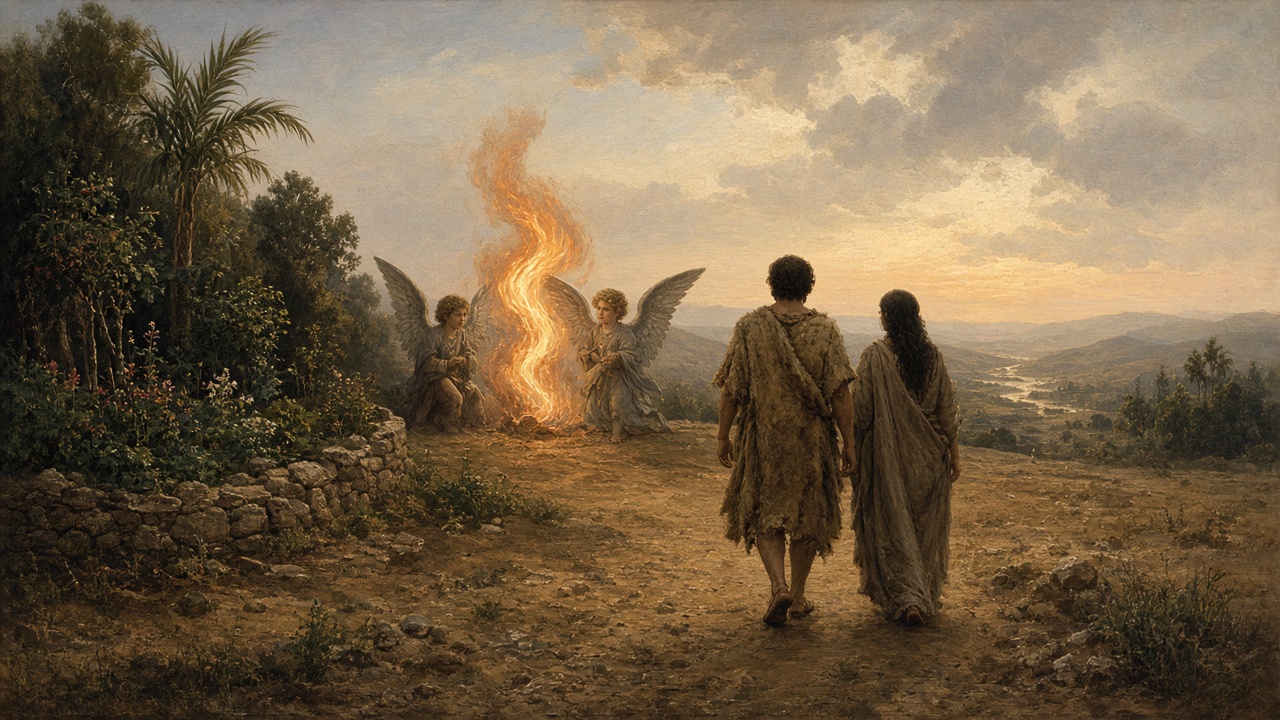
21And the Lord God made for Adam and his wife garments of skin, and clothed them. 22And God said, Behold, Adam is become as one of us, to know good and evil, and now lest at any time he stretch forth his hand, and take of the tree of life and eat, and so he shall live forever— 23So the Lord God sent him forth out of the garden of Delight to cultivate the ground out of which he was taken. 24And he cast out Adam and caused him to dwell over against the garden of Delight, and stationed the cherubs and the fiery sword that turns about to keep the way of the tree of life.
Did you know?
The Fall and Exile from Eden
- A traditional reference explains Adam as “red,” a Babylonian word used as the generic name for man, with the same meaning in Hebrew and Assyrian, and links the name to his being formed from the dust of the earth. In this chapter that origin returns in the judgment: he will toil for his food until he returns to the ground, for he is dust and to dust he will return, and he is sent to work the soil from which he was taken.Sources: Adam · the Bible text itself
- In this chapter Adam gives his wife the name Eve, meaning “life” or “living,” because she would be the mother of all the living.Sources: Eve · the Bible text itself
- The site of the garden of Eden, from which the man is driven in this chapter, has been much discussed and placed in Armenia, west of the Caspian Sea, in Media, near Damascus, in Palestine, in southern Arabia, and in Babylonia. A traditional geographical note looks for it along the Tigris and the Euphrates, in the land of Shinar, or Babylonia.Sources: Eden · the Bible text itself
Notes written with AI assistance from open sources (Theographic Bible Metadata, CC BY-SA 4.0; Easton’s Bible Dictionary, public domain) and reviewed before publishing.
Credits and license for this translation
LXX2012: Septuagint in British/International English 2012
The Septuagint with Apocrypha, translated from Greek to English by Sir Lancelot C. L. Brenton and published in 1885, with some language updates (British/International English)
Public Domain
Language: English
Dialect (if applicable): British
Language in English: English
Translation by: Sir Lancelot Charles Lee Breton
LXX2012: Septuagint in English 2012, British/International English Edition
This is a translation of the Old Testament and Apocrypha/Deuterocanon from Hebrew to Greek to 19th Century British English, with some updates of spelling and word usage to contemporary British/International English. The original English translation was done by Sir Lancelot Charles Lee Brenton and published by Samuel Bagster & Sons, Ltd., in London in 1851. It has entered the Public Domain due to the passage of sufficient time. In the process of scanning and typing the text, the original poetry and prose formatting, as well as peripheral material like introductions and notes, have been omitted.
This edition of the Septuagint has some language updates. Brenton's word order and punctuation has been mostly retained, meaning that quotation marks are not used, and sentences within quotes may not start with capital letters, as was standard usage in 1851. Names transliterated from Greek to those transliterated from Hebrew in the common English Bibles often differ. These language updates are dedicated to the Public Domain by the author of those edits, Michael Paul Johnson. Therefore this edition may be freely copied, published, etc.
Before considering making changes to the text of this work, I recommend that you consult with God, because this is really His Book.
If you find errors in the text, please report them so that we can correct them.
Donations to help with the expenses of operating this web site and thus help others have free access to the Word of God may be made to us, but are not required. Please see http://MLJohnson.org/partner/ for more about that.
Section headings adapted from the Berean Standard Bible (public domain); they are not part of this translation’s text.
Source: http://ebible.org/eng-uk-lxx2012/ · eBible.org