Genesis 25
LXX2012: Septuagint in British/International English 2012 · Tap a verse to see its cross-references.
Abraham and Keturah
1And Abraam again took a wife, whose name was Chettura. 2And she bore to him Zombran, and Jezan, and Madal, and Madiam, and Jesboc, and Soie. 3And Jezan begot Saba and Dedan. And the sons of Dedan were the Assurians and the Latusians, and Laomim. 4And the sons of Madiam were Gephar and Aphir, and Enoch, and Abeida, and Eldaga; all these were sons of Chettura. 5But Abraam gave all his possessions to Isaac his son. 6But to the sons of his concubines Abraam gave gifts, and he sent them away from his son Isaac, while he was yet living, to the east into the country of the east.
The Death of Abraham
7And these were the years of the days of the life of Abraam as many as he lived, one hundred and seventy-five years. 8And Abraam failing died in a good old age, an old man and full of days, and was added to his people. 9And Isaac and Ismael his sons buried him in the double cave, in the field of Ephron the son of Saar the Chettite, which is over against Mambre: 10even the field and the cave which Abraam bought of the sons of Chet; there they buried Abraam and Sarrha his wife. 11And it came to pass after Abraam was dead, that God blessed Isaac his son, and Isaac lived by the well of the vision.
The Descendants of Ishmael
12And these are the generations of Ismael the son of Abraam, whom Agar the Egyptian the handmaid of Sarrha bore to Abraam. 13And these are the names of the sons of Ismael, according to the names of their generations. The firstborn of Ismael, Nabaioth, and Kedar, and Nabdeel, and Massam, 14and Masma, and Duma, and Masse, 15and Choddan, and Thaeman, and Jetur, and Naphes, and Kedma. 16These are the sons of Ismael, and these are their names in their tents and in their dwellings, twelve princes according to their nations. 17And these are the years of the life of Ismael, one hundred and thirty-seven years; and he failed and died, and was added to his fathers. 18And he lived from Evilat to Sur, which is opposite Egypt, until one comes to the Assyrians; he lived in the presence of all his brethren.
Jacob and Esau
19And these are the generations of Isaac the son of Abraam. 20Abraam begot Isaac. And Isaac was forty years old when he took as wife Rebecca, daughter of Bathuel the Syrian, out of Syrian Mesopotamia, sister of Laban the Syrian. 21And Isaac prayed the Lord concerning Rebecca his wife, because she was barren; and the Lord heard him, and his wife Rebecca conceived in her womb. 22And the babes leapt within her; and she said, If it will be so with me, why is this to me? And she went to enquire of the Lord. 23And the Lord said to her, There are two nations in your womb, and two peoples shall be separated from your belly, and one people shall excel the other, and the elder shall serve the younger. 24And the days were fulfilled that she should be delivered, and she had twins in her womb. 25And the first came out red, hairy all over like a skin; and she called his name Esau. 26And after this came forth his brother, and his hand took hold of the heel of Esau; and she called his name Jacob. And Isaac was sixty years old when Rebecca bore them. 27And the lads grew, and Esau was a man skilled in hunting, dwelling in the country, and Jacob a simple man, dwelling in a house. 28And Isaac loved Esau, because his venison was his food, but Rebecca loved Jacob.
Esau Sells His Birthright
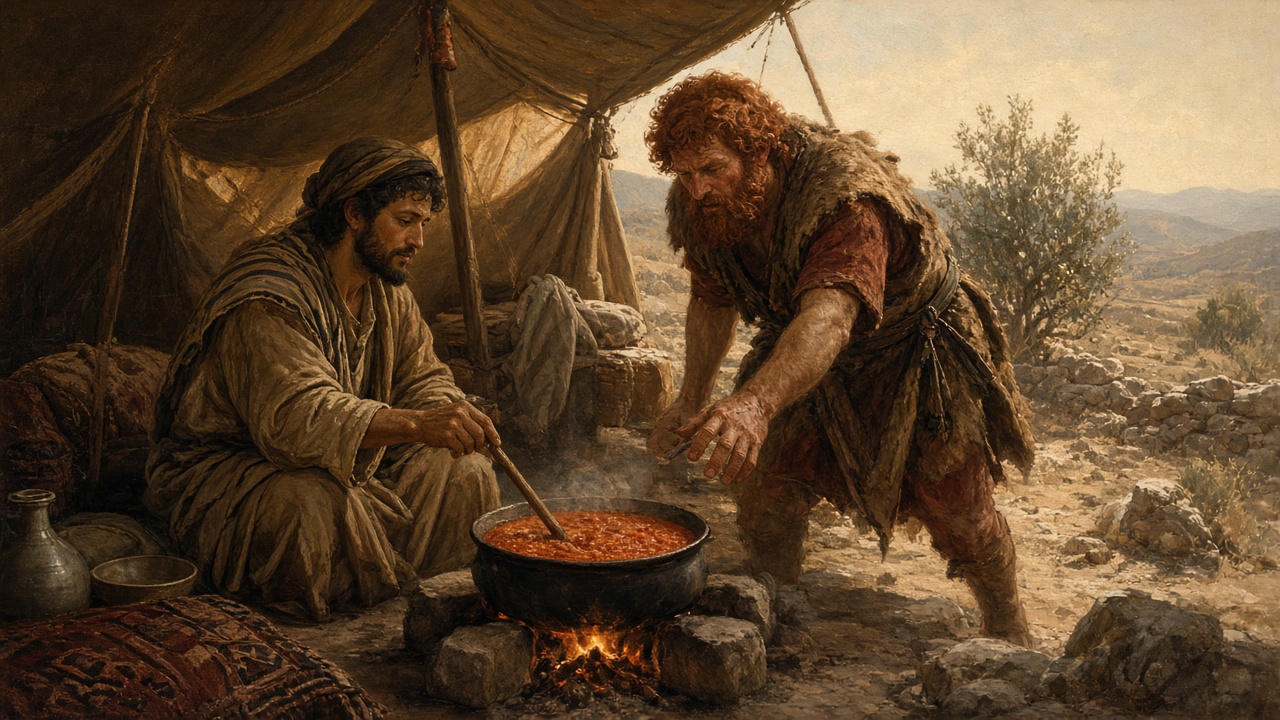
29And Jacob cooked pottage, and Esau came from the plain, fainting. 30And Esau said to Jacob, Let me taste of that red pottage, because I am fainting; therefore his name was called Edom. 31And Jacob said to Esau, Sell me this day your birthright. 32And Esau said, Behold, I am going to die, and for what good does this birthright belong to me? 33And Jacob said to him, Swear to me this day; and he swore to him; and Esau sold his birthright to Jacob. 34And Jacob gave bread to Esau, and pottage of lentiles; and he ate and drank, and he arose and departed; so Esau slighted his birthright.
Did you know?
Abraham’s heirs and the twin brothers
- Keturah, whose name Easton's Bible Dictionary (1897) explains as “incense,” is introduced here as another wife of Abraham. That dictionary says he probably married her after Sarah’s death, though her nationality is unknown, and notes that 1 Chronicles calls her a concubine. She bore him six sons, including Jokshan and Midian, the father of the Midianites; while Abraham was still alive he gave gifts to the sons of his concubines and sent them away from Isaac to the land of the east.Sources: Keturah · Midian · the Bible text itself
- Isaac and Ishmael together buried Abraham in the cave of Machpelah near Mamre, in the field Abraham had bought from Ephron the Hittite, where Sarah already lay. Easton's Bible Dictionary (1897) explains Machpelah as “portion” or “double cave,” set on a hillside east of Hebron and facing Mamre, a place called the oaks—or, in a margin, the terebinths—of Mamre.Sources: Machpelah · Mamre · the Bible text itself
- Esau, Rebekah’s firstborn twin, was born red and covered with hair like a fur coat. Easton's Bible Dictionary (1897) links the further name Edom, “red,” to the red lentil stew for which he sold his birthright, and explains Jacob as “one who follows on another’s heels” or “supplanter,” matching the report that Jacob was born grasping Esau’s heel. Esau grew up as a skillful hunter and a man of the field, while Jacob was a quiet man who stayed at home.Sources: Esau (Edom) · Jacob (Israel) · the Bible text itself
Notes written with AI assistance from open sources (Theographic Bible Metadata, CC BY-SA 4.0; Easton’s Bible Dictionary, public domain) and reviewed before publishing.
Places in this chapter
- East · Today: region around Amman · 31.955, 35.934 · verse 6
- Machpelah · Today: Cave of the Patriarchs · 31.525, 35.111 · verse 9
- Negeb · 31.245, 34.841 · verse 11
- Assyria · 36.359, 43.153 · verse 18
- Egypt · 30.129, 31.308 · verse 18
Only places identified with high confidence are shown (90% or more according to the scholarly sources compiled by OpenBible). Period map: DARE (Digital Atlas of the Roman Empire), CC BY 4.0; modern map: © OpenStreetMap contributors; places: OpenBible.info (CC BY 4.0).
Credits and license for this translation
LXX2012: Septuagint in British/International English 2012
The Septuagint with Apocrypha, translated from Greek to English by Sir Lancelot C. L. Brenton and published in 1885, with some language updates (British/International English)
Public Domain
Language: English
Dialect (if applicable): British
Language in English: English
Translation by: Sir Lancelot Charles Lee Breton
LXX2012: Septuagint in English 2012, British/International English Edition
This is a translation of the Old Testament and Apocrypha/Deuterocanon from Hebrew to Greek to 19th Century British English, with some updates of spelling and word usage to contemporary British/International English. The original English translation was done by Sir Lancelot Charles Lee Brenton and published by Samuel Bagster & Sons, Ltd., in London in 1851. It has entered the Public Domain due to the passage of sufficient time. In the process of scanning and typing the text, the original poetry and prose formatting, as well as peripheral material like introductions and notes, have been omitted.
This edition of the Septuagint has some language updates. Brenton's word order and punctuation has been mostly retained, meaning that quotation marks are not used, and sentences within quotes may not start with capital letters, as was standard usage in 1851. Names transliterated from Greek to those transliterated from Hebrew in the common English Bibles often differ. These language updates are dedicated to the Public Domain by the author of those edits, Michael Paul Johnson. Therefore this edition may be freely copied, published, etc.
Before considering making changes to the text of this work, I recommend that you consult with God, because this is really His Book.
If you find errors in the text, please report them so that we can correct them.
Donations to help with the expenses of operating this web site and thus help others have free access to the Word of God may be made to us, but are not required. Please see http://MLJohnson.org/partner/ for more about that.
Section headings adapted from the Berean Standard Bible (public domain); they are not part of this translation’s text.
Source: http://ebible.org/eng-uk-lxx2012/ · eBible.org