Genesis 22
LXX2012: Septuagint in British/International English 2012 · Tap a verse to see its cross-references.
The Offering of Isaac
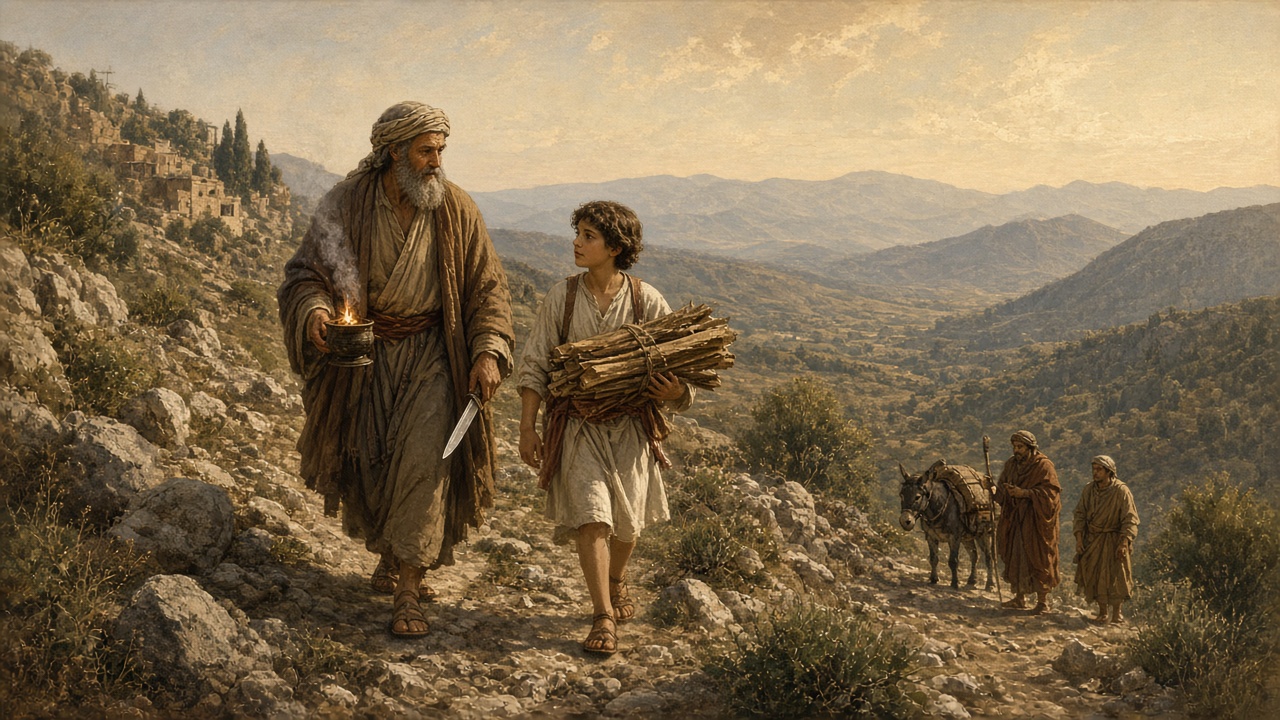
1And it came to pass after these things that God tempted Abraam, and said to him, Abraam, Abraam; and he said, Behold! I am here. 2And he said, Take your son, the beloved one, whom you have loved—Isaac, and go into the high land, and offer him there for a whole burnt offering on one of the mountains which I will tell you of. 3And Abraam rose up in the morning and saddled his ass, and he took with him two servants, and Isaac his son, and having split wood for a whole burnt offering, he arose and departed, and came to the place of which God spoke to him, 4on the third day; and Abraam having lifted up his eyes, saw the place afar off. 5And Abraam said to his servants, Sit you⌃ here with the ass, and I and the lad will proceed thus far, and having worshipped we will return to you. 6And Abraam took the wood of the whole burnt offering, and laid it on Isaac his son, and he took into his hands both the fire and the knife, and the two went together. 7And Isaac said to Abraam his father, Father. And he said, What is it, son? And he said, Behold the fire and the wood, where is the sheep for a whole burnt offering? 8And Abraam said, God will provide himself a sheep for a whole burnt offering, my son. And both having gone together, 9came to the place which God spoke of to him; and there Abraam built the altar, and laid the wood on it, and having bound the feet of Isaac his son together, he laid him on the altar upon the wood. 10And Abraam stretched forth his hand to take the knife to kill his son.
The LORD Provides the Sacrifice
11And an angel of the Lord called him out of heaven, and said, Abraam, Abraam. And he said, Behold, I am here. 12And he said, Lay not your hand upon the child, neither do anything to him, for now I know that you fear God, and for my sake you have not spared your beloved son. 13And Abraam lifted up his eyes and saw, and behold! a ram caught by his horns in a plant of Sabec; and Abraam went and took the ram, and offered him up for a whole burnt offering in the place of Isaac his son. 14And Abraam called the name of that place, The Lord has seen; that they might say today, In the mount the Lord was seen. 15And an angel of the Lord called Abraam the second time out of heaven, saying, I have sworn by myself, says the Lord, because you have done this thing, and on my account have not spared your beloved son, 16surely blessing I will bless you, and multiplying I will multiply your seed as the stars of heaven, and as the sand which is by the shore of the sea, and your seed shall inherit the cities of their enemies. 17And in your seed shall all the nations of the earth be blessed, because you have listened to my voice. 18And Abraam returned to his servants, and they arose and went together to the well of the oath; and Abraam lived at the well of the oath. 19And it came to pass after these things, that it was reported to Abraam, saying, Behold, Melcha herself too has born sons to Nachor your brother,
The Sons of Nahor
20Uz the firstborn, and Baux his brother, and Camuel the father of the Syrians, and Chazad, and 21Azav and Phaldes, and Jeldaph, and Bathuel, and Bathuel begot Rebecca; 22these are eight sons, which Melcha bore to Nachor the brother of Abraam. 23And his concubine whose name was Rheuma, she also bore Tabec, and Taam, and Tochos, and Mocha.
Did you know?
God Tests Abraham
- Isaac was Abraham’s only son by Sarah. The next memorable event recorded in his life, after he was weaned, is God’s command that Abraham offer him as a burnt offering on a mountain in the land of Moriah.Sources: Isaac · the Bible text itself
- Easton's Bible Dictionary (1897) notes that some contend the land of Moriah is Mount Gerizim, but regards it as most probably one of the hills of Jerusalem, northeast of Zion, where Solomon’s temple was built on the threshing-floor of Ornan the Jebusite.Sources: Moriah
- The chapter ends with news of Abraham’s relatives: his brother Nahor had remained in Haran, east of the Euphrates, and Milcah had borne him eight sons, among them Bethuel, Rebekah’s father. Rebekah became Isaac’s wife, and contact between the family in Canaan and the kin at Haran lasted until Jacob left Haran.Sources: Nahor (brother of Abraham) · Bethuel · the Bible text itself
Notes written with AI assistance from open sources (Theographic Bible Metadata, CC BY-SA 4.0; Easton’s Bible Dictionary, public domain) and reviewed before publishing.
Credits and license for this translation
LXX2012: Septuagint in British/International English 2012
The Septuagint with Apocrypha, translated from Greek to English by Sir Lancelot C. L. Brenton and published in 1885, with some language updates (British/International English)
Public Domain
Language: English
Dialect (if applicable): British
Language in English: English
Translation by: Sir Lancelot Charles Lee Breton
LXX2012: Septuagint in English 2012, British/International English Edition
This is a translation of the Old Testament and Apocrypha/Deuterocanon from Hebrew to Greek to 19th Century British English, with some updates of spelling and word usage to contemporary British/International English. The original English translation was done by Sir Lancelot Charles Lee Brenton and published by Samuel Bagster & Sons, Ltd., in London in 1851. It has entered the Public Domain due to the passage of sufficient time. In the process of scanning and typing the text, the original poetry and prose formatting, as well as peripheral material like introductions and notes, have been omitted.
This edition of the Septuagint has some language updates. Brenton's word order and punctuation has been mostly retained, meaning that quotation marks are not used, and sentences within quotes may not start with capital letters, as was standard usage in 1851. Names transliterated from Greek to those transliterated from Hebrew in the common English Bibles often differ. These language updates are dedicated to the Public Domain by the author of those edits, Michael Paul Johnson. Therefore this edition may be freely copied, published, etc.
Before considering making changes to the text of this work, I recommend that you consult with God, because this is really His Book.
If you find errors in the text, please report them so that we can correct them.
Donations to help with the expenses of operating this web site and thus help others have free access to the Word of God may be made to us, but are not required. Please see http://MLJohnson.org/partner/ for more about that.
Section headings adapted from the Berean Standard Bible (public domain); they are not part of this translation’s text.
Source: http://ebible.org/eng-uk-lxx2012/ · eBible.org