Ezra 9
LXX2012: Septuagint in British/International English 2012 · Tap a verse to see its cross-references.
Intermarriage with Neighboring Peoples
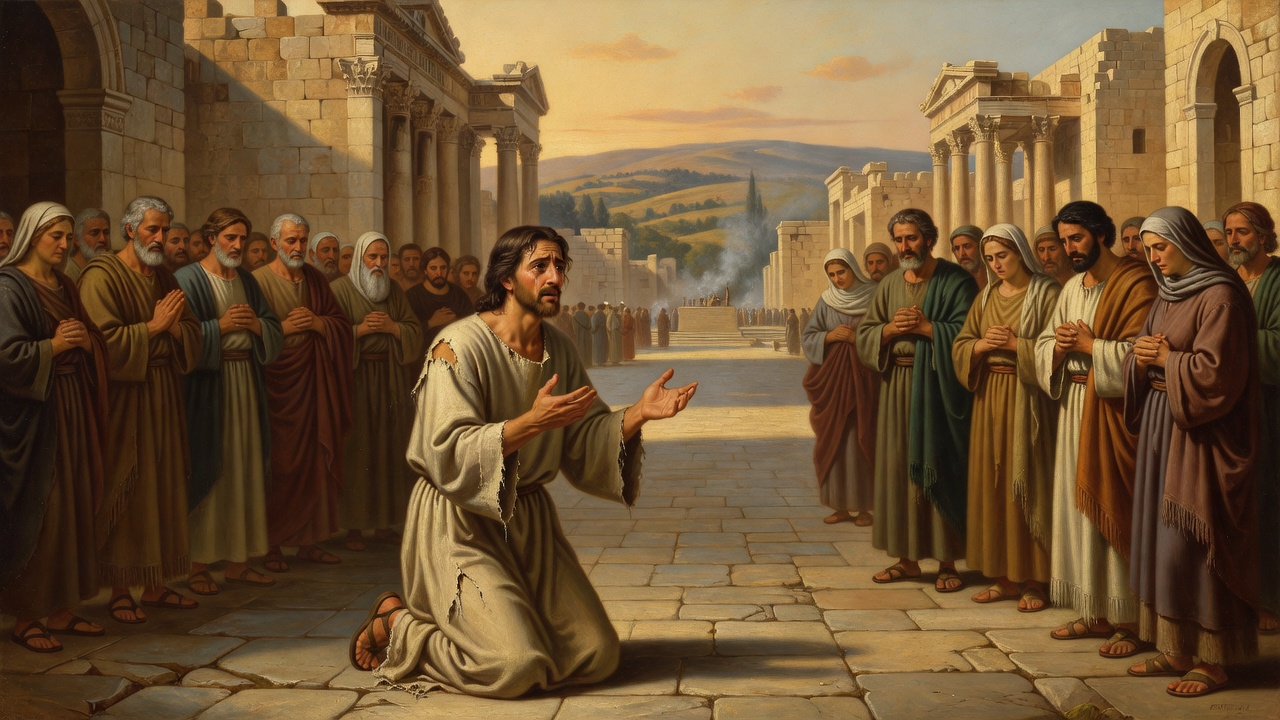
1And when these things were finished, the princes drew near to me, saying, The people of Israel, and the priests, and the Levites, have not separated themselves from the people of the lands in their abominations, even the Chananite, the Ethite, the Pherezite, the Jebusite, the Ammonite, the Moabite, and the Moserite and the Amorite. 2For they have taken of their daughters for themselves and their sons; and the holy seed has passed amongst the nations of the lands, and the hand of the rulers has been first in this transgression. 3And when I heard this thing, I tore my garments, and trembled, and plucked some of the hairs of my head and of my beard, and sat down mourning. 4Then there assembled to me all that followed the word of the God of Israel, on account of the transgression of the captivity; and I remained mourning until the evening sacrifice.
Ezra’s Prayer of Confession
5And at the evening sacrifice I rose up from my humiliation; and when I had torn my garments, then I trembled, and I bow myself on my knees, and spread out my hands to the Lord God, 6and I said, O Lord, I am ashamed and confounded, O my God, to lift up my face to you: for our transgressions have abounded over our head, and our trespasses have increased even to heaven. 7From the days of our fathers we have been in a great trespass until this day: and because of our iniquities we, and our kings, and our children, have been delivered into the hand of the kings of the Gentiles by the sword, and by captivity, and by spoil, and with shame of our face, as at this day. 8And now our God has dealt mercifully with us, so as to leave us to escape, and to give us an establishment in the place of his sanctuary, to enlighten our eyes, and to give a little quickening in our servitude. 9For we are slaves, yet in our servitude the Lord our God has not deserted us; and he has extended favour to us in the sight of the kings of the Persians, to give us a quickening, that they should raise up the house of our God, and restore the desolate places of it, and to give us a fence in Juda and Jerusalem. 10What shall we say, our God, after this? for we have forsaken your commandments, 11which you have given us by the hand of your servants the prophets, saying, The land, into which you⌃ go to inherit it, is a land subject to disturbance by the removal of the people of the nations for their abominations, wherewith they have filled it from one end to the other by their uncleanness. 12And now give not your daughters to their sons, and take not of their daughters for your sons, neither shall you⌃ seek their peace or their good for ever: that you⌃ may be strong, and eat the good of the land, and transmit it as an inheritance to your children for ever. 13And after all that is come upon us because of our evil deeds, and our great trespass, it is clear that there is none such as our God, for you have lightly visited our iniquities, and given us deliverance; 14whereas we have repeatedly broken your commandments, and intermarried with the people of the lands: be not very angry with us to our utter destruction, so that there should be no remnant or escaping one. 15O Lord God of Israel, you are righteous; for we remain yet escaped, as at this day: behold, we are before you in our trespasses: for we can’t stand before you on this account.
Did you know?
Ezra's Prayer of Confession
- When Ezra learned that the returned exiles and their leaders had intermarried with surrounding peoples, he expressed extreme grief by tearing his tunic and cloak, pulling hair from his head and beard, and sitting in shock until the evening offering.Sources: the Bible text itself
- In his prayer of confession, Ezra recognized that God had extended mercy to the remnant through the kings of the Persian Empire, who allowed the Judeans to rebuild the temple in Jerusalem even while remaining foreign subjects.Sources: the Bible text itself · Persia · Jerusalem
Notes written with AI assistance from open sources (Theographic Bible Metadata, CC BY-SA 4.0; Easton’s Bible Dictionary, public domain) and reviewed before publishing.
Places in this chapter
- Jerusalem · 31.777, 35.234 · verse 9
- Judea · Today: Judea 2 · 31.777, 35.234 · verse 9
- Persia · 34.806, 48.516 · verse 9
Only places identified with high confidence are shown (90% or more according to the scholarly sources compiled by OpenBible). Period map: DARE (Digital Atlas of the Roman Empire), CC BY 4.0; modern map: © OpenStreetMap contributors; places: OpenBible.info (CC BY 4.0).
Credits and license for this translation
LXX2012: Septuagint in British/International English 2012
The Septuagint with Apocrypha, translated from Greek to English by Sir Lancelot C. L. Brenton and published in 1885, with some language updates (British/International English)
Public Domain
Language: English
Dialect (if applicable): British
Language in English: English
Translation by: Sir Lancelot Charles Lee Breton
LXX2012: Septuagint in English 2012, British/International English Edition
This is a translation of the Old Testament and Apocrypha/Deuterocanon from Hebrew to Greek to 19th Century British English, with some updates of spelling and word usage to contemporary British/International English. The original English translation was done by Sir Lancelot Charles Lee Brenton and published by Samuel Bagster & Sons, Ltd., in London in 1851. It has entered the Public Domain due to the passage of sufficient time. In the process of scanning and typing the text, the original poetry and prose formatting, as well as peripheral material like introductions and notes, have been omitted.
This edition of the Septuagint has some language updates. Brenton's word order and punctuation has been mostly retained, meaning that quotation marks are not used, and sentences within quotes may not start with capital letters, as was standard usage in 1851. Names transliterated from Greek to those transliterated from Hebrew in the common English Bibles often differ. These language updates are dedicated to the Public Domain by the author of those edits, Michael Paul Johnson. Therefore this edition may be freely copied, published, etc.
Before considering making changes to the text of this work, I recommend that you consult with God, because this is really His Book.
If you find errors in the text, please report them so that we can correct them.
Donations to help with the expenses of operating this web site and thus help others have free access to the Word of God may be made to us, but are not required. Please see http://MLJohnson.org/partner/ for more about that.
Section headings adapted from the Berean Standard Bible (public domain); they are not part of this translation’s text.
Source: http://ebible.org/eng-uk-lxx2012/ · eBible.org