Ezra 5
LXX2012: Septuagint in British/International English 2012 · Tap a verse to see its cross-references.
Temple Rebuilding Resumes
1And Aggaeus the prophet, and Zacharias the son of Addo, prophesied a prophesy to the Jews in Juda and Jerusalem in the name of the God of Israel, even to them. 2Then rose up Zorobabel the son of Salathiel, and Jesus the son of Josedec, and began to build the house of God that was in Jerusalem: and with them were the prophets of God assisting them. 3At the same time came there upon them Thanthanai, the governor on this side the river, and Satharbuzanai, and their fellow-servants, and spoke thus to them, Who has ordained a decree for you to build this house, and to provide this preparation? 4Then they spoke thus to them, What are the names of the men that build this city? 5But the eyes of God were upon the captivity of Juda, and they did not cause them to cease till the decree was brought to Darius; and then was sent by the tribute-gatherer concerning this
Tattenai’s Letter to Darius
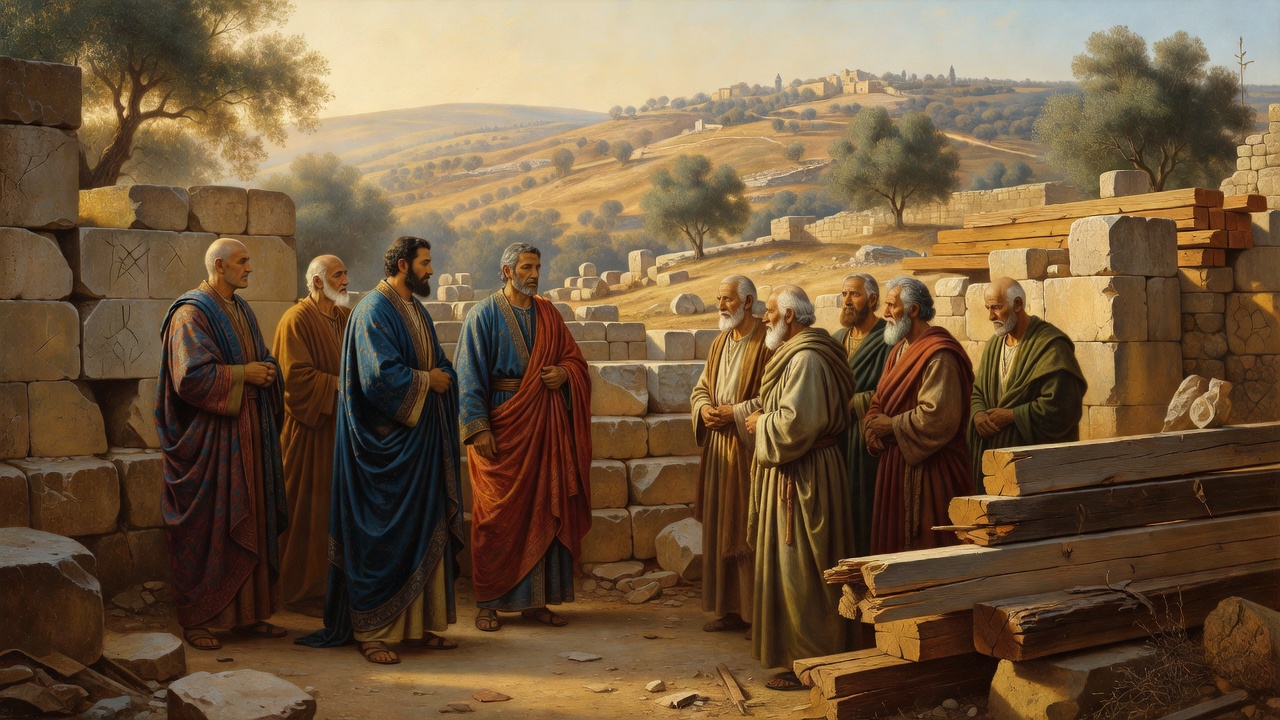
6the copy of a letter, which Thanthanai, the governor of the part on this side the river, and Satharbuzanai, and their fellow-servants the Apharsachaeans who were on this side of the river, sent to king Darius. 7They sent an account to him, and thus it was written in it: All peace to king Darius. 8Be it known to the king, that we went into the land of Judea, to the house of the great God; and it is building with choice stones, and they are laying timbers in the walls, and that work is prospering, and goes on favourably in their hands. 9Then we asked those elders, and thus we said to them, Who gave you the order to build this house, and to provide this preparation? 10And we asked them their names, in order to declare them to you, so as to write to you the names of their leading men. 11And they answered us thus, saying, We are the servants of the God of heaven and earth, and we are building the house which had been built many years before this, and a great king of Israel built it, and established it for them. 12But after that our fathers provoked the God of heaven, he gave them into the hands of Nabuchodonosor the Chaldean, king of Babylon, and he destroyed this house, and carried the people captive to Babylon. 13And in the first year of king Cyrus, Cyrus the king made a decree that this house of God should be built. 14And the gold and silver vessels of the house of God, which Nabuchodonosor brought out from the house that was in Jerusalem, and carried them into the temple of the king, them did king Cyrus bring out from the temple of the king, and gave them to Sabanasar the treasurer, who was over the treasurer; 15and said to him, Take all the vessels, and go, put them in the house that is in Jerusalem in their place. 16Then that Sabanazar came, and laid the foundations of the house of God in Jerusalem: and from that time even until now it has been building, and has not been finished. 17And now, if it seem good to the king, lest search be made in the treasure-house of the king at Babylon, that you may know if it be that a decree was made by king Cyrus to build that house of God that was in Jerusalem, and let the king send to us when he has learnt concerning this matter.
Did you know?
Resuming the Temple and the Persian Inquiry
- Construction on the temple had ceased for years, but work resumed under the leadership of Zerubbabel and Jeshua after the prophets Haggai and Zechariah urged the people in Jerusalem to rebuild. Zechariah, described in Ezra as the son of Iddo, ministered alongside Haggai during the reign of King Darius.Sources: the Bible text itself · Haggai · Zechariah · Zerubbabel
- Tattenai served as the Persian governor of the province west of the Euphrates River. When he and officials such as Shethar-bozenai observed the diligent construction with large stones and timber, they questioned the Jewish elders regarding their authorization and sent a formal inquiry to King Darius.Sources: the Bible text itself · Tatnai · Shethar-boznai
- In their response to Tattenai, the Jewish leaders appealed to the decree of Cyrus, who had conquered Babylon, permitted the return of the exiles, and returned the gold and silver vessels previously looted by Nebuchadnezzar. Tattenai asked the king to search the royal archives in Babylon to verify this decree.Sources: the Bible text itself · Cyrus · Nebuchadnezzar
Notes written with AI assistance from open sources (Theographic Bible Metadata, CC BY-SA 4.0; Easton’s Bible Dictionary, public domain) and reviewed before publishing.
Places in this chapter
- Jerusalem · 31.777, 35.234 · verses 1, 2, 3, 14, 15, 16, 17
- Beyond the River · 31.777, 35.234 · verses 3, 6
- Euphrates · Today: Euphrates River · 31.004, 47.442 · verse 6
- Judea · Today: Judea 2 · 31.777, 35.234 · verse 8
- Babylon · 32.543, 44.422 · verses 12, 13, 14, 17
- Babylonia · 32.543, 44.422 · verse 12
Only places identified with high confidence are shown (90% or more according to the scholarly sources compiled by OpenBible). Period map: DARE (Digital Atlas of the Roman Empire), CC BY 4.0; modern map: © OpenStreetMap contributors; places: OpenBible.info (CC BY 4.0).
Credits and license for this translation
LXX2012: Septuagint in British/International English 2012
The Septuagint with Apocrypha, translated from Greek to English by Sir Lancelot C. L. Brenton and published in 1885, with some language updates (British/International English)
Public Domain
Language: English
Dialect (if applicable): British
Language in English: English
Translation by: Sir Lancelot Charles Lee Breton
LXX2012: Septuagint in English 2012, British/International English Edition
This is a translation of the Old Testament and Apocrypha/Deuterocanon from Hebrew to Greek to 19th Century British English, with some updates of spelling and word usage to contemporary British/International English. The original English translation was done by Sir Lancelot Charles Lee Brenton and published by Samuel Bagster & Sons, Ltd., in London in 1851. It has entered the Public Domain due to the passage of sufficient time. In the process of scanning and typing the text, the original poetry and prose formatting, as well as peripheral material like introductions and notes, have been omitted.
This edition of the Septuagint has some language updates. Brenton's word order and punctuation has been mostly retained, meaning that quotation marks are not used, and sentences within quotes may not start with capital letters, as was standard usage in 1851. Names transliterated from Greek to those transliterated from Hebrew in the common English Bibles often differ. These language updates are dedicated to the Public Domain by the author of those edits, Michael Paul Johnson. Therefore this edition may be freely copied, published, etc.
Before considering making changes to the text of this work, I recommend that you consult with God, because this is really His Book.
If you find errors in the text, please report them so that we can correct them.
Donations to help with the expenses of operating this web site and thus help others have free access to the Word of God may be made to us, but are not required. Please see http://MLJohnson.org/partner/ for more about that.
Section headings adapted from the Berean Standard Bible (public domain); they are not part of this translation’s text.
Source: http://ebible.org/eng-uk-lxx2012/ · eBible.org