Ezra 2
LXX2012: Septuagint in British/International English 2012 · Tap a verse to see its cross-references.
The List of Returning Exiles
1And these are the people of the land that went up, of the number of prisoners who were removed, whom Nabuchodonosor king of Babylon carried away to Babylon, and they returned to Juda and Jerusalem, every man to his city; 2who came with Zorobabel: Jesus, Neemias, Saraias, Reelias, Mardochaeus, Balasan, Masphar, Baguai, Reum, Baana. The number of the people of Israel: 3the children of Phares, two thousand and one hundred and seventy-two. 4The children of Saphatia, three hundred and seventy-two. 5The children of Ares, seven hundred and seventy-five. 6The children of Phaath Moab, belonging to the sons of Jesue and Joab, two thousand and eight hundred and twelve. 7The children of Aelam, a thousand and two hundred and fifty-four. 8The children of Zatthua, nine hundred and forty-five. 9The children of Zacchu, seven hundred and sixty. 10The children of Banui, six hundred and forty-two. 11The children of Babai, six hundred and twenty-three. 12The children of Asgad, a thousand and two hundred and twenty-two. 13The children of Adonicam, six hundred and sixty-six. 14The children of Bague, two thousand and fifty-six. 15The children of Addin, four hundred and fifty-four. 16The children of Ater the son of Ezekias, ninety eight. 17The children of Bassu, three hundred and twenty-three. 18The children of Jora, one hundred and twelve. 19The children of Asum, two hundred and twenty-three. 20The children of Gaber, ninety-five. 21The children of Bethlaem, one hundred and twenty-three. 22The children of Netopha, fifty-six. 23The children of Anathoth, one hundred and twenty-eight. 24The children of Azmoth, forty-three. 25The children of Cariathiarim, Chaphira, and Beroth, seven hundred and forty-three. 26The children of Rama and Gabaa, six hundred and twenty-one. 27The men of Machmas, one hundred and twenty-two. 28The men of Baethel and Aia, four hundred and twenty-three. 29The children of Nabu, fifty-two. 30The children of Magebis, one hundred and fifty-six. 31The children of Elamar, a thousand and two hundred and fifty-four. 32The children of Elam, three hundred and twenty. 33The children of Lodadi and Ono, seven hundred and twenty-five. 34The children of Jericho, three hundred and forty-five. 35The children of Senaa, three thousand and six hundred and thirty. 36And the priests, the sons of Jedua, belonging to the house of Jesus, were nine hundred and seventy-three. 37The children of Emmer, a thousand and fifty-two. 38The children of Phassur, a thousand and two hundred and forty-seven. 39The children of Erem, a thousand and seven. 40And the Levites, the sons of Jesus and Cadmiel, belonging to the sons of Oduia, seventy-four. 41The sons of Asaph, singers, one hundred and twenty-eight. 42The children of the porters, the children of Sellum, the children of Ater, the children of Telmon, the children of Acub, the children of Atita, the children of Sobai, in all one hundred and thirty-nine. 43The Nathinim: the children of Suthia, the children of Asupha, the children of Tabaoth, 44the sons of Cades, the children of Siaa, the children of Phadon, 45the children of Labano, the children of Agaba, the sons of Acub, 46the children of Agab, the children of Selami, the children of Anan, 47the children of Geddel, the children of Gaar, the children of Raia, 48the children of Rason, the children of Necoda, the children of Gazem, 49the children of Azo, the children of Phase, the children of Basi, 50the children of Asena, the children of Mounim, the children of Nephusim, 51the children of Bacbuc, the children of Acupha, the children of Arur, 52the children of Basaloth, the children of Mauda, the children of Arsa, 53the children of Barcos, the children of Sisara, the children of Thema, 54the children of Nasthie, the children of Atupha. 55The children of the servants of Solomon: the children of Sotai, the children of Sephera, the children of Phadura, 56the children of Jeela, the children of Darcon, the children of Gedel, 57the children of Saphatia, the children of Atil, the children of Phacherath, the children of Aseboim, the children of Emei. 58All the Nathanim, and the sons of Abdeselma were three hundred and ninety-two. 59And these are they that went up from Thelmelech, Thelaresa, Cherub, Hedan, Emmer: and they were not able to tell the house of their fathers, and their seed, whether they were of Israel: 60the children of Dalaea, the children of Bua, the children of Tobias, the children of Necoda, six hundred and fifty-two. 61And of the children of the priests, the children of Labeia, the children of Akkus, the children of Berzellai, who took a wife of the daughter of Berzellai the Galaadite, and was called by their name. 62These sought their genealogy as though they had been reckoned, but they were not found; and they were removed, as polluted, from the priesthood. 63And the Athersastha told them that they should not eat of the most holy things, until a priest should arise with Lights and Perfections. 64And all the congregation together were about forty-two thousand and three hundred and sixty; 65besides their menservants and maidservants, and these were seven thousand and three hundred and thirty-seven: and amongst these were two hundred singing men and singing women. 66Their horses were seven hundred and thirty-six, their mules, two hundred and forty-five. 67Their camels, four hundred and thirty-five; their asses, six thousand and seven hundred and twenty.
Offerings by the Exiles
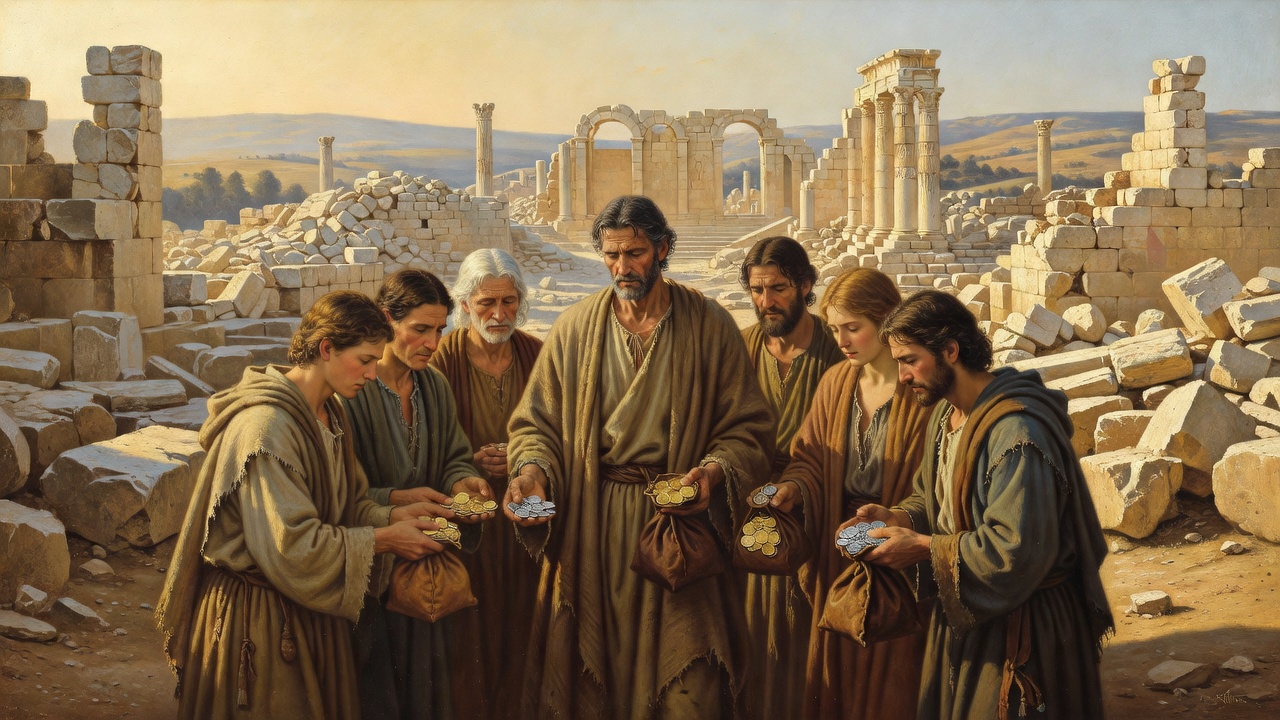
68And some of the chiefs of families, when they went into the house of the Lord that was in Jerusalem, offered willingly for the house of God, to establish it on its prepared place. 69According to their power they gave into the treasury of the work pure gold sixty-one thousand pieces, and five thousand pounds of silver, and one hundred priests' garments. 70So the priests, and the Levites, and some of the people, and the singers, and the porters, and the Nathinim, lived in their cities, and all Israel in their cities.
Did you know?
The List of the Returning Exiles
- Under the leadership of figures like Zerubbabel and Jeshua, the first wave of Jewish exiles returned from Babylon to Judah and Jerusalem after their captivity under Nebuchadnezzar. The whole assembly totaled 42,360 people, along with more than 7,000 servants, singers, and their livestock.Sources: the Bible text itself · Zerubbabel · Nebuchadnezzar
- Genealogical records were essential for verifying communal and religious status after the exile. Priests who could not locate their ancestral lineage in the written registers were excluded from priestly duties and forbidden from eating the sacred food until a priest could consult the Urim and Thummim.Sources: the Bible text itself
- Upon reaching the site of the ruined temple in Jerusalem, family leaders presented freewill offerings of gold darics, minas of silver, and priestly robes to fund rebuilding the house of God on its original foundations.Sources: the Bible text itself · Jerusalem
Notes written with AI assistance from open sources (Theographic Bible Metadata, CC BY-SA 4.0; Easton’s Bible Dictionary, public domain) and reviewed before publishing.
Places in this chapter
- Babylon · 32.543, 44.422 · verse 1
- Babylonia · 32.543, 44.422 · verse 1
- Jerusalem · 31.777, 35.234 · verses 1, 68, 70
- Bethlehem · 31.704, 35.208 · verse 21
- Kiriath-jearim · Today: Deir el Azar · 31.809, 35.104 · verse 25
- Lod · 31.950, 34.900 · verse 33
- Jericho · Today: Tell es Sultan · 31.872, 35.445 · verse 34
- Immer · Today: in Babylonia · 32.543, 44.422 · verse 59
- Gilead · Today: Gilead 1 · 32.187, 35.692 · verse 61
Only places identified with high confidence are shown (90% or more according to the scholarly sources compiled by OpenBible). Period map: DARE (Digital Atlas of the Roman Empire), CC BY 4.0; modern map: © OpenStreetMap contributors; places: OpenBible.info (CC BY 4.0).
Credits and license for this translation
LXX2012: Septuagint in British/International English 2012
The Septuagint with Apocrypha, translated from Greek to English by Sir Lancelot C. L. Brenton and published in 1885, with some language updates (British/International English)
Public Domain
Language: English
Dialect (if applicable): British
Language in English: English
Translation by: Sir Lancelot Charles Lee Breton
LXX2012: Septuagint in English 2012, British/International English Edition
This is a translation of the Old Testament and Apocrypha/Deuterocanon from Hebrew to Greek to 19th Century British English, with some updates of spelling and word usage to contemporary British/International English. The original English translation was done by Sir Lancelot Charles Lee Brenton and published by Samuel Bagster & Sons, Ltd., in London in 1851. It has entered the Public Domain due to the passage of sufficient time. In the process of scanning and typing the text, the original poetry and prose formatting, as well as peripheral material like introductions and notes, have been omitted.
This edition of the Septuagint has some language updates. Brenton's word order and punctuation has been mostly retained, meaning that quotation marks are not used, and sentences within quotes may not start with capital letters, as was standard usage in 1851. Names transliterated from Greek to those transliterated from Hebrew in the common English Bibles often differ. These language updates are dedicated to the Public Domain by the author of those edits, Michael Paul Johnson. Therefore this edition may be freely copied, published, etc.
Before considering making changes to the text of this work, I recommend that you consult with God, because this is really His Book.
If you find errors in the text, please report them so that we can correct them.
Donations to help with the expenses of operating this web site and thus help others have free access to the Word of God may be made to us, but are not required. Please see http://MLJohnson.org/partner/ for more about that.
Section headings adapted from the Berean Standard Bible (public domain); they are not part of this translation’s text.
Source: http://ebible.org/eng-uk-lxx2012/ · eBible.org