Exodus 19
LXX2012: Septuagint in British/International English 2012 · Tap a verse to see its cross-references.
Israel at Mount Sinai
1And in the third month of the departure of the children of Israel out of the land of Egypt, on the same day, they came into the wilderness of Sina. 2And they departed from Raphidin, and came into the wilderness of Sina, and there Israel encamped before the mountain. 3And Moses went up to the mount of God, and God called him out of the mountain, saying, These things shall you say to the house of Jacob, and you shall report them to the children of Israel. 4You⌃ have seen all that I have done to the Egyptians, and I took you up as upon eagles' wings, and I brought you near to myself. 5And now if you⌃ will indeed hear my voice, and keep my covenant, you⌃ shall be to me a peculiar people above all nations; for the whole earth is mine. 6And you⌃ shall be to me a royal priesthood and a holy nation: these words shall you speak to the children of Israel. 7And Moses came and called the elders of the people, and he set before them all these words, which God appointed them. 8And all the people answered with one accord, and said, All things that God has spoken, we will do and listen to: and Moses reported these words to God. 9And the Lord said to Moses, Behold! I come to you in a pillar of a cloud, that the people may hear me speaking to you, and may believe you for ever: and Moses reported the words of the people to the Lord. 10And the Lord said to Moses, Go down and solemnly charge the people, and sanctify them today and to-morrow, and let them wash their garments. 11And let them be ready against the third day, for on the third day the Lord will descend upon mount Sina before all the people. 12And you shall separate the people round about, saying, Take heed to yourselves that you⌃ go not up into the mountain, nor touch any part of it: every one that touches the mountain shall surely die. 13A hand shall not touch it, for every one that touches shall be stoned with stones or shot through with a dart, whether beast or whether man, it shall not live: when the voices and trumpets and cloud depart from off the mountain, they shall come up on the mountain. 14And Moses went down from the mountain to the people, and sanctified them, and they washed their clothes. 15And he said to the people, Be ready: for three days come not near to a woman.
The LORD Visits Sinai
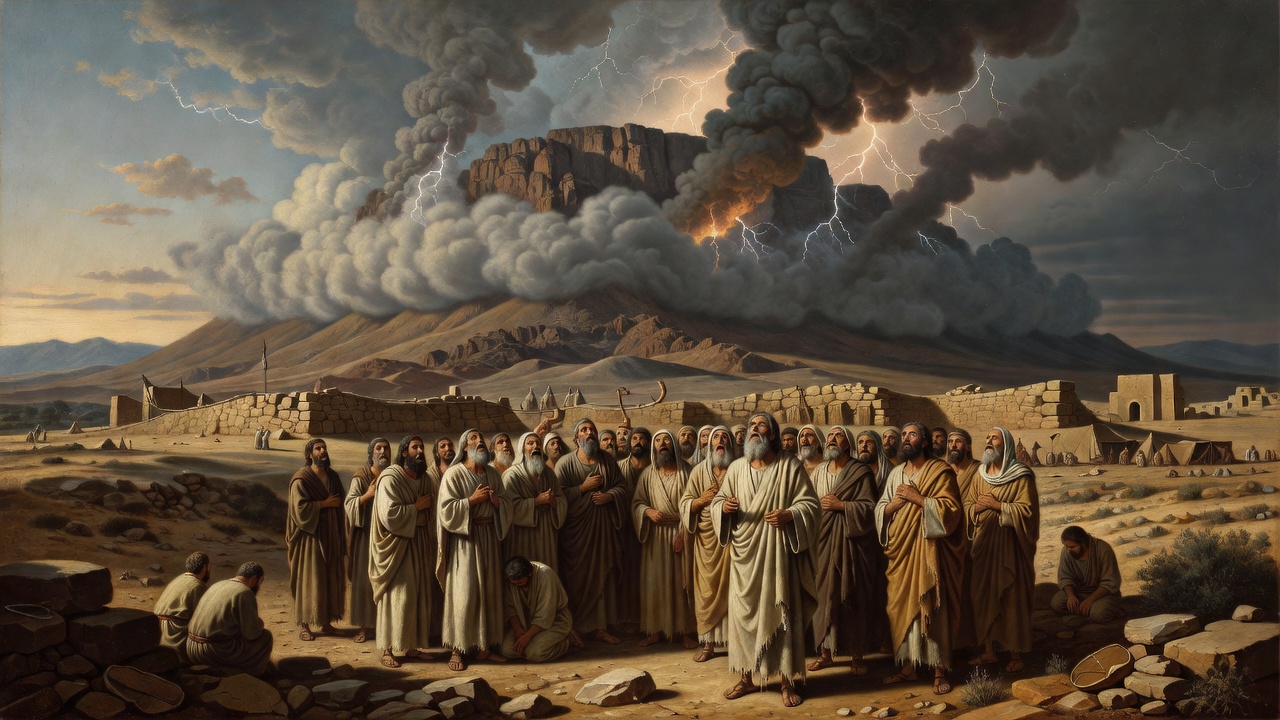
16And it came to pass on the third day, as the morning drew near, there were voices and lightnings and a dark cloud on mount Sina: the voice of the trumpet sounded loud, and all the people in the camp trembled. 17And Moses led the people forth out of the camp to meet God, and they stood by under the camp. 18The mount of Sina was altogether on a smoke, because God had descended upon it in fire; and the smoke went up as the smoke of a furnace, and the people were exceedingly amazed. 19And the sounds of the trumpet were waxing very much louder. Moses spoke, and God answered him with a voice. 20And the Lord came down upon mount Sina on the top of the mountain; and the Lord called Moses to the top of the mountain, and Moses went up. 21And God spoke to Moses, saying, Go down, and solemnly charge the people, lest at any time they draw near to God to gaze, and a multitude of them fall. 22And let the priests that draw near to the Lord God sanctify themselves, destroy some of them. 23And Moses said to God, The people will not be able to approach to the mount of Sina, for you have solemnly charged us, saying, Set bounds to the mountain and sanctify it. 24And the Lord said to him, Go, descend, and come up you and Aaron with you; but let not the priests and the people force their way to come up to God, lest the Lord destroy some of them. 25And Moses went down to the people, and spoke to them.
Did you know?
Israel at Mount Sinai
- In the third month after they left Egypt, the Israelites set out from Rephidim, entered the Wilderness of Sinai, and camped in front of the mountain. Easton's Bible Dictionary (1897) identifies that mountain district as Sinai, also called Horeb, explains the name as of Sin, the moon god, and says they remained encamped about a year after a journey of about 150 miles from the Red Sea, including all the windings of the route.Sources: the Bible text itself · Mount Sinai · Sinai
- Easton's Bible Dictionary (1897) places Rephidim, the station they had just left, in the Wady Feiran, near its junction with the Wady esh-Sheikh. There no water could be found, and the people were ready to stone Moses; at God's command he struck the rock in Horeb, and the Amalekites who afterward attacked the camp were utterly defeated.Sources: the Bible text itself · Rephidim
- Easton's Bible Dictionary (1897) says that the last twenty-two chapters of Exodus, the whole of Leviticus, and Numbers 1-11 record what took place while Israel was encamped in this district. Aaron, whom Moses is told to bring with him, was his elder brother, born in Egypt three years before him, and had been sent to cooperate with him in bringing about the exodus.Sources: the Bible text itself · Mount Sinai · Aaron
Notes written with AI assistance from open sources (Theographic Bible Metadata, CC BY-SA 4.0; Easton’s Bible Dictionary, public domain) and reviewed before publishing.
Places in this chapter
- Egypt · 30.129, 31.308 · verses 1, 4
- Wilderness of Sinai · Today: about 50 km around Jebel Musa · 28.540, 33.973 · verses 1, 2
Only places identified with high confidence are shown (90% or more according to the scholarly sources compiled by OpenBible). Period map: DARE (Digital Atlas of the Roman Empire), CC BY 4.0; modern map: © OpenStreetMap contributors; places: OpenBible.info (CC BY 4.0).
Credits and license for this translation
LXX2012: Septuagint in British/International English 2012
The Septuagint with Apocrypha, translated from Greek to English by Sir Lancelot C. L. Brenton and published in 1885, with some language updates (British/International English)
Public Domain
Language: English
Dialect (if applicable): British
Language in English: English
Translation by: Sir Lancelot Charles Lee Breton
LXX2012: Septuagint in English 2012, British/International English Edition
This is a translation of the Old Testament and Apocrypha/Deuterocanon from Hebrew to Greek to 19th Century British English, with some updates of spelling and word usage to contemporary British/International English. The original English translation was done by Sir Lancelot Charles Lee Brenton and published by Samuel Bagster & Sons, Ltd., in London in 1851. It has entered the Public Domain due to the passage of sufficient time. In the process of scanning and typing the text, the original poetry and prose formatting, as well as peripheral material like introductions and notes, have been omitted.
This edition of the Septuagint has some language updates. Brenton's word order and punctuation has been mostly retained, meaning that quotation marks are not used, and sentences within quotes may not start with capital letters, as was standard usage in 1851. Names transliterated from Greek to those transliterated from Hebrew in the common English Bibles often differ. These language updates are dedicated to the Public Domain by the author of those edits, Michael Paul Johnson. Therefore this edition may be freely copied, published, etc.
Before considering making changes to the text of this work, I recommend that you consult with God, because this is really His Book.
If you find errors in the text, please report them so that we can correct them.
Donations to help with the expenses of operating this web site and thus help others have free access to the Word of God may be made to us, but are not required. Please see http://MLJohnson.org/partner/ for more about that.
Section headings adapted from the Berean Standard Bible (public domain); they are not part of this translation’s text.
Source: http://ebible.org/eng-uk-lxx2012/ · eBible.org