Esther 2
LXX2012: Septuagint in British/International English 2012 · Tap a verse to see its cross-references.
Seeking Vashti’s Successor
1And after this the king's anger was pacified, and he no more mentioned Astin, bearing in mind what she had said, and how he had condemned her. 2Then the servants of the king said, Let there be sought for the king chaste and beautiful young virgins. 3And let the king appoint local governors in all the provinces of his kingdom, and let them select fair and chaste young damsels and bring them to the city Susa, into the women's apartment, and let them be consigned to the king's chamberlain, the keeper of the women; and let things for purification and other attendance be given to them. 4And let the woman who shall please the king be queen instead of Astin. And the thing pleased the king; and he did so.
Esther Finds Favor
5Now there was a Jew in the city Susa, and his name was Mardochaeus, the son of Jairus, the son of Semeias, the son of Cisaeus, of the tribe of Benjamin; 6who had been brought a prisoner from Jerusalem, which Nabuchodonosor king of Babylon had carried into captivity. 7And he had a foster child, daughter of Aminadab his father's brother, and her name was Esther; and when her parents were dead, he brought her up for a wife for himself: and the damsel was beautiful. 8And because the king's ordinance was published, many damsels were gathered to the city Susa under the hand of Gai; and Esther was brought to Gai the keeper of the women. 9And the damsel pleased him, and she found favour in his sight; and he hasted to give her the things for purification, and her portion, and the seven maidens appointed her out of the palace: and he treated her and her maidens well in the women's apartment. 10But Esther did not reveal her family nor her kindred: for Mardochaeus had charged her not to tell. 11But Mardochaeus used to walk every day by the women's court, to see what would become of Esther. 12Now this was the time for a virgin to go into the king, when she should have fulfilled twelve months; for so are the days of purification fulfilled, six months while they are anointing themselves with oil of myrrh, and six months with spices and women's purifications. 13And then the damsel goes in to the king; and the officer to whoever he shall give the command, will bring her to come in with him from the women's apartment to the king's chamber. 14She enters in the evening, and in the morning she departs to the second women's apartment, where Gai the king's chamberlain is keeper of the women: and she goes not in to the king again, unless she should be called by name. 15And when the time. was fulfilled for Esther the daughter of Aminadab the brother of Mardochaeus' father to go in to the king, she neglected nothing which the chamberlain, the women's keeper, commanded; for Esther found grace in the sight of all that looked upon her. 16So Esther went in to king Artaxerxes in the twelfth month, which is Adar, in the seventh year of his reign.
Esther Becomes Queen
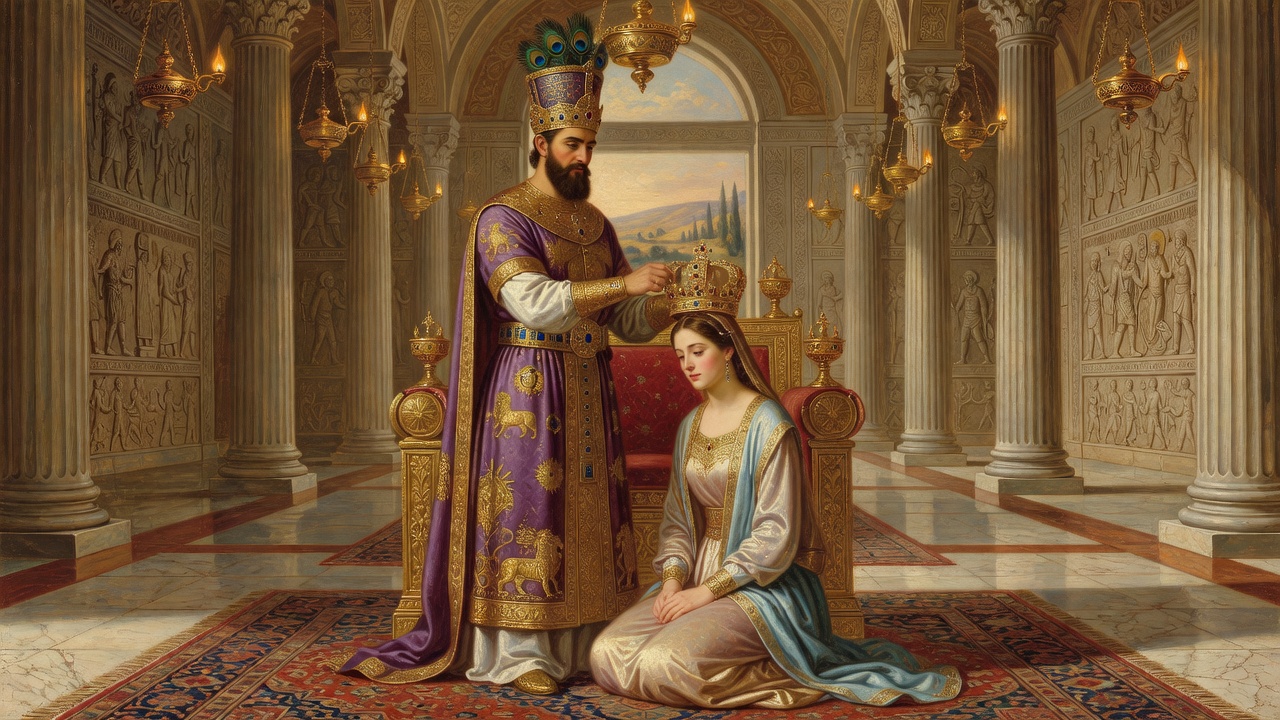
17And the king loved Esther, and she found favour beyond all the other virgins: and he put on her the queen's crown. 18And the king made a banquet for all his friends and great men for seven days, and he highly celebrated the marriage of Esther; and he made a release to those who were under his dominion. 19But Mardochaeus served in the palace. 20Now Esther had not revealed her kindred; for so Mardochaeus commanded her, to fear God, and perform his commandments, as when she was with him: and Esther changed not her manner of life.
Mordecai Uncovers a Conspiracy
21And two chamberlains of the king, the chiefs of the body-guard, were grieved, because Mardochaeus was promoted; and they sought to kill king Artaxerxes. 22And the matter was revealed to Mardochaeus, and he made it known to Esther, and she declared to the king the matter of the conspiracy. 23And the king examined the two chamberlains, and hanged them: and the king gave orders to make a note for a memorial in the royal records of the good offices of Mardochaeus, as a commendation.
Did you know?
Esther's Rise to Queen
- Esther originally bore the Hebrew name Hadassah, meaning "myrtle," but became known as Esther (derived from the Persian word for "star") in the Persian court. An orphaned Benjamite, she was brought up by her cousin Mordecai, who instructed her not to disclose her Jewish heritage.Sources: Esther · the Bible text itself
- Young women brought to the citadel of Susa underwent a strict twelve-month preparation under the royal official Hegai. The regimen required six months of treatments with oil of myrrh followed by six months with perfumes and cosmetics before an audience with the king.Sources: Hegai · the Bible text itself
- While sitting at the palace gate, Mordecai uncovered an assassination plot against King Ahasuerus by two royal guards, Bigthan and Teresh. Queen Esther reported the treason in Mordecai's name, and the event was formally recorded in the king's chronicles.Sources: the Bible text itself
Notes written with AI assistance from open sources (Theographic Bible Metadata, CC BY-SA 4.0; Easton’s Bible Dictionary, public domain) and reviewed before publishing.
Places in this chapter
- Susa · Today: Shush · 32.189, 48.258 · verses 3, 5, 8
- Babylon · 32.543, 44.422 · verse 6
- Jerusalem · 31.777, 35.234 · verse 6
Only places identified with high confidence are shown (90% or more according to the scholarly sources compiled by OpenBible). Period map: DARE (Digital Atlas of the Roman Empire), CC BY 4.0; modern map: © OpenStreetMap contributors; places: OpenBible.info (CC BY 4.0).
Credits and license for this translation
LXX2012: Septuagint in British/International English 2012
The Septuagint with Apocrypha, translated from Greek to English by Sir Lancelot C. L. Brenton and published in 1885, with some language updates (British/International English)
Public Domain
Language: English
Dialect (if applicable): British
Language in English: English
Translation by: Sir Lancelot Charles Lee Breton
LXX2012: Septuagint in English 2012, British/International English Edition
This is a translation of the Old Testament and Apocrypha/Deuterocanon from Hebrew to Greek to 19th Century British English, with some updates of spelling and word usage to contemporary British/International English. The original English translation was done by Sir Lancelot Charles Lee Brenton and published by Samuel Bagster & Sons, Ltd., in London in 1851. It has entered the Public Domain due to the passage of sufficient time. In the process of scanning and typing the text, the original poetry and prose formatting, as well as peripheral material like introductions and notes, have been omitted.
This edition of the Septuagint has some language updates. Brenton's word order and punctuation has been mostly retained, meaning that quotation marks are not used, and sentences within quotes may not start with capital letters, as was standard usage in 1851. Names transliterated from Greek to those transliterated from Hebrew in the common English Bibles often differ. These language updates are dedicated to the Public Domain by the author of those edits, Michael Paul Johnson. Therefore this edition may be freely copied, published, etc.
Before considering making changes to the text of this work, I recommend that you consult with God, because this is really His Book.
If you find errors in the text, please report them so that we can correct them.
Donations to help with the expenses of operating this web site and thus help others have free access to the Word of God may be made to us, but are not required. Please see http://MLJohnson.org/partner/ for more about that.
Section headings adapted from the Berean Standard Bible (public domain); they are not part of this translation’s text.
Source: http://ebible.org/eng-uk-lxx2012/ · eBible.org