Deuteronomy 34
LXX2012: Septuagint in British/International English 2012 · Tap a verse to see its cross-references.
The Death of Moses
1And Moses went up from Araboth Moab to the mount of Nabau, to the top of Phasga, which is before Jericho; and the Lord showed him all the mount of Galaad to Dan, and all the land of Nephthali, 2and all the land of Ephraim and Manasse, and all the land of Juda to the farthest sea; 3and the wilderness, and the country round about Jericho, the city of palm-trees, to Segor. 4And the Lord said to Moses, This is the land of which I swore to Abraam, and Isaac, and Jacob, saying, To your seed will I give it: and I have showed it to your eyes, but you shall not go in there. 5So Moses the servant of the Lord died in the land of Moab by the word of the Lord. 6And they buried him in Gai near the house of Phogor; and no one has seen his sepulchre to this day. 7And Moses was one hundred and twenty years old at his death; his eyes were not dimmed, nor were his natural powers destroyed. 8And the children of Israel wept for Moses in Araboth of Moab at Jordan near Jericho thirty days; and the days of the sad mourning for Moses were completed. 9And Joshua the son of Naue was filled with the spirit of knowledge, for Moses had laid his hands upon him; and the children of Israel listened to him; and they did as the Lord commanded Moses. 10And there rose up no more a prophet in Israel like Moses, whom the Lord knew face to face, 11in all the signs and wonders, which the Lord sent him to work in Egypt on Pharao, and his servants, and all his land; 12the great wonders, and the mighty hand which Moses displayed before all Israel.
Did you know?
The Death of Moses
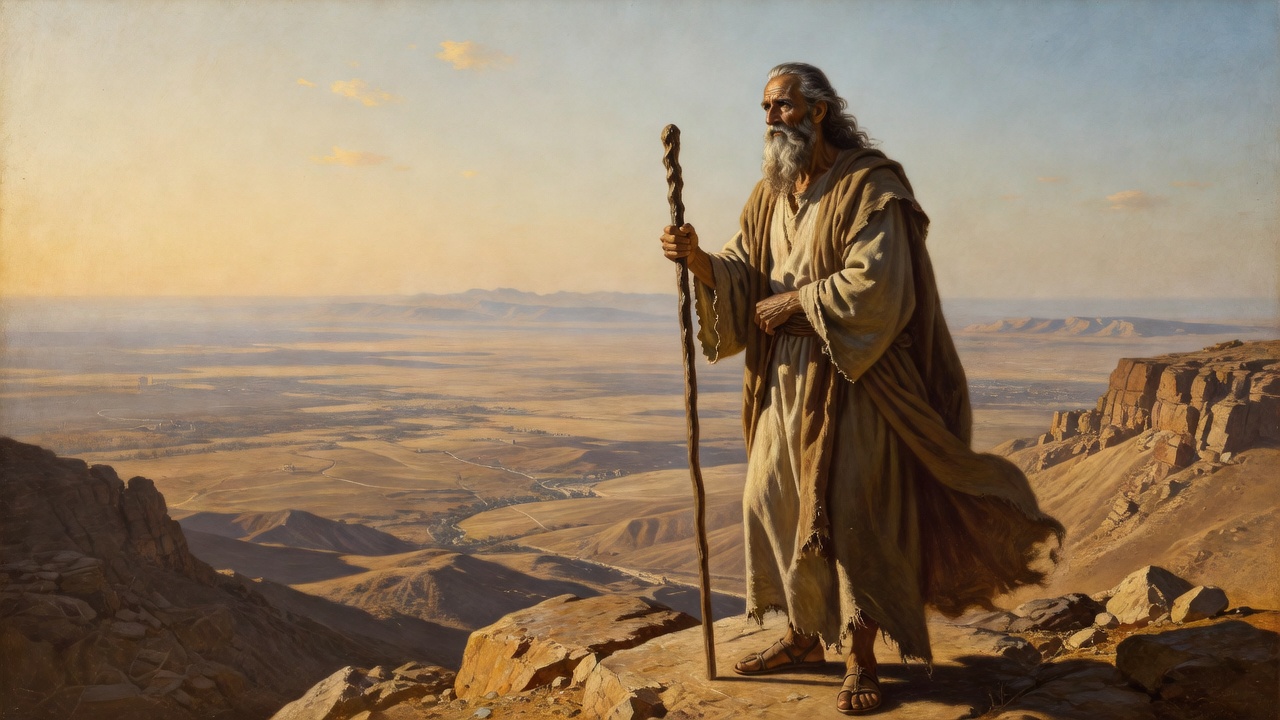
- Moses ascends Mount Nebo, a summit of the Pisgah ridge located east of the Dead Sea and the Jordan River. From this vantage point facing Jericho, he is shown a panoramic view of the entire territory promised to the descendants of Abraham, Isaac, and Jacob.Sources: Mount Nebo · Pisgah · Jericho · the Bible text itself
- Moses dies at 120 years of age with his eyesight and vitality undiminished, and is buried in a valley in Moab opposite Beth-peor at a site intentionally left unknown. In keeping with ancient mourning customs, the Israelites observe thirty days of lamentation for him in the plains of Moab.Sources: the Bible text itself · Lifetime of Moses
- Leadership passes smoothly to Joshua, whom Moses had commissioned by laying hands on him, imparting the spirit of wisdom. The book closes with an epilogue celebrating Moses' unique standing as a prophet who knew the Lord face to face and performed unprecedented wonders in Egypt.Sources: the Bible text itself
Notes written with AI assistance from open sources (Theographic Bible Metadata, CC BY-SA 4.0; Easton’s Bible Dictionary, public domain) and reviewed before publishing.
Places in this chapter
- Gilead · Today: Gilead 1 · 32.187, 35.692 · verse 1
- Jericho · Today: Tell es Sultan · 31.872, 35.445 · verses 1, 3
- Moab · Today: Moab 2 · 31.840, 35.674 · verses 1, 8
- Great Sea · Today: Mediterranean Sea · 31.805, 34.170 · verse 2
- City of Palms · Today: Tell es Sultan · 31.872, 35.445 · verse 3
- Negeb · 31.245, 34.841 · verse 3
- Valley of Jericho · 31.872, 35.445 · verse 3
- Moab · Today: Moab 1 · 31.181, 35.701 · verses 5, 6
- Egypt · 30.129, 31.308 · verse 11
Only places identified with high confidence are shown (90% or more according to the scholarly sources compiled by OpenBible). Period map: DARE (Digital Atlas of the Roman Empire), CC BY 4.0; modern map: © OpenStreetMap contributors; places: OpenBible.info (CC BY 4.0).
Credits and license for this translation
LXX2012: Septuagint in British/International English 2012
The Septuagint with Apocrypha, translated from Greek to English by Sir Lancelot C. L. Brenton and published in 1885, with some language updates (British/International English)
Public Domain
Language: English
Dialect (if applicable): British
Language in English: English
Translation by: Sir Lancelot Charles Lee Breton
LXX2012: Septuagint in English 2012, British/International English Edition
This is a translation of the Old Testament and Apocrypha/Deuterocanon from Hebrew to Greek to 19th Century British English, with some updates of spelling and word usage to contemporary British/International English. The original English translation was done by Sir Lancelot Charles Lee Brenton and published by Samuel Bagster & Sons, Ltd., in London in 1851. It has entered the Public Domain due to the passage of sufficient time. In the process of scanning and typing the text, the original poetry and prose formatting, as well as peripheral material like introductions and notes, have been omitted.
This edition of the Septuagint has some language updates. Brenton's word order and punctuation has been mostly retained, meaning that quotation marks are not used, and sentences within quotes may not start with capital letters, as was standard usage in 1851. Names transliterated from Greek to those transliterated from Hebrew in the common English Bibles often differ. These language updates are dedicated to the Public Domain by the author of those edits, Michael Paul Johnson. Therefore this edition may be freely copied, published, etc.
Before considering making changes to the text of this work, I recommend that you consult with God, because this is really His Book.
If you find errors in the text, please report them so that we can correct them.
Donations to help with the expenses of operating this web site and thus help others have free access to the Word of God may be made to us, but are not required. Please see http://MLJohnson.org/partner/ for more about that.
Section headings adapted from the Berean Standard Bible (public domain); they are not part of this translation’s text.
Source: http://ebible.org/eng-uk-lxx2012/ · eBible.org