Deuteronomy 32
LXX2012: Septuagint in British/International English 2012 · Tap a verse to see its cross-references.
The Song of Moses
1Attend, O heaven, and I will speak; and let the earth hear the words out of my mouth. 2Let my speech be looked for as the rain, and my words come down as dew, as the shower upon the herbage, and as snow upon the grass. 3For I have called on the name of the Lord: assign you⌃ greatness to our God. 4As for God, his works are true, and all his ways are judgement: God is faithful, and there is no unrighteousness in him; just and holy is the Lord. 5They have sinned, not pleasing him; spotted children, a froward and perverse generation. 6Do you⌃ thus recompense the Lord? is the people thus foolish and unwise? did not he himself your father purchase you, and make you, and form you? 7Remember the days of old, consider the years for past ages: ask your father, and he shall relate to you, your elders, and they shall tell you. 8When the Most High divided the nations, when he separated the sons of Adam, he set the bounds of the nations according to the number of the angels of God. 9And his people Jacob became the portion of the Lord, Israel was the line of his inheritance. 10He maintained him in the wilderness, in burning thirst and a dry land: he led him about and instructed him, and kept him as the apple of an eye. 11As an eagle would watch over his brood, and yearns over his young, receives them having spread his wings, and takes them up on his back: 12the Lord alone led them, there was no strange god with them. 13He brought them up on the strength of the land; he fed them with the fruits of the fields; they sucked honey out of the rock, and oil out of the solid rock. 14Butter of cows, and milk of sheep, with the fat of lambs and rams, of calves and kids, with fat of kidneys of wheat; and he drank wine, the blood of the grape. 15So Jacob ate and was filled, and the beloved one kicked; he grew fat, he became thick and broad: then he forsook the God that made him, and departed from God his Saviour. 16They provoked me to anger with strange gods; with their abominations they bitterly angered me. 17They sacrificed to devils, and not to God; to gods whom they knew not: new and fresh gods came in, whom their fathers knew not. 18You have forsaken God that begot you, and forgotten God who feeds you. 19And the Lord saw, and was jealous; and was provoked by the anger of his sons and daughters, 20and said, I will turn away my face from them, and will show what shall happen to them in the last days; for it is a perverse generation, sons in whom is no faith. 21They have provoked me to jealousy with that which is not God, they have exasperated me with their idols; and I will provoke them to jealousy with them that are no nation, I will anger them with a nation void of understanding. 22For a fire has been kindled out of my wrath, it shall burn to hell below; it shall devour the land, and the fruits of it; it shall set on fire the foundations of the mountains. 23I will gather evils upon them, and will fight with my weapons against them. 24They shall be consumed with hunger and the devouring of birds, and there shall be irremediable destruction: I will send forth against them the teeth of wild beasts, with the rage of serpents creeping on the ground. 25Without, the sword shall bereave them of children, and terror shall issue out of the secret chambers; the young man shall perish with the virgin, the suckling with him who has grown old. 26I said, I will scatter them, and I will cause their memorial to cease from amongst men. 27Were it not for the wrath of the enemy, lest they should live long, lest their enemies should combine against them; lest they should say, Our own high arm, and not the Lord, has done all these things. 28It is a nation that has lost counsel, neither is there understanding in them. 29They had not sense to understand: let them reserve these things against the time to come. 30How should one pursue a thousand, and two rout tens of thousands, if God had not sold them, and the Lord delivered them up? 31For their gods are not as our God, but our enemies are void of understanding. 32For their vine is of the vine of Sodom, and their vine-branch of Gomorrha: their grape is a grape of gall, their cluster is one of bitterness. 33Their wine is the rage of serpents, and the incurable rage of asps. 34Behold! are not these things stored up by me, and sealed amongst my treasures? 35In the day of vengeance I will recompense, whenever their foot shall be tripped up; for the day of their destruction is near to them, and the judgements at hand are close upon you. 36For the Lord shall judge his people, and shall be comforted over his servants; for he saw that they were utterly weakened, and failed in the hostile invasion, and were become feeble: 37and the Lord said, Where are their gods on whom they trusted? 38the fat of whose sacrifices you⌃ ate, and you⌃ drank the wine of their drink-offerings? let them arise and help you, and be your protectors. 39Behold, behold that I am he, and there is no god beside me: I kill, and I will make to live: I will strike, and I will heal; and there is none who shall deliver out of my hands. 40For I will lift up my hand to heaven, and swear by my right hand, and I will say, I live for ever. 41For I will sharpen my sword like lightning, and my hand shall take hold of judgement; and I will render judgement to my enemies, and will recompense them that hate me. 42I will make my weapons drunk with blood, and my sword shall devour flesh, it shall glut itself with the blood of the wounded, and from the captivity of the heads of their enemies that rule over them. 43Rejoice, you⌃ heavens, with him, and let all the angels of God worship him; rejoice you⌃ Gentiles, with his people, and let all the sons of God strengthen themselves in him; for he will avenge the blood of his sons, and he will render vengeance, and recompense justice to his enemies, and will reward them that hate him; and the Lord shall purge the land of his people. 44And Moses wrote this song in that day, and taught it to the children of Israel; and Moses went in and spoke all the words of this law in the ears of the people, he and Joshua the son of Naue. 45And Moses finished speaking to all Israel. 46And he said to them, Take heed with your heart to all these words, which I testify to you this day, which you⌃ shall command your sons, to observe and do all the words of this law. 47For this is no vain word to you; for it is your life, and because of this word you⌃ shall live long upon the land, into which you⌃ go over Jordan to inherit it.
Moses’ Death Foretold
48And the Lord spoke to Moses in this day, saying, 49Go up to the mount Abarim, this mountain Nabau which is in the land of Moab over against Jericho, and behold the land of Chanaan, which I give to the sons of Israel: 50and die in the mount whither you go up, and be added to your people; as Aaron your brother died in mount Or, and was added to his people. 51Because you⌃ disobeyed my word amongst the children of Israel, at the waters of strife of Cades in the wilderness of Sin; because you⌃ sanctified me not amongst the sons of Israel. 52You shall see the land before you, but you shall not enter into it.
Did you know?
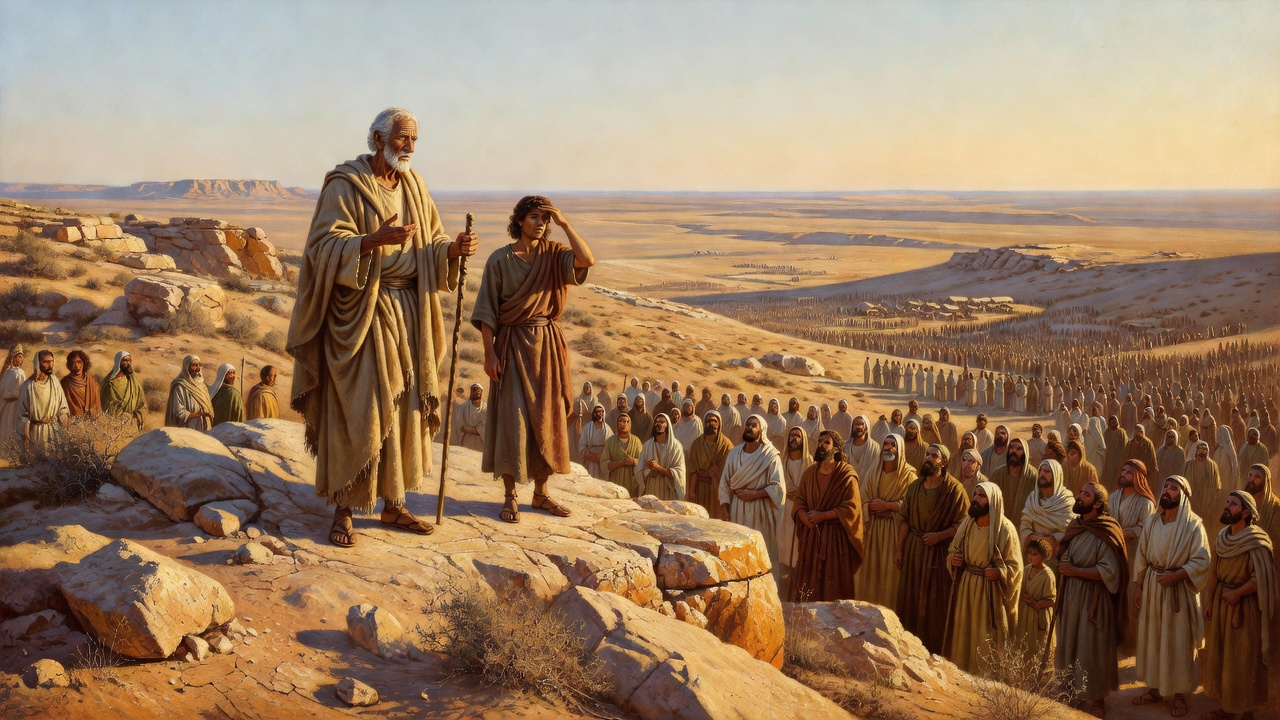
The Song of Moses and the View from Mount Nebo
- Moses, accompanied by Joshua son of Nun, recited this extended prophetic poem to the entire assembly of Israel. The song repeatedly uses the metaphor of God as the faithful Rock, contrasting divine protection and abundance in the wilderness with warnings about future idolatry and rebellion.Sources: the Bible text itself · Joshua · Nun
- The poem draws on the proverbial wickedness of Sodom and Gomorrah, comparing the spiritual corruption and hostility of Israel's adversaries to bitter grapes and deadly venom. In the biblical record, these ancient cities destroyed by fire serve as quintessential symbols of judgment and ruin.Sources: the Bible text itself · Sodom · Gomorrah
- Immediately after delivering the song, Moses was commanded to climb Mount Nebo in the Abarim range of Moab to gaze upon the promised land of Canaan. Because of the events at Meribah-kadesh, he was told he would die on the mountain without entering the land, just as his brother Aaron had died on Mount Hor.Sources: the Bible text itself · Mount Nebo · Aaron
Notes written with AI assistance from open sources (Theographic Bible Metadata, CC BY-SA 4.0; Easton’s Bible Dictionary, public domain) and reviewed before publishing.
Places in this chapter
- Bashan · 32.781, 35.935 · verse 14
- Jordan · Today: Jordan River · 31.761, 35.558 · verse 47
- Abarim · 31.754, 35.715 · verse 49
- Canaan · 32.767, 35.333 · verse 49
- Jericho · Today: Tell es Sultan · 31.872, 35.445 · verse 49
- Moab · Today: Moab 1 · 31.181, 35.701 · verse 49
- Meribah · Today: Ain el Qudeirat · 30.648, 34.422 · verse 51
- Zin · Today: Zin Desert · 30.971, 35.325 · verse 51
Only places identified with high confidence are shown (90% or more according to the scholarly sources compiled by OpenBible). Period map: DARE (Digital Atlas of the Roman Empire), CC BY 4.0; modern map: © OpenStreetMap contributors; places: OpenBible.info (CC BY 4.0).
Credits and license for this translation
LXX2012: Septuagint in British/International English 2012
The Septuagint with Apocrypha, translated from Greek to English by Sir Lancelot C. L. Brenton and published in 1885, with some language updates (British/International English)
Public Domain
Language: English
Dialect (if applicable): British
Language in English: English
Translation by: Sir Lancelot Charles Lee Breton
LXX2012: Septuagint in English 2012, British/International English Edition
This is a translation of the Old Testament and Apocrypha/Deuterocanon from Hebrew to Greek to 19th Century British English, with some updates of spelling and word usage to contemporary British/International English. The original English translation was done by Sir Lancelot Charles Lee Brenton and published by Samuel Bagster & Sons, Ltd., in London in 1851. It has entered the Public Domain due to the passage of sufficient time. In the process of scanning and typing the text, the original poetry and prose formatting, as well as peripheral material like introductions and notes, have been omitted.
This edition of the Septuagint has some language updates. Brenton's word order and punctuation has been mostly retained, meaning that quotation marks are not used, and sentences within quotes may not start with capital letters, as was standard usage in 1851. Names transliterated from Greek to those transliterated from Hebrew in the common English Bibles often differ. These language updates are dedicated to the Public Domain by the author of those edits, Michael Paul Johnson. Therefore this edition may be freely copied, published, etc.
Before considering making changes to the text of this work, I recommend that you consult with God, because this is really His Book.
If you find errors in the text, please report them so that we can correct them.
Donations to help with the expenses of operating this web site and thus help others have free access to the Word of God may be made to us, but are not required. Please see http://MLJohnson.org/partner/ for more about that.
Section headings adapted from the Berean Standard Bible (public domain); they are not part of this translation’s text.
Source: http://ebible.org/eng-uk-lxx2012/ · eBible.org