2 Samuel 18
LXX2012: Septuagint in British/International English 2012 · Tap a verse to see its cross-references.
Absalom Killed
1And David numbered the people with him, and set over them captains of thousands and captains of hundreds. 2And David sent away the people, the third part under the hand of Joab, and the third part under the hand of Abessa the son of Saruia, the brother of Joab, and the third part under the hand of Ethi the Gittite. And David said to the people, I also will surely go out with you. 3And they said, You shall not go out: for if we should indeed flee, they will not care for us; and if half of us should die, they will not mind us; for you are as ten thousand of us: and now it is well that you shall be to us an aid to help us in the city. 4And the king said to them, Whatsoever shall seem good in your eyes I will do. And the king stood by the side of the gate, and all the people went out by hundreds and by thousands. 5And the king commanded Joab and Abessa and Ethi, saying, Spare for my sake the young man Abessalom. And all the people heard the king charging all the commanders concerning Abessalom. 6And all the people went out into the wood against Israel; and the battle was in the wood of Ephraim. 7And the people of Israel fell down there before the servants of David, and there was a great slaughter in that day, even twenty thousand men. 8And the battle there was scattered over the face of all the land: and the wood consumed more of the people than the sword consumed amongst the people in that day. 9And Abessalom went to meet the servants of David: and Abessalom was mounted on his mule, and the mule came under the thick boughs of a great oak; and his head was entangled in the oak, and he was suspended between heaven and earth; and the mule passed on from under him. 10And a man saw it, and reported to Joab, and said, Behold, I saw Abessalom hanging in an oak. 11And Joab said to the man who reported it to him, And, behold, you did see him: why did you not strike him there to the ground? and I would have given you ten pieces of silver, and a girdle. 12And the man said to Joab, Were I even to receive a thousand shekels of silver, I would not lift my hand against the king's son; for in our ears the king charged you and Abessa and Ethi, saying, Take care of the young man Abessalom for me, 13so as to do no harm to his life: and nothing of the matter will be concealed from the king, and you will set yourself against me. 14And Joab said, I will begin this; I will not thus remain with you. And Joab took three darts in his hand, and thrust them into the heart of Abessalom, while he was yet alive in the heart of the oak. 15And ten young men that bore Joab's armour compassed Abessalom, and struck him and killed him. 16And Joab blew the trumpet, and the people returned from pursuing Israel, for Joab spared the people. 17And he took Abessalom, and cast him into a great cavern in the wood, into a deep pit, and set up over him a very great heap of stones: and all Israel fled every man to his tent. 18Now Abessalom while yet alive had taken and set up for himself the pillar near which he was taken, and set it up so as to have the pillar in the king's dale; for he said he had no son to keep his name in remembrance: and he called the pillar, Abessalom's hand, until this day.
David Mourns for Absalom
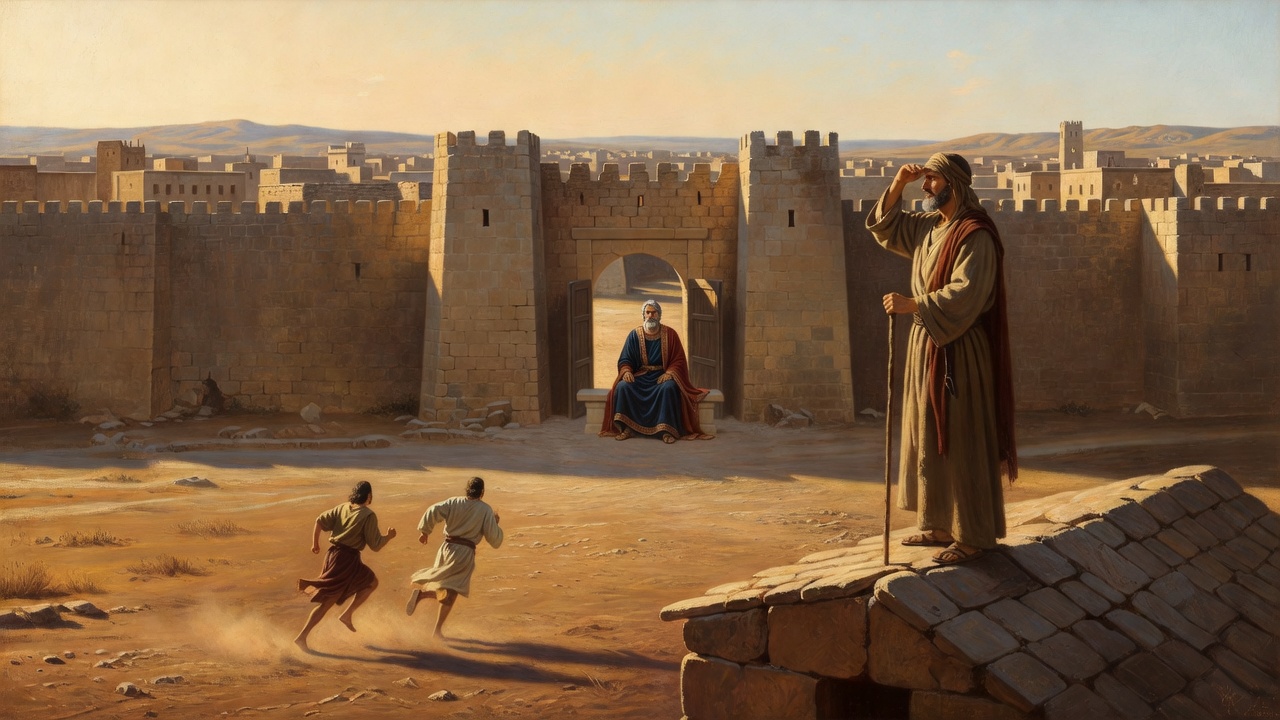
19And Achimaas the son of Sadoc said, Let me run now and carry glad tidings to the king, for the Lord has delivered him from the hand of his enemies. 20And Joab said to him, You shall not be a messenger of glad tidings this day; you shall bear them another day; but on this day you shall bear no tidings, because the king's son is dead. 21And Joab said to Chusi, Go, report to the king all that you have seen. And Chusi did obeisance to Joab, and went out. 22And Achimaas the son of Sadoc said again to Joab, Nay, let me also run after Chusi. And Joab said, Why would you thus run, my son? attend, you have no tidings for profit if you go. 23And he said, Why should I not run? and Joab said to him, Run. And Achimaas ran along the way of Kechar, and outran Chusi. 24And David was sitting between the two gates: and the watchman went up on the top of the gate of the wall, and lifted up his eyes, and looked, and behold a man running alone before him. 25And the watchman cried out, and reported to the king. And the king said, If he be alone, there are good tidings in his mouth. And the man came and drew near. 26And the watchman saw another man running: and the watchman cried at the gate, and said, And look, another man running alone. And the king said, He also brings glad tidings. 27And the watchman said, I see the running of the first as the running of Achimaas the son of Sadoc. And the king said, He is a good man, and will come to report glad tidings. 28And Achimaas cried out and said to the king, Peace. And he did obeisance to the king with his face to the ground, and said, Blessed be the Lord your God, who has delivered up the men that lifted up their hands against my lord the king. 29And the king said, Is the young man Abessalom safe? and Achimaas said, I saw a great multitude at the time of Joab's sending the king's servant and your servant, and I knew not what was there. 30And the king said, Turn aside, stand still here. And he turned aside, and stood. 31And, behold, Chusi came up, and said to the king, Let my lord the king hear glad tidings, for the Lord has avenged you this day upon all them that rose up against you. 32And the king said to Chusi, Is it well with the young man Abessalom? and Chusi said, Let the enemies of my lord the king, and all whoever have risen up against him for evil, be as that young man. 33And the king was troubled, and went to the chamber over the gate, and wept: and thus he said as he went, My son Abessalom, my son, my son Abessalom; would God I had died for you, even I had died for you, Abessalom, my son, my son!
Did you know?
The Defeat and Death of Absalom
- David organized his forces into three divisions led by Joab, Joab's brother Abishai, and Ittai the Gittite, a commander from the Philistine city of Gath. Despite David's explicit instruction to spare Absalom, Joab killed the trapped prince in the forest of Ephraim.Sources: Joab · Abishai · Ittai · the Bible text itself
- During his life, Absalom had erected a memorial pillar for himself in the King's Valley (also known as the Valley of Shaveh) because he had no surviving sons to preserve his name. After his death, however, he was hastily buried in a forest pit covered by a large heap of stones.Sources: Valley of Shaveh · the Bible text itself
- Ahimaaz, the son of the high priest Zadok, was swift of foot and recognizable from afar by his running style. Although he outran the Cushite messenger to bring word of the battle's outcome, he avoided directly telling David about Absalom's death.Sources: Ahimaaz · Zadok · the Bible text itself
Notes written with AI assistance from open sources (Theographic Bible Metadata, CC BY-SA 4.0; Easton’s Bible Dictionary, public domain) and reviewed before publishing.
Places in this chapter
- Ephraim · Today: Ephraim 3 · 32.381, 35.765 · verse 6
- Ethiopia · 16.935, 33.751 · verses 21, 31
- Jordan Valley · 32.317, 35.570 · verse 23
Only places identified with high confidence are shown (90% or more according to the scholarly sources compiled by OpenBible). Period map: DARE (Digital Atlas of the Roman Empire), CC BY 4.0; modern map: © OpenStreetMap contributors; places: OpenBible.info (CC BY 4.0).
Credits and license for this translation
LXX2012: Septuagint in British/International English 2012
The Septuagint with Apocrypha, translated from Greek to English by Sir Lancelot C. L. Brenton and published in 1885, with some language updates (British/International English)
Public Domain
Language: English
Dialect (if applicable): British
Language in English: English
Translation by: Sir Lancelot Charles Lee Breton
LXX2012: Septuagint in English 2012, British/International English Edition
This is a translation of the Old Testament and Apocrypha/Deuterocanon from Hebrew to Greek to 19th Century British English, with some updates of spelling and word usage to contemporary British/International English. The original English translation was done by Sir Lancelot Charles Lee Brenton and published by Samuel Bagster & Sons, Ltd., in London in 1851. It has entered the Public Domain due to the passage of sufficient time. In the process of scanning and typing the text, the original poetry and prose formatting, as well as peripheral material like introductions and notes, have been omitted.
This edition of the Septuagint has some language updates. Brenton's word order and punctuation has been mostly retained, meaning that quotation marks are not used, and sentences within quotes may not start with capital letters, as was standard usage in 1851. Names transliterated from Greek to those transliterated from Hebrew in the common English Bibles often differ. These language updates are dedicated to the Public Domain by the author of those edits, Michael Paul Johnson. Therefore this edition may be freely copied, published, etc.
Before considering making changes to the text of this work, I recommend that you consult with God, because this is really His Book.
If you find errors in the text, please report them so that we can correct them.
Donations to help with the expenses of operating this web site and thus help others have free access to the Word of God may be made to us, but are not required. Please see http://MLJohnson.org/partner/ for more about that.
Section headings adapted from the Berean Standard Bible (public domain); they are not part of this translation’s text.
Source: http://ebible.org/eng-uk-lxx2012/ · eBible.org