2 Kings 14
LXX2012: Septuagint in British/International English 2012 · Tap a verse to see its cross-references.
Amaziah Reigns in Judah
1In the second year of Joas the son of Joachaz king of Israel, did Amessias also the son of Joas the king of Juda begin to reign. 2Twenty and five years old was he when he began to reign, and he reigned twenty and nine years in Jerusalem: and his mother's name was Joadim of Jerusalem. 3And he did that which was right in the sight of the Lord, but not as David his father: he did according to all things that his father Joas did. 4Only he removed not the high places: as yet the people sacrificed and burnt incense on the high places. 5And it came to pass when the kingdom was established in his hand, that he killed his servants that had slain the king his father. 6But he killed not the sons of those that had slain him; according as it is written in the book of the laws of Moses, as the Lord gave commandment, saying, The fathers shall not be put to death for the children, and the children shall not be put to death for the fathers; but every one shall die for his own sins. 7He struck of Edom ten thousand in the valley of salt, and took the Rock in the war, and called its name Jethoel until this day.
Jehoash Defeats Amaziah
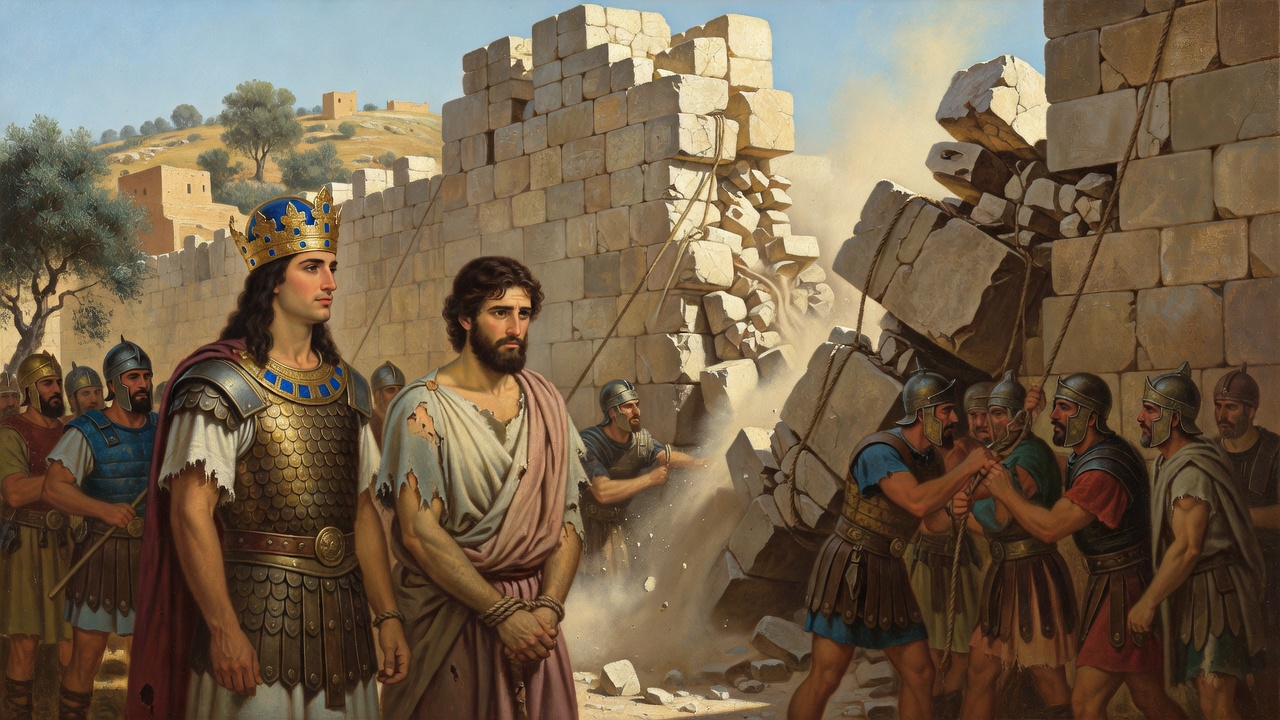
8Then Amessias sent messengers to Joas son of Joachaz son of Ju king of Israel, saying, Come, let us look one another in the face. 9And Joas the king of Israel sent to Amessias king of Juda, saying, The thistle that was in Libanus sent to the cedar that was in Libanus, saying, Give my daughter to your son to wife: and the wild beasts of the field that were in Libanus passed by and trod down the thistle. 10You have struck and wounded Edom, and your heart has lifted you up: stay at home and glorify yourself; for therefore are you quarrelsome to your hurt? So both you will fall and Juda with you. 11Nevertheless Amessias listened not: so Joas king of Israel went up, and he and Amessias king of Juda looked one another in the face in Baethsamys of Juda. 12And Juda was overthrown before Israel, and every man fled to his tent. 13And Joas king of Israel took Amessias the son of Joas the son of Ochozias, in Baethsamys; and he came to Jerusalem, and broke down the wall of Jerusalem, beginning at the gate of Ephraim as far as the gate of the corner, four hundred cubits. 14And he took the gold, and the silver, and all the vessels that were found in the house of the Lord, and in the treasures of the king's house, and the hostages, and returned to Samaria.
Jeroboam II Succeeds Jehoash in Israel
15And the rest of the acts of Joas, even all that he did in his might, how he warred with Amessias king of Juda, are not these things written in the book of the chronicles of the kings of Israel? 16And Joas slept with his fathers, and was buried in Samaria with the kings of Israel; and Jeroboam his son reigned in his stead.
The Death of Amaziah
17And Amessias the son of Joas king of Juda lived after the death of Joas son of Joachaz king of Israel fifteen years. 18And the rest of the acts of Amessias, and all that he did, are not these written in the book of the chronicles of the kings of Juda? 19And they formed a conspiracy against him in Jerusalem, and he fled to Lachis: and they sent after him to Lachis, and killed him there. 20And they brought him upon horses; and he was buried in Jerusalem with his fathers in the city of David.
Azariah Succeeds Amaziah in Judah
21And all the people of Juda took Azarias, and he was sixteen years old, and made him king in the room of his father Amessias. 22He built Aeloth, and restored it to Juda, after the king slept with his fathers.
Jeroboam II Reigns in Israel
23In the fifteenth year of Amessias son of Joas king of Juda began Jeroboam son of Joas to reign over Israel in Samaria forty and one years. 24And he did that which was evil in the sight of the Lord: he departed not from all the sins of Jeroboam the son of Nabat, who led Israel to sin. 25He recovered the coast of Israel from the entering in of Aemath to the sea of Araba, according to the word of the Lord God of Israel, which he spoke by his servant Jonas the son of Amathi, the prophet of Gethchopher. 26For the Lord saw that the affliction of Israel was very bitter, and that they were few in number, straitened and in lack, and destitute, and Israel had no helper. 27And the Lord said that he would not blot out the seed of Israel from under heaven; so he delivered them by the hand of Jeroboam the son of Joas. 28And the rest of the acts of Jeroboam and all that he did, and his mighty deeds, which he achieved in war, and how he recovered Damascus and Aemath to Juda in Israel, are not these things written in the book of the chronicles of the kings of Israel? 29And Jeroboam slept with his fathers, even with the kings of Israel; and Zacharias his son reigned in his stead.
Did you know?
Conflict Between Kingdoms and Territorial Restoration
- When Amaziah secured his throne and executed the conspirators who murdered his father Joash, he intentionally spared their children. The text notes that he acted in accordance with the Book of the Law of Moses, which commanded that fathers and children must not be put to death for one another's sins.Sources: the Bible text itself · Amaziah · Moses
- After defeating Edom, Amaziah challenged King Jehoash of Israel to battle. Jehoash answered with a parable of a lowly thistle in Lebanon that asked a mighty cedar for a marriage alliance before being trampled by a wild beast, warning Amaziah that pride over his victory would bring him down.Sources: the Bible text itself · Amaziah · Joash
- Despite continuing the worship of the golden calves, Jeroboam II ruled Israel for forty-one prosperous years and expanded its borders from Lebo-hamath to the Sea of the Arabah. The author notes this fulfilled a prophecy given through Jonah son of Amittai, as the Lord showed mercy on Israel's bitter affliction.Sources: the Bible text itself · Jeroboam
Notes written with AI assistance from open sources (Theographic Bible Metadata, CC BY-SA 4.0; Easton’s Bible Dictionary, public domain) and reviewed before publishing.
Places in this chapter
- Jerusalem · 31.777, 35.234 · verses 2, 13, 19, 20
- Edom · 30.746, 35.604 · verses 7, 10
- Lebanon · 33.540, 35.584 · verse 9
- Corner Gate · Today: in Jerusalem · 31.777, 35.234 · verse 13
- Ephraim Gate · Today: in Jerusalem · 31.777, 35.234 · verse 13
- Samaria · 32.276, 35.195 · verses 14, 16, 23, 29
- Lachish · Today: Tell ed Duweir · 31.565, 34.849 · verse 19
- City of David · 31.774, 35.236 · verse 20
- Salt Sea · Today: Dead Sea · 31.500, 35.500 · verse 25
- Damascus · 33.511, 36.306 · verse 28
- Hamath · Today: Hama · 35.136, 36.750 · verse 28
Only places identified with high confidence are shown (90% or more according to the scholarly sources compiled by OpenBible). Period map: DARE (Digital Atlas of the Roman Empire), CC BY 4.0; modern map: © OpenStreetMap contributors; places: OpenBible.info (CC BY 4.0).
Credits and license for this translation
LXX2012: Septuagint in British/International English 2012
The Septuagint with Apocrypha, translated from Greek to English by Sir Lancelot C. L. Brenton and published in 1885, with some language updates (British/International English)
Public Domain
Language: English
Dialect (if applicable): British
Language in English: English
Translation by: Sir Lancelot Charles Lee Breton
LXX2012: Septuagint in English 2012, British/International English Edition
This is a translation of the Old Testament and Apocrypha/Deuterocanon from Hebrew to Greek to 19th Century British English, with some updates of spelling and word usage to contemporary British/International English. The original English translation was done by Sir Lancelot Charles Lee Brenton and published by Samuel Bagster & Sons, Ltd., in London in 1851. It has entered the Public Domain due to the passage of sufficient time. In the process of scanning and typing the text, the original poetry and prose formatting, as well as peripheral material like introductions and notes, have been omitted.
This edition of the Septuagint has some language updates. Brenton's word order and punctuation has been mostly retained, meaning that quotation marks are not used, and sentences within quotes may not start with capital letters, as was standard usage in 1851. Names transliterated from Greek to those transliterated from Hebrew in the common English Bibles often differ. These language updates are dedicated to the Public Domain by the author of those edits, Michael Paul Johnson. Therefore this edition may be freely copied, published, etc.
Before considering making changes to the text of this work, I recommend that you consult with God, because this is really His Book.
If you find errors in the text, please report them so that we can correct them.
Donations to help with the expenses of operating this web site and thus help others have free access to the Word of God may be made to us, but are not required. Please see http://MLJohnson.org/partner/ for more about that.
Section headings adapted from the Berean Standard Bible (public domain); they are not part of this translation’s text.
Source: http://ebible.org/eng-uk-lxx2012/ · eBible.org