2 Chronicles 8
LXX2012: Septuagint in British/International English 2012 · Tap a verse to see its cross-references.
Solomon’s Additional Achievements
1And it came to pass after twenty years, in which Solomon built the house of the Lord, and his own house, 2that Solomon rebuilt the cities which Chiram had given to Solomon, and caused the children of Israel to dwell in them. 3And Solomon came to Baesoba, and fortified it. 4And he built Thoedmor in the wilderness, and all the strong cities which he built in Emath. 5And he built Baethoron the upper, and Baethoron the lower, strong cities, —they had walls, gates, and bars; 6and Balaath, and all the strong cities which Solomon had, and all his chariot cities, and cities of horsemen, and all things that Solomon desired according to his desire of building, in Jerusalem, and in Libanus, and in all his kingdom. 7As for all the people that was left of the Chettites, and the Amorites, and the Pherezites, and the Evites, and the Jebusites, who are not of Israel, 8but were of the children of them whom the children Israel destroyed not, that were left after them in the land, even them did Solomon make tributaries to this day. 9But Solomon did not make any of the children of Israel servants in his kingdom; for, behold, they were warriors and rulers, and mighty men, and captains of chariots and horsemen. 10And these are the chiefs of the officers of king Solomon, two hundred and fifty overseeing the work amongst the people. 11And Solomon brought up the daughter of Pharao from the city of David to the house which he had built for her: for he said, My wife shall not dwell in the city of David, the king of Israel, for the place is holy into which the ark of the Lord has entered. 12Then Solomon offered up to the Lord whole burnt offerings on the altar which he had built to the Lord before the temple, 13according to the daily rate, to offer up sacrifices according to the commandments of Moses, on the sabbaths, and at the new moons, and at the feasts, three times in the year, at the feast of unleavened bread, and at the feast of weeks, and at the feast of tabernacles. 14And he established, according to the order of his father David, the courses of the priests, and that according to their public ministrations: and the Levites were appointed over their charges, to praise and minister before the priests according to the daily order: and the porters were appointed according to their courses to the different gates: for thus were the commandments of David the man of God. 15They transgressed not the commandments of the king concerning the priests and the Levites with regard to everything else, and with regard to the treasures. 16Now all the work had been prepared from the day when the foundation was laid, until Solomon finished the house of the Lord. 17Then Solomon went to Gasion Gaber, and to Aelath near the sea in the land of Idumea. 18And Chiram sent by the hand of his servants ships, and servants skilled in naval affairs; and they went with the servants of Solomon to Sophira, and brought thence four hundred and fifty talents of gold, and they came to king Solomon.
Did you know?
Solomon's Construction and Administration
- Solomon fortified strategic locations throughout his realm, including Upper and Lower Beth-horon to secure the pass from Jerusalem to the coastal plain, and Tadmor (later known as Palmyra) in the Syrian wilderness.Sources: the Bible text itself · Beth-horon · Tadmor
- Solomon relocated his wife, the daughter of Pharaoh, from the City of David into her own palace, declaring that any dwelling where the Ark of the Lord had entered was holy.Sources: the Bible text itself · Daughter of Pharaoh
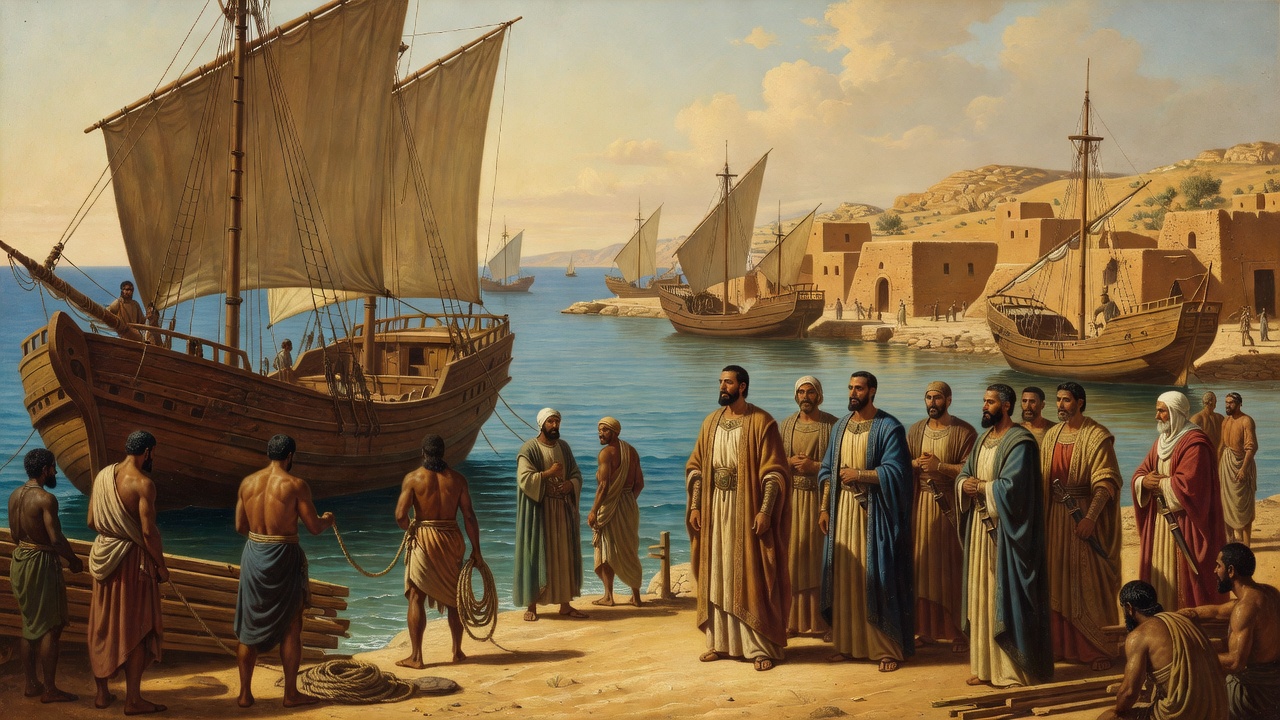
- In an alliance with King Hiram of Tyre, experienced sailors sailed from Ezion-geber and Eloth on the Red Sea coast of Edom alongside Solomon's men to Ophir, returning with 450 talents of gold.Sources: the Bible text itself · Hiram
Notes written with AI assistance from open sources (Theographic Bible Metadata, CC BY-SA 4.0; Easton’s Bible Dictionary, public domain) and reviewed before publishing.
Places in this chapter
- Hamath · Today: Hama · 35.136, 36.750 · verse 4
- Tadmor · Today: Palmyra · 34.547, 38.274 · verse 4
- Lower Beth-horon · Today: Beit Ur al Tahta · 31.895, 35.084 · verse 5
- Upper Beth-horon · Today: Beit Ur al Fauqa · 31.886, 35.114 · verse 5
- Jerusalem · 31.777, 35.234 · verse 6
- Lebanon · 33.540, 35.584 · verse 6
- City of David · 31.774, 35.236 · verse 11
- Edom · 30.746, 35.604 · verse 17
- Red Sea · Today: Gulf of Aqaba · 28.750, 34.750 · verse 17
Only places identified with high confidence are shown (90% or more according to the scholarly sources compiled by OpenBible). Period map: DARE (Digital Atlas of the Roman Empire), CC BY 4.0; modern map: © OpenStreetMap contributors; places: OpenBible.info (CC BY 4.0).
Credits and license for this translation
LXX2012: Septuagint in British/International English 2012
The Septuagint with Apocrypha, translated from Greek to English by Sir Lancelot C. L. Brenton and published in 1885, with some language updates (British/International English)
Public Domain
Language: English
Dialect (if applicable): British
Language in English: English
Translation by: Sir Lancelot Charles Lee Breton
LXX2012: Septuagint in English 2012, British/International English Edition
This is a translation of the Old Testament and Apocrypha/Deuterocanon from Hebrew to Greek to 19th Century British English, with some updates of spelling and word usage to contemporary British/International English. The original English translation was done by Sir Lancelot Charles Lee Brenton and published by Samuel Bagster & Sons, Ltd., in London in 1851. It has entered the Public Domain due to the passage of sufficient time. In the process of scanning and typing the text, the original poetry and prose formatting, as well as peripheral material like introductions and notes, have been omitted.
This edition of the Septuagint has some language updates. Brenton's word order and punctuation has been mostly retained, meaning that quotation marks are not used, and sentences within quotes may not start with capital letters, as was standard usage in 1851. Names transliterated from Greek to those transliterated from Hebrew in the common English Bibles often differ. These language updates are dedicated to the Public Domain by the author of those edits, Michael Paul Johnson. Therefore this edition may be freely copied, published, etc.
Before considering making changes to the text of this work, I recommend that you consult with God, because this is really His Book.
If you find errors in the text, please report them so that we can correct them.
Donations to help with the expenses of operating this web site and thus help others have free access to the Word of God may be made to us, but are not required. Please see http://MLJohnson.org/partner/ for more about that.
Section headings adapted from the Berean Standard Bible (public domain); they are not part of this translation’s text.
Source: http://ebible.org/eng-uk-lxx2012/ · eBible.org