2 Chronicles 25
LXX2012: Septuagint in British/International English 2012 · Tap a verse to see its cross-references.
Amaziah Reigns in Judah
1Amasias began to reign when he was twenty and five years old, and he reigned twenty-nine years in Jerusalem; and his mother's name was Joadaen of Jerusalem. 2And he did that which was right in the sight of the Lord, but not with a perfect heart. 3And it came to pass, when the kingdom was established in his hand, that he killed his servants who had slain the king his father. 4But he killed not their sons, according to the covenant of the law of the Lord, as it is written, and as the Lord commanded, saying, The fathers shall not die for the children, and the sons shall not die for the fathers, but they shall die each for his own sin.
Amaziah’s Victories
5And Amasias assembled the house of Juda, and appointed them according to the houses of their families for captains of thousands and captains of hundreds in all Juda and Jerusalem: and he numbered them from twenty years old and upwards, and found them three hundred thousand able to go out to war, holding spear and shield. 6Also he hired of Israel one hundred thousand mighty men for one hundred talents of silver. 7And there came a man of God to him, saying, O king, let not the host of Israel go with you; for the Lord is not with Israel, even all the sons of Ephraim. 8For if you shall undertake to strengthen yourself with these, then the lord shall put you to flight before the enemies: for it is of the Lord both to strengthen and to put to flight. 9And Amasias said to the man of God, But what shall I do for the hundred talents which I have given to the army of Israel? And the man of God said, The Lord can give you much more than these. 10And Amasias separated from the army that came to him from Ephraim, that they might go away to their place; and they were very angry with Juda, and they returned to their place with great wrath. 11And Amasias strengthened himself, and took his people, and went to the valley of salt, and struck there the children of Seir ten thousand. 12And the children of Juda took ten thousand prisoners, and they carried them to the top of the precipice, and cast them headlong from the top of the precipice, and they were all dashed to pieces. 13And the men of the host whom Amasias sent back so that they should not go with him to battle, went and attacked the cities of Juda, from Samaria to Baethoron; and they struck three thousand amongst them, and took much spoil.
Amaziah Rebuked for Idolatry
14And it came to pass, after Amasias had returned from striking Idumea, that he brought home the gods of the children of Seir, and set them up for himself as gods, and bowed down before them, and he sacrificed to them. 15And the anger of the Lord came upon Amasias, and he sent him a prophet, and he said to him, Why have you sought the gods of the people, which have not rescued their own people out of your hand? 16And it came to pass when the prophet was speaking to him, that he said to him, have I made you king's counsellor? take heed lest you be scourged: and the prophet forebore, and said, I know that God is disposed against you to destroy you, because you have done this thing, and have not listened to my counsel.
Jehoash Defeats Amaziah
17And Amasias king of Juda took counsel, and sent to Joas, son of Joachaz, son of Jeu, king of Israel, saying, Come, and let us look one another in the face. 18And Joas king of Israel sent to Amasias king of Juda, saying, The thistle that was in Libanus sent to the cedar that was in Libanus, saying, Give your daughter to my son to wife; but, behold, your wild beasts of the field that are in Libanus shall come: and the wild beasts did come, and trod down the thistle. 19You have said, Behold, I have struck Idumea, and your stout heart exalts you: now stay at home; for why do you implicate yourself in mischief, that you should fall, and Juda with you. 20Nevertheless Amasias listened not, for it was of the Lord to deliver him into the enemy's hands, because he sought after the gods of the Idumeans. 21So Joas king of Israel went up; and they saw one another, he and Amasias king of Juda, in Baethsamys, which is of Juda. 22And Juda was put to flight before Israel, and they fled every man to his tent. 23And Joas king of Israel took prisoner Amasias king of Juda, son of Joas, son of Joachaz, in Baethsamys, and brought him to Jerusalem; and he pulled down part of the wall of Jerusalem from the gate of Ephraim to the corner gate, four hundred cubits. 24And he took all the gold and the silver, and all the vessels that were found in the house of the Lord and with Abdedom, and the treasures of the king's house, and the hostages, and he returned to Samaria.
The Death of Amaziah
25And Amasias the son of Joas king of Juda lived after the death of Joas the son of Joachaz king of Israel fifteen years. 26And the rest of the acts of Amasias, the first and the last, Behold! are they not written in the book of the kings of Juda and Israel? 27And at the time when Amasias departed from the Lord, then they formed a conspiracy against him; and he fled from Jerusalem to Lachis: and they sent after him to Lachis, and killed him there. 28And they took him up on horses, and buried him with his fathers in the city of David.
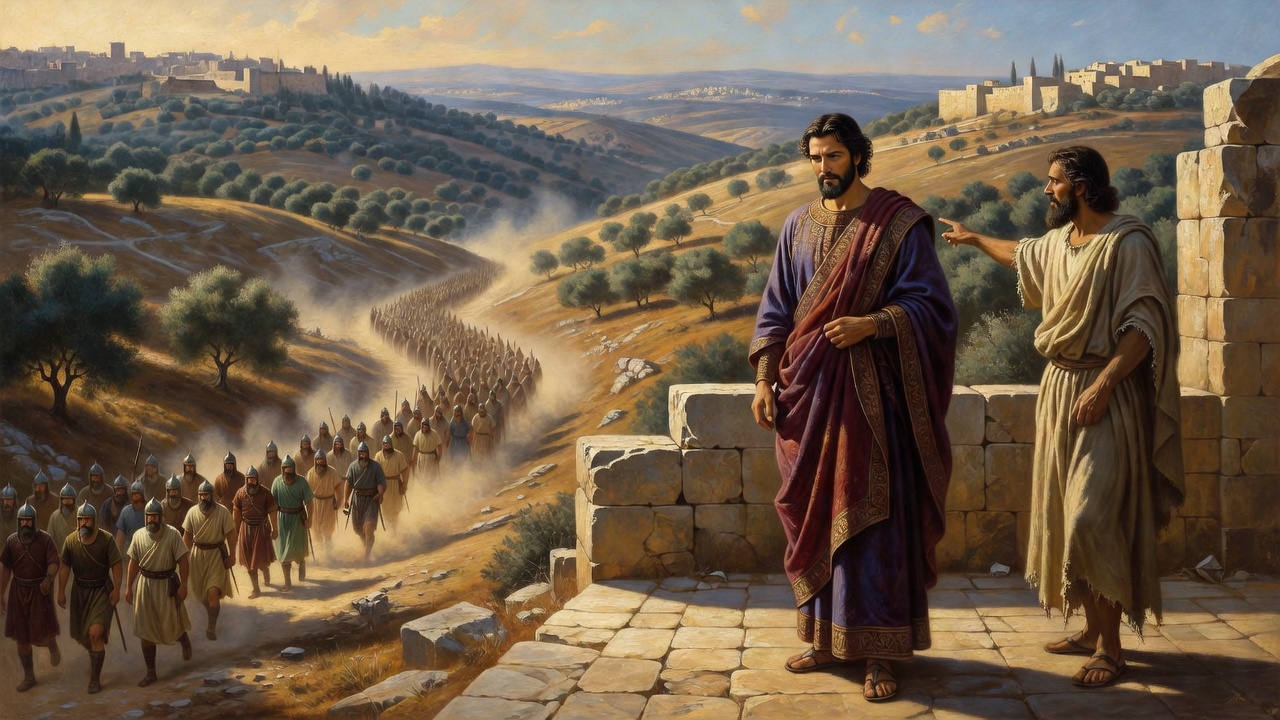
Did you know?
The Reign of Amaziah
- When King Amaziah executed the officials who had murdered his father, he spared their sons, citing the Law of Moses where each person must die only for their own sin rather than the sins of their parents.Sources: the Bible text itself · Amaziah
- Amaziah was the first king of Judah recorded as hiring a mercenary force of 100,000 northern Israelite soldiers. When a prophet commanded him to send them away, the dismissed troops reacted furiously by raiding cities of Judah from Samaria to Beth-horon.Sources: the Bible text itself · Amaziah · Beth-horon
- After defeating the Edomites in the Valley of Salt, Amaziah challenged King Jehoash of Israel, who warned him through a fable of a thistle demanding an alliance with a cedar of Lebanon before being trampled by a wild beast.Sources: the Bible text itself · Joash · Valley of Salt
Notes written with AI assistance from open sources (Theographic Bible Metadata, CC BY-SA 4.0; Easton’s Bible Dictionary, public domain) and reviewed before publishing.
Places in this chapter
- Jerusalem · 31.777, 35.234 · verses 1, 23, 27
- Beth-horon · Today: Beit Ur al Tahta · 31.895, 35.084 · verse 13
- Samaria · 32.276, 35.195 · verses 13, 24
- Lebanon · 33.540, 35.584 · verse 18
- Edom · 30.746, 35.604 · verses 19, 20
- Corner Gate · Today: in Jerusalem · 31.777, 35.234 · verse 23
- Ephraim Gate · Today: in Jerusalem · 31.777, 35.234 · verse 23
- Lachish · Today: Tell ed Duweir · 31.565, 34.849 · verse 27
- City of David · 31.774, 35.236 · verse 28
Only places identified with high confidence are shown (90% or more according to the scholarly sources compiled by OpenBible). Period map: DARE (Digital Atlas of the Roman Empire), CC BY 4.0; modern map: © OpenStreetMap contributors; places: OpenBible.info (CC BY 4.0).
Credits and license for this translation
LXX2012: Septuagint in British/International English 2012
The Septuagint with Apocrypha, translated from Greek to English by Sir Lancelot C. L. Brenton and published in 1885, with some language updates (British/International English)
Public Domain
Language: English
Dialect (if applicable): British
Language in English: English
Translation by: Sir Lancelot Charles Lee Breton
LXX2012: Septuagint in English 2012, British/International English Edition
This is a translation of the Old Testament and Apocrypha/Deuterocanon from Hebrew to Greek to 19th Century British English, with some updates of spelling and word usage to contemporary British/International English. The original English translation was done by Sir Lancelot Charles Lee Brenton and published by Samuel Bagster & Sons, Ltd., in London in 1851. It has entered the Public Domain due to the passage of sufficient time. In the process of scanning and typing the text, the original poetry and prose formatting, as well as peripheral material like introductions and notes, have been omitted.
This edition of the Septuagint has some language updates. Brenton's word order and punctuation has been mostly retained, meaning that quotation marks are not used, and sentences within quotes may not start with capital letters, as was standard usage in 1851. Names transliterated from Greek to those transliterated from Hebrew in the common English Bibles often differ. These language updates are dedicated to the Public Domain by the author of those edits, Michael Paul Johnson. Therefore this edition may be freely copied, published, etc.
Before considering making changes to the text of this work, I recommend that you consult with God, because this is really His Book.
If you find errors in the text, please report them so that we can correct them.
Donations to help with the expenses of operating this web site and thus help others have free access to the Word of God may be made to us, but are not required. Please see http://MLJohnson.org/partner/ for more about that.
Section headings adapted from the Berean Standard Bible (public domain); they are not part of this translation’s text.
Source: http://ebible.org/eng-uk-lxx2012/ · eBible.org