1 Chronicles 23
LXX2012: Septuagint in British/International English 2012 · Tap a verse to see its cross-references.
The Divisions of the Levites
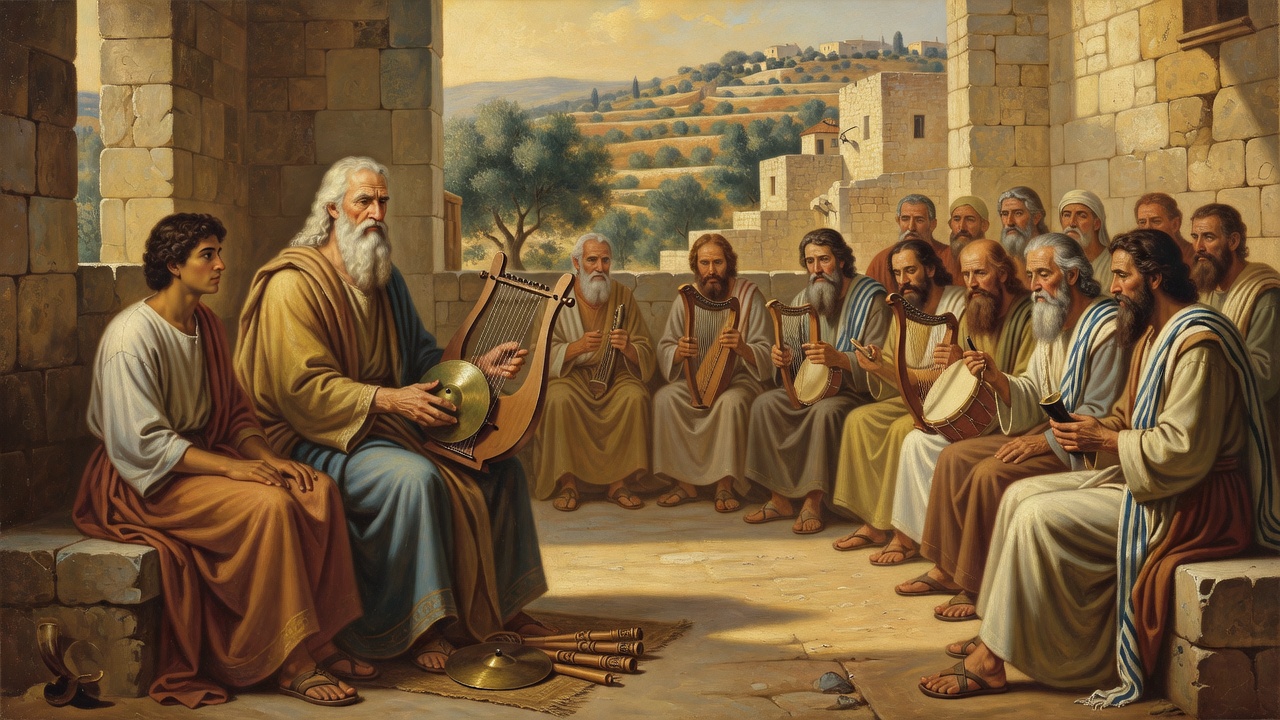
1And David was old and full of days; and he made Solomon his son king over Israel in his stead. 2And he assembled all the chief men of Israel, and the priests, and the Levites. 3And the Levites numbered themselves from thirty years old and upward; and their number by their polls amounted to thirty and eight thousand men. 4Of the overseers over the works of the house of the Lord there were twenty-four thousand, and there were six thousand scribes and judges; 5and four thousand doorkeepers, and four thousand to praise the Lord with instruments which he made to praise the Lord. 6And David divided them into daily courses, for the sons of Levi, for Gedson, Caath, and Merari.
The Gershonites
7And for the family of Gedson, Edan, and Semei. 8The sons of Edan were Jeiel, the chief, and Zethan, and Joel, three. 9The sons of Semei; Salomith, Jeiel, and Dan, three: these were the chiefs of the families of Edan. 10And to the sons of Semei, Jeth, and Ziza, and Joas, and Beria: these were the four sons of Semei. 11And Jeth was the chief, and Ziza the second: and Joas and Beria did not multiply sons, and they became only one reckoning according to the house of their father.
The Kohathites
12The sons of Caath; Ambram, Isaar, Chebron, Oziel, four. 13The sons of Ambram; Aaron and Moses: and Aaron was appointed for the consecration of the most holy things, he and his sons for ever, to burn incense before the Lord, to minister and bless in his name for ever. 14And as for Moses the man of God, his sons were reckoned to the tribe of Levi. 15The sons of Moses; Gersam, and Eliezer. 16The sons of Gersam; Subael the chief. 17And the sons of Eliezer were, Rabia the chief: and Eliezer had no other sons; but the sons of Rabia were very greatly multiplied. 18The sons of Isaar; Salomoth the chief. 19The sons of Chebron; Jeria the chief, Amaria the second, Jeziel the third, Jekemias the fourth. 20The sons of Oziel; Micha the chief, and Isia the second.
The Merarites
21The sons of Merari; Mooli, and Musi: the sons of Mooli; Eleazar, and Kis. 22And Eleazar died, and he had no sons, but daughters: and the sons of Kis, their brethren, took them. 23The sons of Musi; Mooli, and Eder, and Jarimoth, three.
Levite Duties Revised
24These are the sons of Levi according to the houses of their fathers; chiefs of their families according to their numbering, according to the number of their names, according to their polls, doing the works of service of the house of the Lord, from twenty years old and upward. 25For David said, The Lord God of Israel has given rest to his people, and has taken up his abode in Jerusalem for ever. 26And the Levites bore not the tabernacle, and all the vessels of it for its service. 27For by the last words of David was the number of the Levites taken from twenty years old and upward. 28For he appointed them to wait on Aaron, to minister in the house of the Lord, over the courts, and over the chambers, and over the purification of all the holy things, and over the works of the service of the house of God; 29and for the show-bread, and for the fine flour of the meat-offering, and for the unleavened cakes, and for the fried cake, and for the dough, and for every measure; 30and to stand in the morning to praise and give thanks to the Lord, and so in the evening; 31and to be over all the whole burnt offerings that were offered up to the Lord on the sabbaths, and at the new moons, and at the feasts, by number, according to the order given to them, continually before the Lord. 32And they are to keep the charge of the tabernacle of witness, and the charge of the holy place, and the charges of the sons of Aaron their brethren, to minister in the house of the Lord.
Did you know?
David Organizes the Levites
- A census counted 38,000 Levites aged thirty and above in Israel. David organized them into distinct roles: 24,000 to oversee the sanctuary's work, 6,000 as officials and judges, 4,000 as gatekeepers, and 4,000 as musicians praising the LORD with specially made instruments.Sources: the Bible text itself
- Because God had granted rest and chosen Jerusalem as a permanent dwelling place, the Levites no longer needed to transport the tabernacle and its furnishings. David therefore updated their duties to assisting Aaron's priestly line with temple offerings, maintenance, and daily morning and evening praise, lowering the entry age to twenty.Sources: the Bible text itself · Jerusalem
- Although both Aaron and Moses were sons of Amram from the lineage of Kohath, their descendants held different roles. Aaron and his descendants were set apart perpetually for the priesthood to burn incense and bless in the LORD's name, while the sons of Moses were counted among the general Levite clans.Sources: the Bible text itself · Aaron · Moses
Notes written with AI assistance from open sources (Theographic Bible Metadata, CC BY-SA 4.0; Easton’s Bible Dictionary, public domain) and reviewed before publishing.
Places in this chapter
- Jerusalem · 31.777, 35.234 · verse 25
Only places identified with high confidence are shown (90% or more according to the scholarly sources compiled by OpenBible). Period map: DARE (Digital Atlas of the Roman Empire), CC BY 4.0; modern map: © OpenStreetMap contributors; places: OpenBible.info (CC BY 4.0).
Credits and license for this translation
LXX2012: Septuagint in British/International English 2012
The Septuagint with Apocrypha, translated from Greek to English by Sir Lancelot C. L. Brenton and published in 1885, with some language updates (British/International English)
Public Domain
Language: English
Dialect (if applicable): British
Language in English: English
Translation by: Sir Lancelot Charles Lee Breton
LXX2012: Septuagint in English 2012, British/International English Edition
This is a translation of the Old Testament and Apocrypha/Deuterocanon from Hebrew to Greek to 19th Century British English, with some updates of spelling and word usage to contemporary British/International English. The original English translation was done by Sir Lancelot Charles Lee Brenton and published by Samuel Bagster & Sons, Ltd., in London in 1851. It has entered the Public Domain due to the passage of sufficient time. In the process of scanning and typing the text, the original poetry and prose formatting, as well as peripheral material like introductions and notes, have been omitted.
This edition of the Septuagint has some language updates. Brenton's word order and punctuation has been mostly retained, meaning that quotation marks are not used, and sentences within quotes may not start with capital letters, as was standard usage in 1851. Names transliterated from Greek to those transliterated from Hebrew in the common English Bibles often differ. These language updates are dedicated to the Public Domain by the author of those edits, Michael Paul Johnson. Therefore this edition may be freely copied, published, etc.
Before considering making changes to the text of this work, I recommend that you consult with God, because this is really His Book.
If you find errors in the text, please report them so that we can correct them.
Donations to help with the expenses of operating this web site and thus help others have free access to the Word of God may be made to us, but are not required. Please see http://MLJohnson.org/partner/ for more about that.
Section headings adapted from the Berean Standard Bible (public domain); they are not part of this translation’s text.
Source: http://ebible.org/eng-uk-lxx2012/ · eBible.org