1 Chronicles 14
LXX2012: Septuagint in British/International English 2012 · Tap a verse to see its cross-references.
David’s Family Grows
1And Chiram king of Tyre sent messengers to David, and cedar timbers, and masons, and carpenters, to build a house for him. 2And David knew that the Lord had designed him to be king over Israel; because his kingdom was highly exalted, on account of his people Israel. 3And David took more wives in Jerusalem: and there were born to David more sons and daughters. 4And these are the names of those that were born, who were born to him in Jerusalem; Samaa, Sobab, Nathan, and Solomon, 5and Baar, and Elisa, and Eliphaleth, 6and Nageth, and Naphath, and Japhie, 7and Elisamae, and Eliade, and Eliphala.
Two Victories over the Philistines
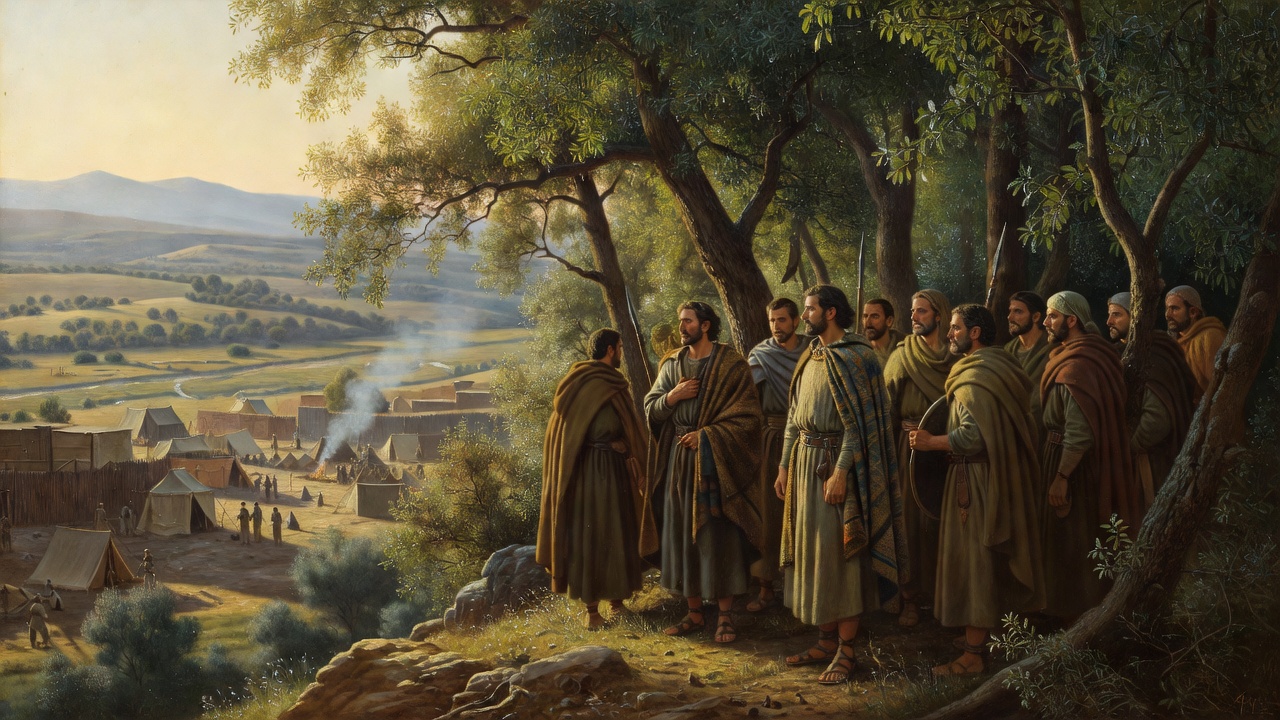
8And the Philistines heard that David was anointed king over all Israel: and all the Philistines went up to seek David; and David heard it, and went out to meet them. 9And the Philistines came and assembled together in the giants' valley. 10And David enquired of God, saying, Shall I go up against the Philistines? and will you deliver them into my hand? And the Lord said to him, Go up, and I will deliver them into your hands. 11And he went up to Baal Pharasin, and David struck them there; and David said, God has broken through enemies by my hand like a breach of water: therefore he called the name of that place, the Breach of Pharasin. 12And the Philistines left their gods there; and David gave orders to burn them with fire. 13And the Philistines once more assembled themselves in the giants' valley. 14And David enquired of God again; and God said to him, You shall not go after them; turn away from them, and you shall come upon them near the pear trees. 15And it shall be, when you shall hear the sound of their tumult in the tops of the pear trees, then you shall go into the battle: for God has gone out before you to strike the army of the Philistines. 16And he did as God commanded him: and he struck the army of the Philistines from Gabaon to Gazera. 17And the name of David was famous in all the land; and the Lord put the terror of him on all the nations.
Did you know?
David's Palace and Victories over the Philistines
- The Phoenician coastal city of Tyre was renowned for its maritime commerce and skilled craftsmen. King Hiram provided David with Lebanese cedar logs, stonemasons, and carpenters to build a royal palace in Jerusalem.Sources: Hiram · Tyre · the Bible text itself
- The Valley of Rephaim lay southwest of Jerusalem, providing invaders a natural corridor toward the city. David named the site of his victory Baal-perazim, meaning a bursting through, comparing God breaking through his enemies to a raging flood.Sources: Valley of Rephaim · Baal-perazim · the Bible text itself
- In their second confrontation, David ambushed the Philistine army near a grove of balsam trees and pursued the retreating forces from Gibeon all the way to Gezer on the coastal plain.Sources: Gibeon · Gezer · the Bible text itself
Notes written with AI assistance from open sources (Theographic Bible Metadata, CC BY-SA 4.0; Easton’s Bible Dictionary, public domain) and reviewed before publishing.
Places in this chapter
- Tyre · 33.271, 35.196 · verse 1
- Jerusalem · 31.777, 35.234 · verses 3, 4
- Valley of Rephaim · 31.763, 35.219 · verse 9
- Gezer · Today: Tel Gezer · 31.859, 34.919 · verse 16
- Gibeon · Today: El Jib · 31.847, 35.183 · verse 16
Only places identified with high confidence are shown (90% or more according to the scholarly sources compiled by OpenBible). Period map: DARE (Digital Atlas of the Roman Empire), CC BY 4.0; modern map: © OpenStreetMap contributors; places: OpenBible.info (CC BY 4.0).
Credits and license for this translation
LXX2012: Septuagint in British/International English 2012
The Septuagint with Apocrypha, translated from Greek to English by Sir Lancelot C. L. Brenton and published in 1885, with some language updates (British/International English)
Public Domain
Language: English
Dialect (if applicable): British
Language in English: English
Translation by: Sir Lancelot Charles Lee Breton
LXX2012: Septuagint in English 2012, British/International English Edition
This is a translation of the Old Testament and Apocrypha/Deuterocanon from Hebrew to Greek to 19th Century British English, with some updates of spelling and word usage to contemporary British/International English. The original English translation was done by Sir Lancelot Charles Lee Brenton and published by Samuel Bagster & Sons, Ltd., in London in 1851. It has entered the Public Domain due to the passage of sufficient time. In the process of scanning and typing the text, the original poetry and prose formatting, as well as peripheral material like introductions and notes, have been omitted.
This edition of the Septuagint has some language updates. Brenton's word order and punctuation has been mostly retained, meaning that quotation marks are not used, and sentences within quotes may not start with capital letters, as was standard usage in 1851. Names transliterated from Greek to those transliterated from Hebrew in the common English Bibles often differ. These language updates are dedicated to the Public Domain by the author of those edits, Michael Paul Johnson. Therefore this edition may be freely copied, published, etc.
Before considering making changes to the text of this work, I recommend that you consult with God, because this is really His Book.
If you find errors in the text, please report them so that we can correct them.
Donations to help with the expenses of operating this web site and thus help others have free access to the Word of God may be made to us, but are not required. Please see http://MLJohnson.org/partner/ for more about that.
Section headings adapted from the Berean Standard Bible (public domain); they are not part of this translation’s text.
Source: http://ebible.org/eng-uk-lxx2012/ · eBible.org