1 Chronicles 10
LXX2012: Septuagint in British/International English 2012 · Tap a verse to see its cross-references.
Saul’s Overthrow and Death
1Now the Philistines warred against Israel; and they fled from before the Philistines, and fell down slain in mount Gelbue. 2And the Philistines pursued after Saul, and after his sons; and the Philistines struck Jonathan, and Aminadab, and Melchisue, sons of Saul. 3And the battle prevailed against Saul, and the archers hit him with bows and arrows, and they were wounded of the bows. 4And Saul said to his armour-bearer, Draw your sword, and pierce me through with it, lest these uncircumcised come and mock me. But his armour-bearer would not, for he was greatly afraid: so Saul took a sword, and fell upon it. 5And his armour-bearer saw that Saul was dead, and he also fell upon his sword. 6So Saul died, and his three sons on that day, and all his family died at the same time.
The Philistines Possess the Towns
7And all the men of Israel that were in the valley saw that Israel fled, and that Saul and his sons were dead, and they left their cities, and fled: and the Philistines came and lived in them. 8And it came to pass on the next day that the Philistines came to strip the slain, and they found Saul and his sons fallen on mount Gelbue. 9And they stripped him, and took his head, and his armour, and sent them into the land of the Philistines round about, to proclaim the glad tidings to their idols, and to the people. 10And they put their armour in the house of their god, and they put his head in the house of Dagon.
Jabesh-gilead’s Tribute to Saul
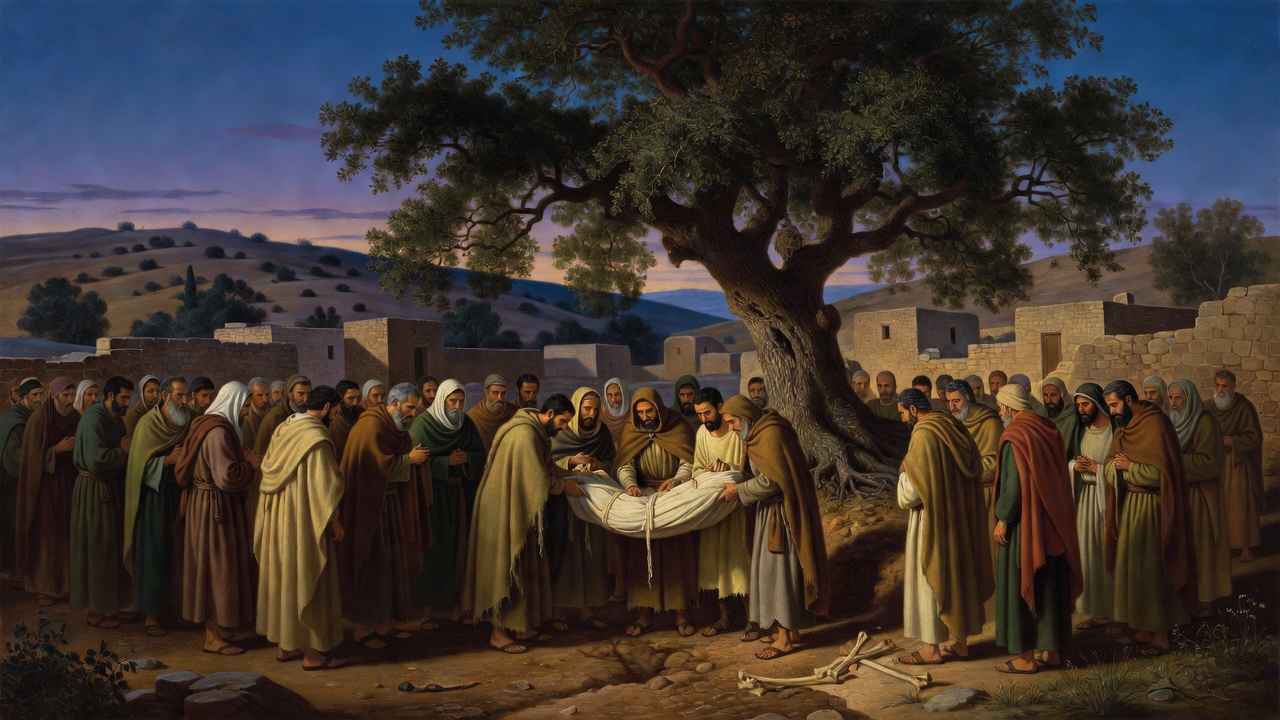
11And all the dwellers in Galaad heard of all that the Philistines had done to Saul and to Israel. 12And all the mighty men rose up from Galaad, and they took the body of Saul, and the bodies of his sons, and brought them to Jabis, and buried their bones under the oak in Jabis, and fasted seven days. 13So Saul died for his transgressions, wherein he transgressed against God, against the word of the Lord, forasmuch as he kept it not, because Saul enquired of a wizard to seek counsel, and Samuel the prophet answered him: 14and he sought not the Lord: so he killed him, and turned the kingdom to David the son of Jesse.
Did you know?
The Fall of Saul and Transition to David
- The Philistines defeated Israel on Mount Gilboa, killing King Saul's sons Jonathan, Abinadab, and Malchi-shua. After Saul took his own life, the Philistines stripped his armor to place it in the temple of their gods and fastened his head in the temple of Dagon, their national deity.Sources: the Bible text itself · Dagon · Mount Gilboa · Jonathan
- Upon hearing how the Philistines treated Saul, valiant men from Jabesh-gilead traveled to retrieve the bodies of Saul and his sons. They carried them back to Jabesh, buried their bones under a large oak tree, and observed a seven-day fast.Sources: the Bible text itself · Jabesh-gilead
- The Chronicler summarizes Saul's downfall as a consequence of unfaithfulness to the LORD, including his failure to inquire of God and his consultation of a medium. This tragic end sets the stage for the kingdom to be transferred to David, the son of Jesse.Sources: the Bible text itself · David · Jesse
Notes written with AI assistance from open sources (Theographic Bible Metadata, CC BY-SA 4.0; Easton’s Bible Dictionary, public domain) and reviewed before publishing.
Places in this chapter
- Mount Gilboa · 32.434, 35.414 · verses 1, 8
- Valley of Jezreel · Today: Jezreel Valley · 32.596, 35.242 · verse 7
- Philistia · 31.664, 34.546 · verse 9
Only places identified with high confidence are shown (90% or more according to the scholarly sources compiled by OpenBible). Period map: DARE (Digital Atlas of the Roman Empire), CC BY 4.0; modern map: © OpenStreetMap contributors; places: OpenBible.info (CC BY 4.0).
Credits and license for this translation
LXX2012: Septuagint in British/International English 2012
The Septuagint with Apocrypha, translated from Greek to English by Sir Lancelot C. L. Brenton and published in 1885, with some language updates (British/International English)
Public Domain
Language: English
Dialect (if applicable): British
Language in English: English
Translation by: Sir Lancelot Charles Lee Breton
LXX2012: Septuagint in English 2012, British/International English Edition
This is a translation of the Old Testament and Apocrypha/Deuterocanon from Hebrew to Greek to 19th Century British English, with some updates of spelling and word usage to contemporary British/International English. The original English translation was done by Sir Lancelot Charles Lee Brenton and published by Samuel Bagster & Sons, Ltd., in London in 1851. It has entered the Public Domain due to the passage of sufficient time. In the process of scanning and typing the text, the original poetry and prose formatting, as well as peripheral material like introductions and notes, have been omitted.
This edition of the Septuagint has some language updates. Brenton's word order and punctuation has been mostly retained, meaning that quotation marks are not used, and sentences within quotes may not start with capital letters, as was standard usage in 1851. Names transliterated from Greek to those transliterated from Hebrew in the common English Bibles often differ. These language updates are dedicated to the Public Domain by the author of those edits, Michael Paul Johnson. Therefore this edition may be freely copied, published, etc.
Before considering making changes to the text of this work, I recommend that you consult with God, because this is really His Book.
If you find errors in the text, please report them so that we can correct them.
Donations to help with the expenses of operating this web site and thus help others have free access to the Word of God may be made to us, but are not required. Please see http://MLJohnson.org/partner/ for more about that.
Section headings adapted from the Berean Standard Bible (public domain); they are not part of this translation’s text.
Source: http://ebible.org/eng-uk-lxx2012/ · eBible.org