Numbers 6
Translation for Translators · Tap a verse to see its cross-references.
Rules about Nazir-men
1Yahweh also said this to Moses/me: 2“Tell this to the Israeli people: ‘If any of you wants to make a solemn promise to dedicate himself to belong to me in a special way, after you obey these instructions, you will be called a Nazir-man, which means “dedicated man”. 3You must not drink any wine or other alcoholic/fermented drink. You must not drink any vinegar made from wine or from any other alcoholic/fermented drink. You must not drink grape juice or eat grapes or raisins. 4You must not eat anything that comes from grapevines, not even the skins or seeds of grapes, during the time that you are a Nazir-man.
5‘Even your hair will be dedicated to me during the time that you area Nazir-man, so you must never allow anyone to cut your hair. Until the time that your solemn promise to dedicate yourself to me is ended, you must allow your hair to grow long. 6And you must not go near a corpse during the time that you are a Nazir-man. 7Even if the person who died is your father or your mother or your brother or your sister, you must not cause yourself to become unacceptable to me by coming close to the corpse. Your long hair [MTY] shows that you belong to me in a special way, so you must not cut your hair. 8You are required to keep doing this all the time that you are dedicated to me in this special way.
9‘If anyone dies very suddenly when he is near you, then your hair that you have dedicated to me is no longer sacred. So you must wait seven days and then shave it all off. Then you must perform a special ritual to cause yourself to become acceptable to me again. 10The next day you must bring two doves or two young pigeons to the priest at the entrance of the Sacred Tent. 11‘The priest must kill the birds and offer them as sacrifices. One of them will be an offering to enable me to forgive you for the sins you have committed, and the other will be an offering that is burned completely to please me. After the priest burns them on the altar, I will forgive you for having come close to a corpse, and when your hair grows again it will be dedicated to me again. 12The amount of time that you were set apart for me the previous time does not count, because you had become unacceptable to me by coming close to a corpse during the time that you were a Nazir-man. So you must again make a solemn promise to dedicate yourself to me for the entire amount of time that you indicated the previous time. And you must also sacrifice a one-year-old lamb for not doing what you were required to do.
13‘When the time that you promised to dedicate yourself to me is ended, go to the entrance of the Sacred Tent 14and offer as sacrifices to me three animals that have no defects: Offer a one-year-old ram that will be burned completely, a one-year-old female lamb as a sacrifice to enable me to forgive your sins, and one full-grown ram as a sacrifice to maintain fellowship with me.
15‘When you bring those animals, you must also bring some wine to offer as a sacrifice. And you must also bring a basket of bread that you have made with very good flour and olive oil. But you must not put any yeast in the bread. Also brush/spread some olive oil on some thin wafers and bring them to the priest.
16‘The priest will put the young lamb and the young ram on the altar and completely burn them, in order that I will be pleased and will forgive you for your sins. 17Then he will kill the full-grown ram as an offering to restore fellowship with me, and he will also burn on the altar some of the bread and the grain and wine.
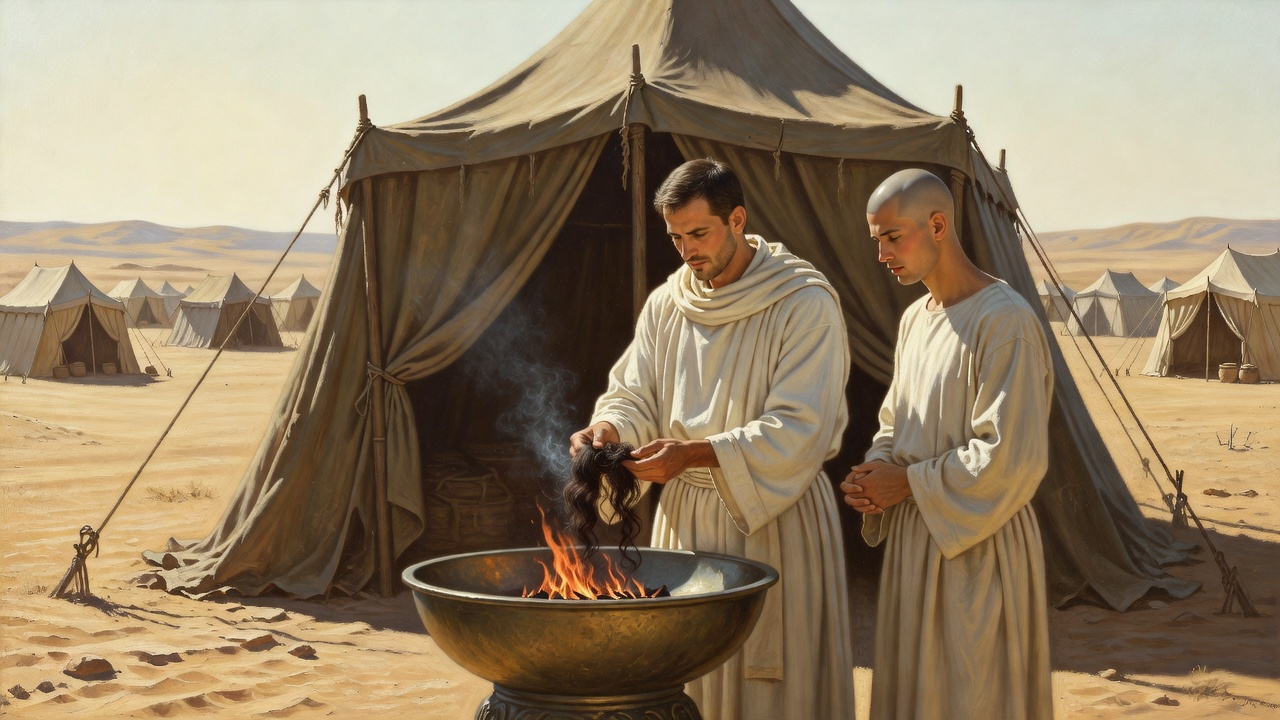
18‘After that, you must stand at the entrance of the Sacred Tent and shave off your hair. Then you must put that hair in the fire that is under the animal that has been sacrificed on the altar to maintain fellowship with me.
19‘The meat from the ram’s shoulder must be boiled. After it is cooked, the priest will take it along with one of the loaves of bread and one wafer which has been brushed with olive oil, and he will put them in your hands. 20Then the priest will take them back and lift them up high to dedicate them to me. They now belong to the priest, and he is permitted to eat some of the meat from the ram’s shoulder and from its ribs and from one of its thighs, because that meat is his share of the sacrifice. After that, you will no longer be a Nazir-man, and you will again be permitted to drink wine.
21‘Those are the regulations about the offerings that Nazir-men solemnly promise to bring to me to end their time of being dedicated to me. They must bring these offerings, but if they want to, they may bring additional offerings. And they must do everything that they solemnly promised to do when they dedicated themselves to me.’”
The blessing for the people
22Yahweh also said to Moses/me, 23“Tell Aaron and his sons that when they ask me to bless the people, they must say,
24‘I desire that Yahweh will bless you
and protect you,
25and that he will smile at you
and act kindly toward you,
26and that he will be good to you [IDM]
and cause things to go well for you.’”
27Then Yahweh said, “If Aaron and his sons ask me to bless the Israeli people, truly I will bless them.”
Did you know?
The Nazirite Vow and the Priestly Blessing
- The Nazirite vow was a voluntary period of special consecration to God available to both men and women. During this time, the person had to abstain completely from grape products and fermented drinks, leave their hair uncut, and avoid ritual defilement from any dead body, even that of an immediate family member.Sources: the Bible text itself
- When the period of separation ended, the Nazirite brought sacrifices to the entrance of the Tent of Meeting, shaved their head of hair, and burned the hair in the fire beneath the peace offering sacrifice. After the priest offered the required portions before God, the vow concluded and the person was allowed to drink wine again.Sources: the Bible text itself
- The chapter concludes with the priestly blessing that God instructed Moses to give to Aaron and his sons. By invoking God's protection, shining face, grace, and peace, the priests placed the divine name upon the people of Israel.Sources: the Bible text itself · Moses · Aaron
Notes written with AI assistance from open sources (Theographic Bible Metadata, CC BY-SA 4.0; Easton’s Bible Dictionary, public domain) and reviewed before publishing.
Credits and license for this translation
Translation for Translators
A Bible Translation for Bible Translators which makes implied information explicit in the text as an aid to the translator who may need that information to correctly translate into a particular language.
Copyright © 2008-2017 Ellis W. Deibler, Jr.
Language: English
Dialect: American
This translation is made available to you under the terms of the
Creative Commons Attribution Share-Alike license 4.0.
You have permission to share and redistribute this Bible translation in any format and to make reasonable revisions and adaptations of this translation, provided that:
You include the above copyright and source information.
If you make any changes to the text, you must indicate that you did so in a way that makes it clear that the original licensor is not necessarily endorsing your changes.
If you redistribute this text, you must distribute your contributions under the same license as the original.
Pictures included with Scriptures and other documents on this site are licensed just for use with those Scriptures and documents.
For other uses, please contact the respective copyright owners.
Note that in addition to the rules above, revising and adapting God's Word involves a great responsibility to be true to God's Word. See Revelation 22:18-19.
2026-10-02
Source: http://ebible.org/eng-t4t/ · eBible.org