Numbers 10
Translation for Translators · Tap a verse to see its cross-references.
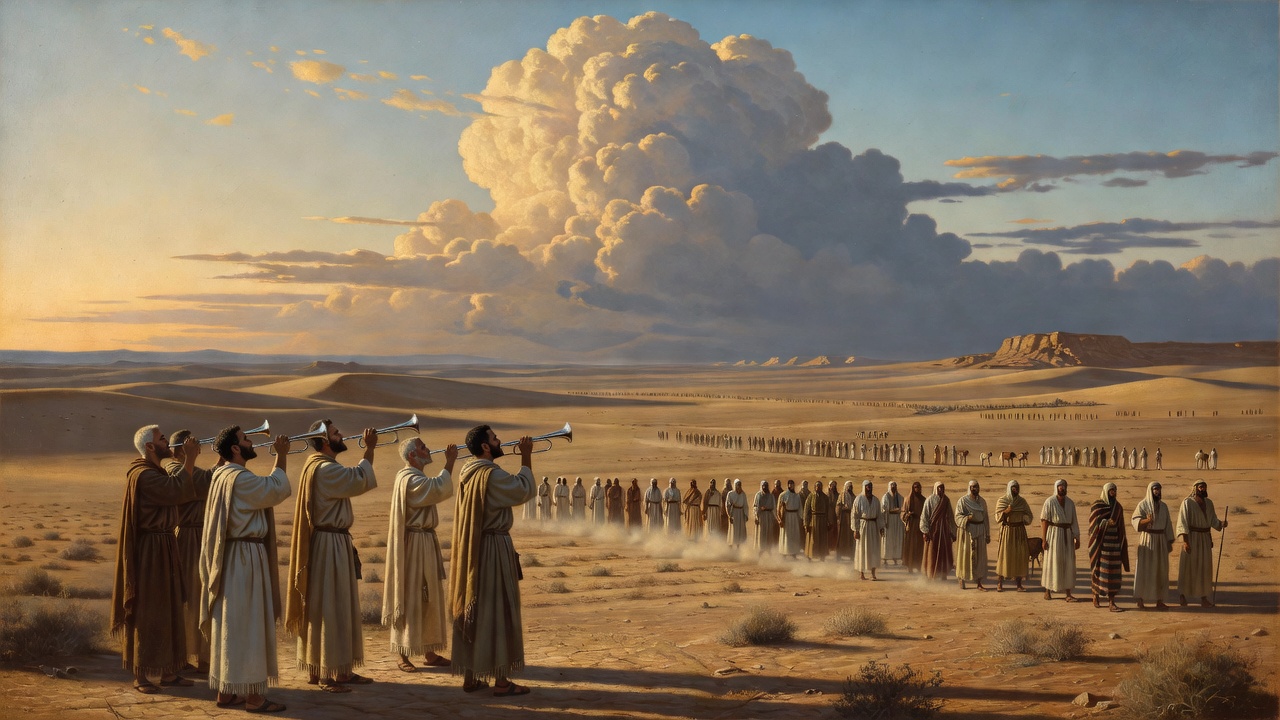
The silver trumpets
1Yahweh also told Moses/me, 2“ Tell someone to make two trumpets by hammering each one from one lump of silver. Blow the trumpets to summon the people to come together and also to signal that they must move their tents to a new location. 3If both trumpets are blown, it means that everyone must gather together at the entrance of the Sacred Tent. 4If only one trumpet is blown, it means that only the twelve leaders of the tribes must gather together. 5If the trumpets are blown loudly, the tribes that are to the east of the Sacred Tent should start to travel. 6When the trumpets are blown loudly the second time, the tribes that are to the south should start to travel. The loud blasts on the trumpet will signal that they should start to travel. 7When you want only to gather the people together, blow the trumpets, but do not blow them as loudly.
8“The priests who are descended from Aaron are the ones who should blow the trumpets. That is a regulation that will never be changed. 9When you fight against enemies who attack you in your own land, tell the priests to blow the trumpets loudly. I, Yahweh, your God, will hear that, and I will rescue you from your enemies. 10Also tell the priests to blow the trumpets when the people are happy, and at the festivals each year, and at the times when they celebrate the new moon each month. Tell them to blow the trumpets when the people bring offerings that will be completely burned, and when they bring offerings to maintain fellowship with me. If they do that, it will help you to remember that I, Yahweh your God, will help you.”
The Israelis traveled
11On the twentieth day of May in the second year after the/we Israelis left Egypt, the cloud rose up from above the Sacred Tent. 12So we/the Israelis traveled from the Sinai Desert, and we/they continued traveling north until the cloud stopped in the Paran Desert. 13That was the first time we/they moved, obeying the instructions that Yahweh had given to Moses/me to tell them.
14The group that went first, carrying their flag/banner, was the group from the tribe of Judah. Nahshon, the son of Amminadab, was their leader. 15The group from the tribe of Issachar followed them. Nethanel, the son of Zuar, was their leader. 16The group from the tribe of Zebulun went next. Eliab, the son of Helon, was their leader. 17Then they dismantled the Sacred Tent, and the descendants of Gershon and Merari carried it, and they went next.
18The group from the tribe of Reuben went next, carrying their flag. Elizur, the son of Shedeur, was their leader. 19The group from the tribe of Simeon was next. Shelumiel, the son of Zurishaddai, was their leader. 20The group from the tribe of Gad was next. Eliasaph, the son of Deuel, was their leader. 21The group descended from Kohath was next. They carried the sacred items from the Sacred Tent. The Sacred Tent itself was set up at the new location before they arrived there.
22The group from the tribe of Ephraim was next, carrying their flag. Elishama, the son of Ammihud, was their leader. 23The group from the tribe of Manasseh went next. Gamaliel, the son of Pedahzur, was their leader. 24The group from the tribe of Benjamin, went next. Abidan, the son of Gideoni, was their leader.
25The ones who went last were the group from the tribe of Dan, carrying their flag. Ahiezer, the son of Ammishaddai, was their leader. 26The group from the tribe of Asher went next. Pagiel, the son of Ocran, was their leader. 27The group from the tribe of Naphtali went last. Ahira, the son of Enan, was their leader. 28That was the order in which the groups of Israeli tribes traveled.
29One day Moses/I said to his/my brother-in-law Hobab, the son of Reuel from the Midian people-group, “We are on the way to the place that Yahweh promised to give to us. Come with us, and we will take good care of you, because Yahweh has promised to do good things for us Israeli people.”
30But Hobab replied, “No, I will not go with you. I want to return to my own land and to my own family.”
31But Moses/I said, “Please do not leave us. You know the places where we can set up our tents in this desert, and you can guide us. 32Come with us. We will share with you all the good things that Yahweh gives to us.”
33So Hobab agreed to go with them. The Israelis left Sinai Mountain, which they called Yahweh’s Mountain, and they walked for three days. The men carrying the sacred chest went in front of the other people for those three days, and they kept looking for a place to set up their tents. 34The cloud sent by Yahweh was over them every day.
35Each morning when the men who were carrying the sacred chest started to walk, Moses/I said,
“Yahweh, arise!
Scatter your enemies!
Cause those who hate you to run away from you!”
36And each time the men stopped to set down the sacred chest, Moses/I said,
“Yahweh, stay close to the thousands of us Israelis!”
Did you know?
Silver Trumpets and the Departure from Sinai
- Two hammered silver trumpets served as Israel's communication system in the wilderness, sounded exclusively by Aaron's priestly sons with distinct long and short blasts to assemble the congregation, signal tribal divisions to break camp, sound alarms in war, and announce festive sacrifices.Sources: the Bible text itself
- On the twentieth day of the second month of their second year after leaving Egypt, the cloud lifted from above the tabernacle, marking Israel's departure from the Wilderness of Sinai after camping there for nearly a year as they journeyed toward the Wilderness of Paran.Sources: the Bible text itself · Sinai · Paran
- Moses urged Hobab, the son of his Midianite father-in-law Reuel, to journey with them and serve as their eyes, relying on Hobab's familiarity with the desert terrain and suitable camping locations in exchange for sharing in the blessings promised to Israel.Sources: the Bible text itself · Jethro
Notes written with AI assistance from open sources (Theographic Bible Metadata, CC BY-SA 4.0; Easton’s Bible Dictionary, public domain) and reviewed before publishing.
Places in this chapter
- Egypt · 30.129, 31.308 · verse 11
- Paran · 30.303, 34.777 · verse 12
- Wilderness of Sinai · Today: about 50 km around Jebel Musa · 28.540, 33.973 · verse 12
Only places identified with high confidence are shown (90% or more according to the scholarly sources compiled by OpenBible). Period map: DARE (Digital Atlas of the Roman Empire), CC BY 4.0; modern map: © OpenStreetMap contributors; places: OpenBible.info (CC BY 4.0).
Credits and license for this translation
Translation for Translators
A Bible Translation for Bible Translators which makes implied information explicit in the text as an aid to the translator who may need that information to correctly translate into a particular language.
Copyright © 2008-2017 Ellis W. Deibler, Jr.
Language: English
Dialect: American
This translation is made available to you under the terms of the
Creative Commons Attribution Share-Alike license 4.0.
You have permission to share and redistribute this Bible translation in any format and to make reasonable revisions and adaptations of this translation, provided that:
You include the above copyright and source information.
If you make any changes to the text, you must indicate that you did so in a way that makes it clear that the original licensor is not necessarily endorsing your changes.
If you redistribute this text, you must distribute your contributions under the same license as the original.
Pictures included with Scriptures and other documents on this site are licensed just for use with those Scriptures and documents.
For other uses, please contact the respective copyright owners.
Note that in addition to the rules above, revising and adapting God's Word involves a great responsibility to be true to God's Word. See Revelation 22:18-19.
2026-10-02
Source: http://ebible.org/eng-t4t/ · eBible.org